Stock Analysis · Ero Copper Corp (ERO)
Overview
Ero Copper Corp is a Brazil-focused mining company whose main business is producing copper, with additional exposure to gold and silver that come out of the same mining and processing stream. The company’s core asset is the Caraíba Operations in Bahia state, an established copper mining complex that includes underground mining, processing facilities, and related infrastructure. Ero also owns the Tucumã Operation in Pará state, a newer copper project that has become increasingly important to the company’s production and growth profile.
In simple terms, Ero digs ore out of the ground, processes it, and sells copper concentrate. That concentrate contains payable copper as well as by-product precious metals. The company therefore rises and falls mainly with copper volumes, copper prices, and how efficiently its Brazilian mines operate.
Based on the company’s recent annual reporting and operating profile, revenue is heavily concentrated in copper and only modestly supported by by-products.
- Copper concentrate sales: approximately 85% to 95% of revenue. This is the company’s main product and economic driver.
- Gold by-product sales: approximately 3% to 10% of revenue, depending on grades, recoveries, and metal prices.
- Silver and other by-products: typically 0% to 5% of revenue.
The business mix is fairly straightforward: one metal dominates, but by-products can still help lower effective costs and support margins when operations are running well. Another useful point for long-term readers is that Ero remains a mid-sized miner rather than a global diversified major, so company-specific mine execution matters much more here than it would at a giant producer.
Over the last several years, the income profile has shown a clear swing pattern: revenue and operating income weakened in 2022 through 2024, then recovered sharply in 2025 as production and profitability improved. That kind of rebound is common in mining, where development timing, ramp-ups, grades, and metal prices can move results quickly.
The operating picture suggests a business with strong earnings power when its mines are performing normally, but also one that can look very different from year to year during expansion phases or operational setbacks.
Key Figures
| Metric | Value | Sector ⓘ |
|---|---|---|
| Date | Oct 03, 2026 | |
| Context | ||
| Sector | Basic Materials | |
| Industry | Copper | |
| Market Cap ⓘ | $3.87B | |
| Beta ⓘ | 1.67 | |
Value (Cheapness) | ||
| P/E Ratio ⓘ | 12.68 | 17.61 |
| P/B Ratio ⓘ | 3.21 | 1.77 |
| FCF Yield ⓘ | 3.96% | 5.87% |
| Dividend Yield ⓘ | N/A | 2.06% |
| EBIT / EV ⓘ | 9.77% | 6.43% |
| PEG ⓘ | N/A | |
Growth (Business expansion) | ||
| Revenue Growth ⓘ | 73.90% | 11.30% |
| RPS Growth (5Y CAGR) ⓘ | 9.27% | 4.46% |
| EPS Growth (5Y CAGR) ⓘ | 14.67% | -13.11% |
| BVPS Growth (5Y CAGR) ⓘ | 19.95% | 5.51% |
| Margin Growth (5Y Trend) ⓘ | -4.63% | -1.57% |
| FCF Growth (5Y CAGR) ⓘ | -15.95% | 0.55% |
| DPS Growth (5Y CAGR) ⓘ | N/A | 6.02% |
Quality (Business durability) | ||
| ROIC (Latest) ⓘ | 20.92% | 9.31% |
| ROA (Latest) ⓘ | 15.43% | 4.94% |
| ROIC (5Y Median) ⓘ | 17.08% | 7.91% |
| ROA (5Y Median) ⓘ | 10.85% | 3.93% |
| Net Debt / EBIT (Latest) ⓘ | 1.13 | 1.40 |
| Net Debt / EBIT (5Y Median) ⓘ | 1.70 | 1.70 |
| Net Debt / EBITDA (Latest) ⓘ | 0.81 | 0.91 |
| Net Debt / Assets ⓘ | 21.88% | 13.69% |
| EBITDA / Interest ⓘ | 19.26 | 11.93 |
| Operating Margin (Latest) ⓘ | 40.05% | 13.07% |
| Operating Margin (5Y Median) ⓘ | 34.59% | 11.86% |
| Debt to Equity (Latest) ⓘ | 47.25% | 40.43% |
| Profit Margin (Latest) ⓘ | 29.79% | 6.57% |
| Free Cash Flow (Latest) ⓘ | $153.52M | |
Momentum (Price trend) | ||
| 3Y Return ⓘ | +112.82% | +65.06% |
| 12M Return (excl. last month) ⓘ | +158.93% | +36.05% |
| 6M Return ⓘ | +37.57% | +1.89% |
| Price vs. 200-Day MA ⓘ | +22.53% | +1.03% |
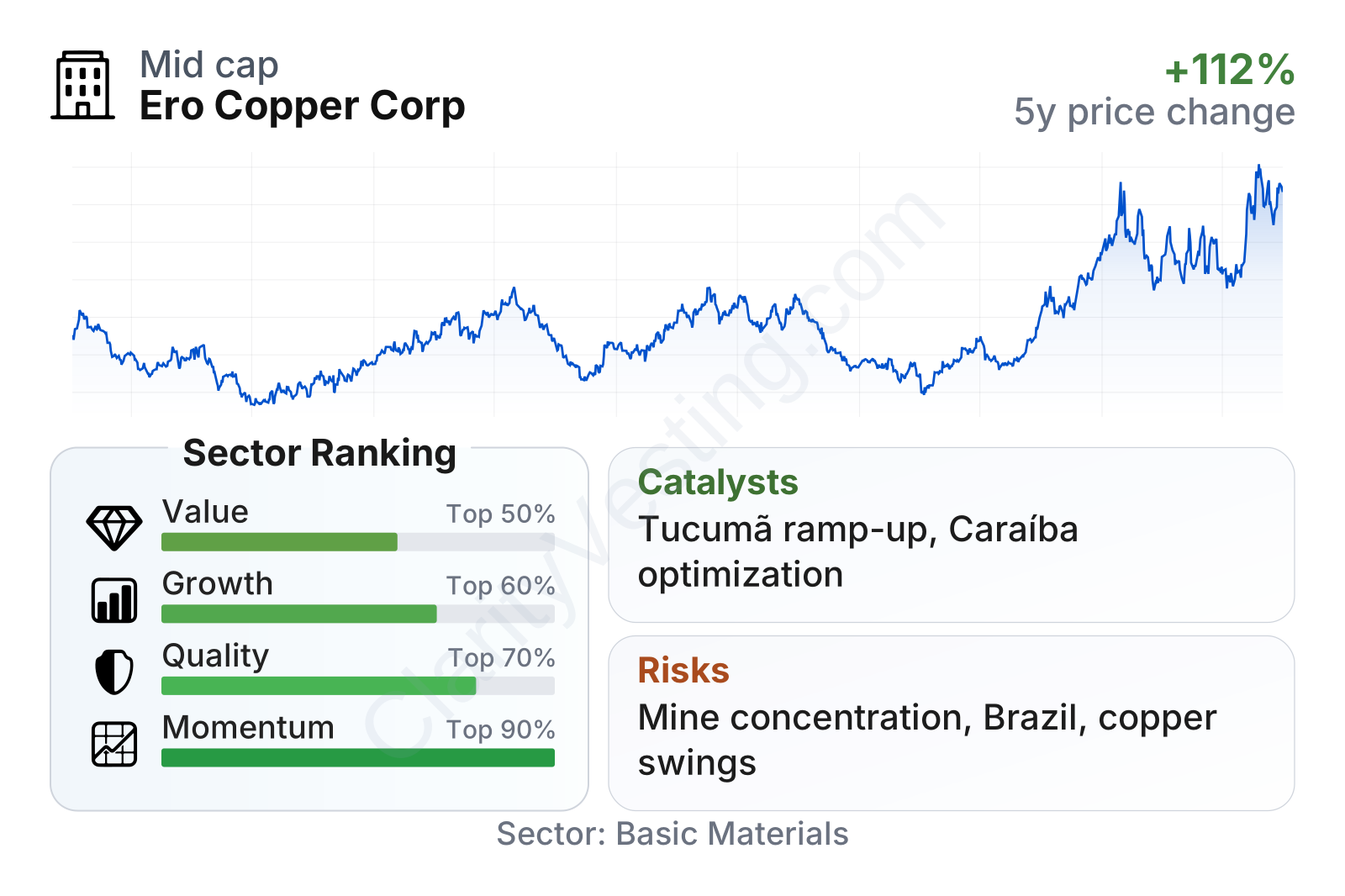
Ero Copper combines a mid-sized market value with unusually strong profitability metrics for its sector at the moment. Returns on capital and assets are well above sector medians, operating and profit margins are materially stronger than typical peers, and interest coverage is comfortable. Growth indicators are also strong, especially recent revenue acceleration and longer-term per-share expansion. The weaker areas are more visible in balance-sheet intensity and cash generation consistency: price volatility is high, debt is still somewhat above the sector median, and free cash flow has been much less stable than accounting earnings.
The share-price history also shows why this name attracts attention but requires patience. The stock has experienced large moves in both directions over the last several years, which is typical for a copper producer with a concentrated asset base and a major project ramp-up underway.
Growth
Ero operates in a sector with a constructive long-term backdrop. Copper is one of the most important industrial metals for electrification, power grids, electric vehicles, renewable energy equipment, data centers, and general infrastructure. Even though copper markets can be cyclical in the short run, the longer-term demand case remains supported by the need to expand and modernize energy and industrial systems.
For Ero specifically, the strategy is logical: improve the mature Caraíba asset while bringing newer copper capacity into production at Tucumã. That gives the company a mix of an established operating base and a newer source of volume growth. If Tucumã continues to ramp up as planned and operating reliability improves, Ero’s production base could look meaningfully larger than it did just a few years ago.
The recent revenue trend reflects that shift. After a weaker period in 2022 and parts of 2023, growth turned positive in 2024 and then accelerated sharply through 2025 and into 2026. Recent year-over-year revenue growth has been far ahead of the sector median, indicating that this is not just a copper-price effect but also a company-specific expansion phase.
Cash generation has been more uneven, which is common during heavy investment periods. Free cash flow went deeply negative during the buildout phase and later recovered into positive territory. For a long-term view, that matters because it suggests Ero may be moving from a capital-hungry construction period toward a more self-funding operating phase, provided production ramp-up and cost control remain on track.
One of the main catalysts is the continued ramp-up and optimization of Tucumã. A second catalyst is higher throughput and development progress at Caraíba, where improved mine sequencing and plant performance can lift copper output without the company needing a completely new business line. A third support is copper pricing itself: when operational delivery improves at the same time as the copper market is favorable, earnings can expand quickly.
Recent company updates have also kept attention on operational milestones rather than financial engineering. That is generally the right focus for a mining company at this stage, because the biggest value shifts still come from production execution, recoveries, costs, and reserve conversion.
Risks
This article is for informational purposes only and does not constitute financial advice. Some content is AI-generated. See Disclaimer