Stock Analysis · Eramet SA (ERMAY)
Overview
Eramet is a French mining and metals group active in materials that are important for both traditional industry and the energy transition. The company produces manganese ore and alloys used mainly in steelmaking, nickel used in stainless steel and batteries, and mineral sands that include titanium feedstocks and zircon for pigments, ceramics, and other industrial applications. Eramet also has a lithium project in Argentina, which gives it exposure to battery materials beyond its more established mining operations.
The business is highly tied to commodity markets. That means revenue and profit can move sharply depending on metal prices, production volumes, operating issues, and currency swings. In strong pricing periods, earnings can rise quickly; in weaker markets, the opposite can happen just as fast.
Based on the company’s recent annual reporting, Eramet’s revenue mix is centered on a few large activities.
- Manganese: approximately 45% to 50% of revenue. This includes manganese ore mining and manganese alloys, largely linked to carbon steel production.
- Nickel: approximately 25% to 30% of revenue. This mainly reflects ferronickel and nickel ore activities, especially in Indonesia and New Caledonia exposure.
- Mineral sands: approximately 15% to 20% of revenue. This segment includes titanium minerals and zircon used in industrial end markets.
- Other activities, including lithium and smaller businesses: approximately 5% to 10% of revenue, still modest today but strategically important for future positioning.
This mix matters for long-term analysis because Eramet is not a broadly diversified mining giant. It is more concentrated in a few commodities, with manganese still the main earnings engine and lithium representing a potential future growth leg rather than a major contributor today.
The multiyear operating profile also shows how cyclical the company is. Revenue climbed sharply in 2022 during a favorable commodity environment, then moved lower over the following years, while net income dropped from a very strong peak to a loss in 2025. In other words, Eramet’s financial path has been driven less by steady compounding and more by swings in metal markets and project execution.
The operating flow over the last several years highlights a clear change in profitability. After a strong 2022, revenue and operating income weakened materially, while interest costs remained meaningful. That helps explain why a business that looked very profitable at the cycle peak became much less resilient when prices and margins softened.
Key Figures
| Metric | Value | Sector ⓘ |
|---|---|---|
| Date | Oct 17, 2026 | |
| Context | ||
| Sector | Basic Materials | |
| Industry | Other Industrial Metals & Mining | |
| Market Cap ⓘ | $1.16B | |
| Beta ⓘ | 0.95 | |
Value (Cheapness) | ||
| P/E Ratio ⓘ | N/A | 16.90 |
| P/B Ratio ⓘ | 3.33 | 1.65 |
| FCF Yield ⓘ | -104.04% | 5.76% |
| Dividend Yield ⓘ | N/A | 2.13% |
| EBIT / EV ⓘ | N/A | 6.30% |
| PEG ⓘ | N/A | |
Growth (Business expansion) | ||
| Revenue Growth ⓘ | 15.70% | 11.10% |
| RPS Growth (5Y CAGR) ⓘ | -7.12% | 4.49% |
| EPS Growth (5Y CAGR) ⓘ | N/A | -13.47% |
| BVPS Growth (5Y CAGR) ⓘ | -8.16% | 5.51% |
| Margin Growth (5Y Trend) ⓘ | -28.62% | -1.54% |
| FCF Growth (5Y CAGR) ⓘ | N/A | 0.37% |
| DPS Growth (5Y CAGR) ⓘ | 81.19% | 6.08% |
Quality (Business durability) | ||
| ROIC (Latest) ⓘ | 4.80% | 9.26% |
| ROA (Latest) ⓘ | -9.30% | 4.91% |
| ROIC (5Y Median) ⓘ | 10.01% | 7.70% |
| ROA (5Y Median) ⓘ | 1.61% | 3.86% |
| Net Debt / EBIT (Latest) ⓘ | 9.45 | 1.40 |
| Net Debt / EBIT (5Y Median) ⓘ | 1.48 | 1.70 |
| Net Debt / EBITDA (Latest) ⓘ | 2.26 | 0.95 |
| Net Debt / Assets ⓘ | 29.17% | 13.69% |
| EBITDA / Interest ⓘ | 2.04 | 12.34 |
| Operating Margin (Latest) ⓘ | 3.48% | 13.20% |
| Operating Margin (5Y Median) ⓘ | 7.88% | 11.80% |
| Debt to Equity (Latest) ⓘ | 707.26% | 40.56% |
| Profit Margin (Latest) ⓘ | -17.30% | 6.43% |
| Free Cash Flow (Latest) ⓘ | -$1.20B | |
Momentum (Price trend) | ||
| 3Y Return ⓘ | -38.33% | +68.89% |
| 12M Return (excl. last month) ⓘ | -0.93% | +30.21% |
| 6M Return ⓘ | -31.61% | -4.16% |
| Price vs. 200-Day MA ⓘ | -32.06% | -1.27% |
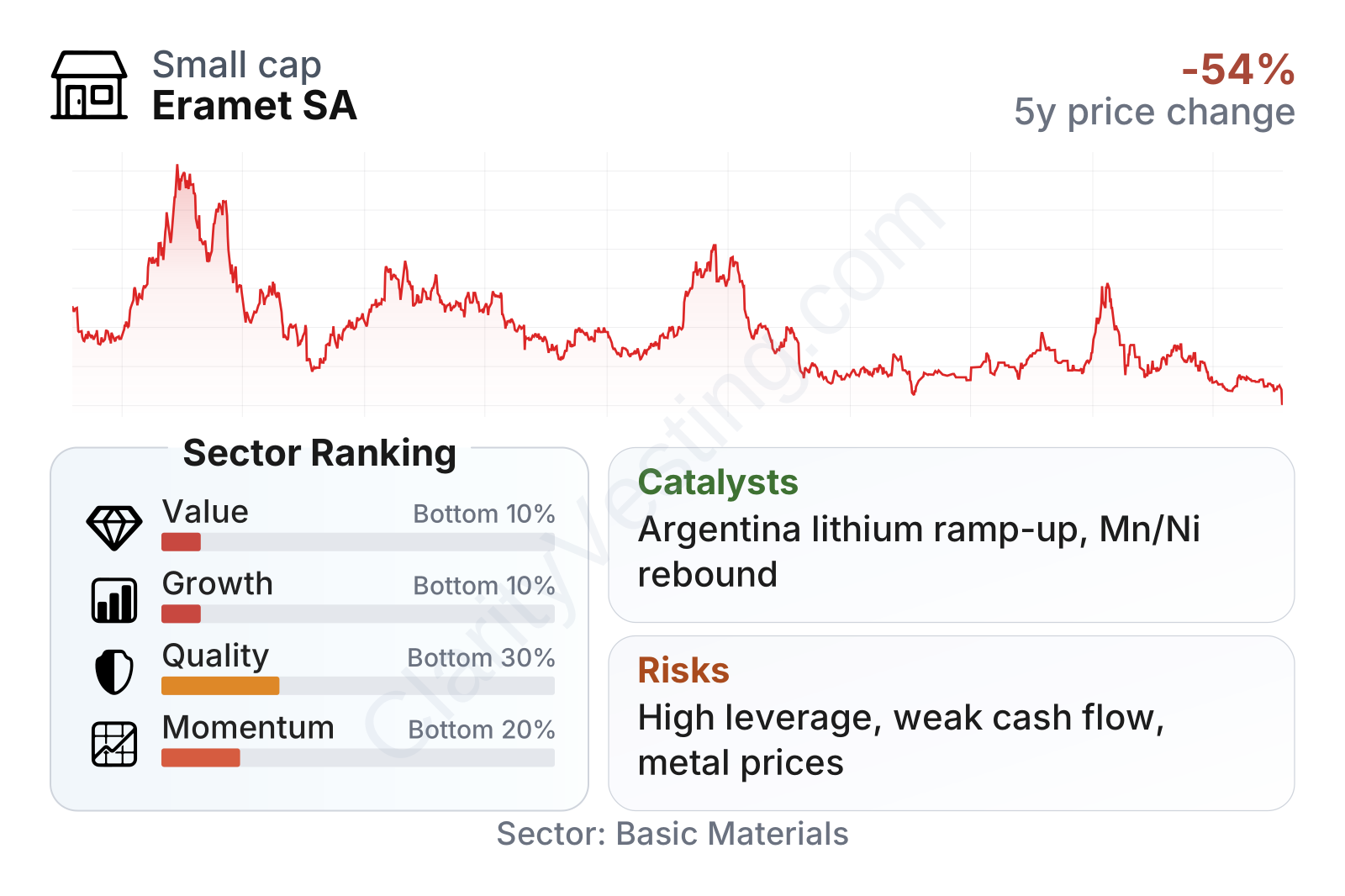
Eramet currently looks weak on most broad financial screens. The value profile ranks near the bottom of the sector, not because the shares look conventionally expensive on earnings alone, but because free cash flow is deeply negative and book value is being valued above the sector median despite weak recent profitability. Quality is also under pressure: current returns on assets and invested capital are negative or near zero, operating margin has collapsed versus the sector, and interest coverage is thin.
Growth metrics send a mixed message. Short-term revenue growth has been better than the sector median, but the longer five-year picture is much less attractive, with declines in revenue per share, book value per share, and operating margin trend. Momentum is also weak, with the share price down over three years and trading well below its long-term average, showing that the market has been cautious for some time rather than just reacting to one short event.
Growth
Eramet operates in sectors that should remain strategically relevant for many years. Manganese is essential for steel, nickel remains important for stainless steel and parts of the battery market, mineral sands serve recurring industrial demand, and lithium is directly tied to electric vehicle batteries and energy storage. So the company is exposed to several long-duration themes, even if not all of them are growing at the same speed.
The most important long-term growth angle is lithium. Eramet has been advancing its Centenario project in Argentina, which is one of the company’s clearest opportunities to shift part of its portfolio toward faster-growing battery materials. For a group with mature and cyclical legacy operations, lithium offers a possible change in earnings mix over time if ramp-up, costs, and market conditions develop favorably.
The broader strategy also makes industrial sense. Eramet already knows how to develop and run large mining projects, and its portfolio links established cash-generating activities with newer materials needed for electrification. That does not eliminate cyclicality, but it does give the company a plausible route to remain relevant as demand patterns evolve.
A second catalyst is any recovery in nickel or manganese prices. Because Eramet’s earnings are very sensitive to commodity prices, even a moderate improvement in market conditions can have an outsized effect on margins and cash generation. This is especially true after a period when profitability has already been compressed.
Recent company communications have also highlighted continued work on portfolio discipline, production optimization, and strategic positioning in battery metals. For long-term analysis, the key point is simple: Eramet does not need every business line to become a major success at once. If lithium scales properly and one or two core commodities recover at the same time, the company’s earnings profile could improve much faster than revenue growth alone would suggest.
Risks
This article is for informational purposes only and does not constitute financial advice. Some content is AI-generated. See Disclaimer


