Stock Analysis · Erasca Inc (ERAS)
Overview
Erasca Inc is a clinical-stage biotechnology company focused on precision oncology, meaning cancer treatments designed around specific genetic mutations that help drive tumor growth. The company’s strategy is centered on the RAS/MAPK pathway, one of the most important signaling networks in cancer biology. Instead of relying on one drug candidate, Erasca has built a portfolio of programs that includes small-molecule therapies and combination approaches aimed at several hard-to-treat cancers.
At this stage, Erasca is not a commercial drug company. It is still developing treatments, running clinical trials, and spending heavily on research. That means its economic profile looks very different from a mature pharmaceutical business.
Its revenue sources are currently very limited:
- Product revenue: approximately 0%. Erasca does not currently sell approved drugs.
- Collaboration, licensing, or other operating revenue: currently not meaningful enough to represent a stable business line in the latest annual results.
- Cash and investment income: this can contribute to reported results indirectly, but it is not core operating revenue and depends on cash balances rather than commercial demand.
In practical terms, the company is still funded mainly by investor capital rather than recurring sales. Its expense base is dominated by research and development, which is typical for a biotech company trying to advance multiple clinical assets before any product approval. Over the last several years, research spending has consistently been the largest operating cost, far ahead of general and administrative expenses.
The financial flow highlights a business with essentially no operating revenue and a cost structure led by research spending. Losses have remained significant, but operating expenses eased in 2025 versus 2024, suggesting some cost discipline while the company continues to fund its pipeline.
Key Figures
| Metric | Value | Sector ⓘ |
|---|---|---|
| Date | Oct 17, 2026 | |
| Context | ||
| Sector | Healthcare | |
| Industry | Biotechnology | |
| Market Cap ⓘ | $5.14B | |
| Beta ⓘ | 0.62 | |
Value (Cheapness) | ||
| P/E Ratio ⓘ | N/A | 24.79 |
| P/B Ratio ⓘ | 12.79 | 3.08 |
| FCF Yield ⓘ | -1.91% | 3.15% |
| Dividend Yield ⓘ | N/A | 1.94% |
| EBIT / EV ⓘ | -6.17% | 0.57% |
| PEG ⓘ | N/A | |
Growth (Business expansion) | ||
| Revenue Growth ⓘ | N/A | 7.45% |
| RPS Growth (5Y CAGR) ⓘ | N/A | 8.61% |
| EPS Growth (5Y CAGR) ⓘ | -22.89% | -17.81% |
| BVPS Growth (5Y CAGR) ⓘ | -30.05% | 3.72% |
| Margin Growth (5Y Trend) ⓘ | N/A | -0.62% |
| FCF Growth (5Y CAGR) ⓘ | -0.74% | 1.04% |
| DPS Growth (5Y CAGR) ⓘ | N/A | 6.77% |
Quality (Business durability) | ||
| ROIC (Latest) ⓘ | -62.73% | 3.24% |
| ROA (Latest) ⓘ | -67.15% | 3.01% |
| ROIC (5Y Median) ⓘ | -33.11% | 4.60% |
| ROA (5Y Median) ⓘ | -36.01% | 1.89% |
| Net Debt / EBIT (Latest) ⓘ | N/A | 1.34 |
| Net Debt / EBIT (5Y Median) ⓘ | N/A | 1.84 |
| Net Debt / EBITDA (Latest) ⓘ | N/A | 1.00 |
| Net Debt / Assets ⓘ | 0.50% | 5.45% |
| EBITDA / Interest ⓘ | N/A | 9.64 |
| Operating Margin (Latest) ⓘ | N/A | 9.27% |
| Operating Margin (5Y Median) ⓘ | N/A | 7.38% |
| Debt to Equity (Latest) ⓘ | 12.36% | 28.58% |
| Profit Margin (Latest) ⓘ | N/A | 3.59% |
| Free Cash Flow (Latest) ⓘ | -$98.08M | |
Momentum (Price trend) | ||
| 3Y Return ⓘ | +549.34% | +42.80% |
| 12M Return (excl. last month) ⓘ | +915.62% | +18.50% |
| 6M Return ⓘ | -18.30% | +7.57% |
| Price vs. 200-Day MA ⓘ | +2.59% | +5.12% |
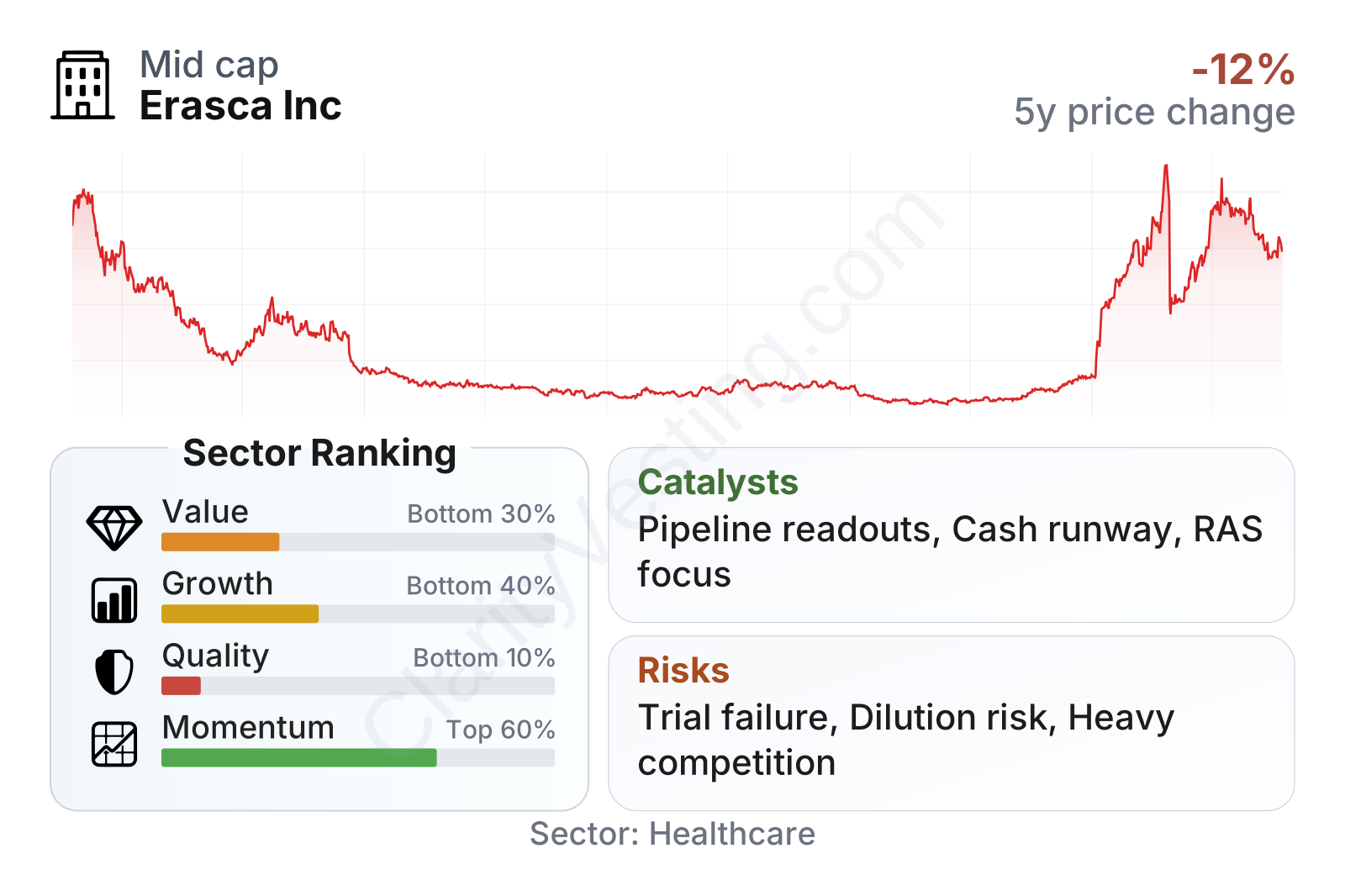
Erasca is a mid-sized biotech by market value, but its fundamentals still reflect a pre-revenue development company rather than an established healthcare business. On valuation measures, it screens weakly versus the broader healthcare sector because there are no earnings to support conventional multiples, cash flow remains negative, and the price-to-book ratio is elevated. Quality metrics also rank poorly, which is normal for a company spending heavily before commercialization. The one area that stands out more positively is share-price momentum over the longer period, helped by a major rerating in 2026 after clinical and corporate developments improved market expectations.
Growth
The company operates in one of the most active areas of drug development: targeted cancer therapies. Oncology remains a large and growing market because cancer incidence is high, treatment needs remain substantial, and drug makers continue to focus on therapies tied to specific biomarkers. Precision oncology in particular has attracted sustained interest because a successful treatment can address a clearly defined patient group and can also become part of combination regimens.
Erasca’s strategy makes sense for future growth in concept. The company is trying to build depth around a known cancer pathway rather than taking a scattered approach across unrelated diseases. That focus may improve the odds of generating useful combinations or identifying patient groups where its medicines can show clearer benefit. The company has also presented itself as pursuing a broad “synthetic lethality” and combination-based approach to RAS-driven cancers, which is important because these tumors are often difficult to treat with a single agent alone.
A key catalyst is clinical progress from the pipeline, especially from the company’s lead and more advanced programs. For a business like Erasca, long-term value creation depends far more on trial readouts, partnership potential, and regulatory progress than on near-term income statement growth. If one of its central programs shows compelling efficacy and manageable safety in a meaningful cancer population, the company’s profile could change quickly.
Recent company updates in 2026 pointed to continued pipeline execution and a strengthened balance sheet through strategic financing activity. For a clinical-stage biotech, that matters because access to capital can determine how many trials it can run at the same time and how quickly it can move programs forward. The company has also emphasized cash runway into future years, which reduces immediate financing pressure.
Free cash flow remains clearly negative, but the trend has become somewhat less severe than in earlier periods. That does not change the speculative nature of the business, yet it does suggest that cash burn has recently become a bit more manageable rather than accelerating.
Risks
This article is for informational purposes only and does not constitute financial advice. Some content is AI-generated. See Disclaimer


