Stock Analysis · Equinix Inc (EQIX)
Overview
Equinix is a specialized real estate company organized as a REIT that owns and operates data centers around the world. Its facilities allow businesses to place servers, networking equipment, and cloud connections in the same buildings used by telecom carriers, cloud platforms, enterprises, and digital service providers. In simple terms, Equinix provides the physical locations and connectivity ecosystems that help companies exchange data quickly and reliably.
The business is built around recurring revenue. Customers typically rent space and power inside Equinix facilities, then pay for related services such as network interconnection and support. Based on company reporting, the revenue mix is dominated by colocation, with a smaller but strategically important contribution from interconnection and a modest contribution from other services.
- Colocation and related recurring data center services: about 75% to 80% of revenue. This includes cabinet, cage, and power offerings, as well as the core rental of space inside data centers.
- Interconnection: about 15% to 20% of revenue. This includes cross connects and other services that let customers connect directly to networks, cloud providers, partners, and customers within Equinix facilities.
- Other services: about 5% to 10% of revenue. This generally includes installation, remote hands, and various support or professional services.
What makes Equinix different from a traditional property owner is that its buildings become digital hubs. The value is not only the real estate itself, but also the concentration of customers already inside its platform. That network effect can make a location more useful as more tenants join.
Over the last several years, revenue and gross profit have moved steadily higher, while operating income and net income have also expanded despite rising interest costs. That pattern suggests a business still scaling on top of a very capital-intensive asset base.
Key Figures
| Metric | Value | Sector ⓘ |
|---|---|---|
| Date | Oct 24, 2026 | |
| Context | ||
| Sector | Real Estate | |
| Industry | REIT - Specialty | |
| Market Cap ⓘ | $98.18B | |
| Beta ⓘ | 0.97 | |
Value (Cheapness) | ||
| P/E Ratio ⓘ | 63.54 | 17.85 |
| P/B Ratio ⓘ | 6.57 | 0.87 |
| FCF Yield ⓘ | 1.40% | 7.30% |
| Dividend Yield ⓘ | 2.00% | 4.83% |
| EBIT / EV ⓘ | 1.87% | 3.78% |
| PEG ⓘ | 2.98 | |
Growth (Business expansion) | ||
| Revenue Growth ⓘ | 16.70% | 5.35% |
| RPS Growth (5Y CAGR) ⓘ | 6.49% | 6.02% |
| EPS Growth (5Y CAGR) ⓘ | 21.53% | -10.65% |
| BVPS Growth (5Y CAGR) ⓘ | 4.59% | 0.43% |
| Margin Growth (5Y Trend) ⓘ | 7.42% | -0.69% |
| FCF Growth (5Y CAGR) ⓘ | 18.29% | 5.40% |
| DPS Growth (5Y CAGR) ⓘ | 13.16% | 5.07% |
Quality (Business durability) | ||
| ROIC (Latest) ⓘ | 6.23% | 5.69% |
| ROE (Latest) ⓘ | 10.76% | 7.37% |
| ROA (Latest) ⓘ | 3.87% | 2.85% |
| ROIC (5Y Median) ⓘ | 4.35% | 4.26% |
| ROE (5Y Median) ⓘ | 6.29% | 6.04% |
| ROA (5Y Median) ⓘ | 2.42% | 2.45% |
| Net Debt / EBIT (Latest) ⓘ | 9.71 | 7.55 |
| Net Debt / EBIT (5Y Median) ⓘ | 10.47 | 8.26 |
| Net Debt / EBITDA (Latest) ⓘ | 4.98 | 5.26 |
| Net Debt / Assets ⓘ | 54.48% | 37.45% |
| EBITDA / Interest ⓘ | 7.77 | 4.11 |
| Operating Margin (Latest) ⓘ | 23.45% | 33.86% |
| Operating Margin (5Y Median) ⓘ | 16.37% | 37.49% |
| Debt to Equity (Latest) ⓘ | 162.40% | 88.76% |
| Profit Margin (Latest) ⓘ | 15.48% | 18.94% |
| Free Cash Flow (Latest) ⓘ | $1.37B | |
Momentum (Price trend) | ||
| 3Y Return ⓘ | +45.13% | +36.33% |
| 12M Return (excl. last month) ⓘ | +35.57% | +4.32% |
| 6M Return ⓘ | -12.73% | -1.74% |
| Price vs. 200-Day MA ⓘ | -4.55% | -1.42% |
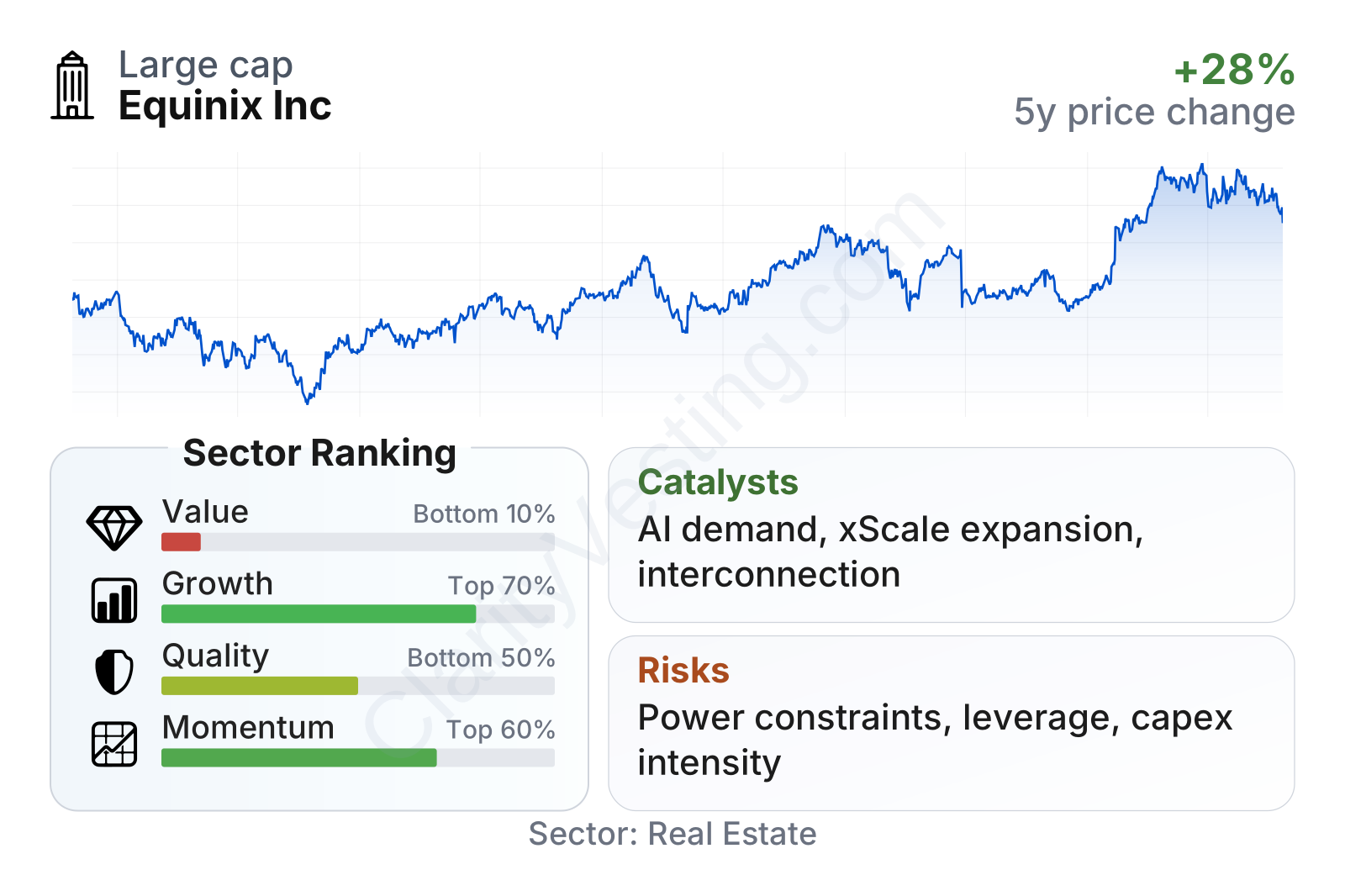
Equinix is a very large company within specialty real estate, and its share-price behavior has recently been stronger than much of the sector. The table points to a mixed profile: growth and market momentum are clearly above many peers, while value metrics screen as expensive and quality is more balanced than exceptional. Revenue growth, free cash flow growth, and earnings growth have been strong over a multi-year period, but the stock is trading at rich multiples compared with typical real estate names. That premium reflects the market’s view that Equinix is not a conventional landlord.
Growth
Equinix operates in a part of the market that benefits from long-term digital infrastructure demand. Data traffic keeps rising, enterprises continue moving workloads into hybrid cloud environments, and artificial intelligence is increasing the need for dense, connected infrastructure. Those trends support demand for data center capacity, especially in major metropolitan areas where networks, cloud providers, and enterprise customers want to be close to one another.
The company’s strategy is coherent for future expansion. It continues to invest in new capacity, extend its global footprint, and deepen the usefulness of its facilities as connection hubs rather than simple server warehouses. This matters because customers often value low-latency access to cloud platforms and business partners as much as the underlying space and power. That tends to support sticky customer relationships and recurring revenue.
Revenue per share has trended upward over the past five years, showing that growth has not come only from adding assets, but also from building more revenue on a per-share basis. That is an encouraging sign for a capital-heavy company, since it suggests expansion has not been entirely diluted away.
Dividend per share has also climbed steadily. Even though the dividend yield remains lower than the real estate sector median, the growth rate of the payout has been strong, which fits a business still emphasizing expansion while continuing to return cash as a REIT.
One of the strongest catalysts is the rising importance of interconnected infrastructure for cloud, AI, and enterprise networking. Equinix is positioned where these ecosystems meet: carriers, enterprises, content companies, and cloud providers already operate in many of its sites. That installed base can make new customer wins easier and can raise the value of each additional deployment.
Recent company communications have continued to emphasize capacity additions, xScale expansion for hyperscale deployments, and demand tied to AI-ready and cloud-adjacent infrastructure. Those developments reinforce the idea that Equinix has meaningful exposure to some of the most durable themes in digital infrastructure.
Risks
This article is for informational purposes only and does not constitute financial advice. Some content is AI-generated. See Disclaimer


