Stock Analysis · Edgewell Personal Care Co (EPC)
Overview
Edgewell Personal Care is a consumer staples company that sells everyday grooming and personal care products. Its portfolio includes shaving systems and blades, sun care, feminine care, and wet shave products sold through retail stores, e-commerce channels, and international distributors. The company owns recognized brands such as Schick, Wilkinson Sword, Banana Boat, Hawaiian Tropic, Playtex, Stayfree, Carefree, and Edge.
Revenue is mainly generated from two reporting segments disclosed by the company, with a broad mix of products inside each one.
- Wet Shave — about 60% to 65%: men’s and women’s razors, replacement blades, disposable razors, shaving preparation products, and private-label shaving products. This is the company’s largest business and includes major brands such as Schick, Wilkinson Sword, Edge, and Skintimate.
- Sun and Skin Care — about 35% to 40%: sun protection, after-sun products, feminine care, and skin care products. This segment includes Banana Boat, Hawaiian Tropic, Playtex, Stayfree, and Carefree.
Geographically, Edgewell is not a purely U.S. business. North America is the largest market, but international operations are also meaningful, which gives the company some diversification while also exposing it to currency swings and different consumer trends.
The business model is straightforward: manufacture or source personal care products, support them with advertising and retail relationships, and earn profits through brand recognition, distribution scale, and repeat household demand. Over the last several years, sales have been fairly steady around the low-$2 billion range, but profits have become less stable as costs and brand investment have absorbed a larger share of revenue.
The operating picture shows a company with relatively stable sales but weaker conversion of revenue into profit. Gross profit held up better than net income, while selling and administrative costs increased over time and operating income fell sharply in the latest annual period. That suggests the main issue has not been demand alone, but also cost structure and margin pressure.
Key Figures
| Metric | Value | Sector ⓘ |
|---|---|---|
| Date | Oct 17, 2026 | |
| Context | ||
| Sector | Consumer Defensive | |
| Industry | Household & Personal Products | |
| Market Cap ⓘ | $1.32B | |
| Beta ⓘ | 0.35 | |
Value (Cheapness) | ||
| P/E Ratio ⓘ | N/A | 17.88 |
| P/B Ratio ⓘ | 0.91 | 1.29 |
| FCF Yield ⓘ | 3.96% | 12.39% |
| Dividend Yield ⓘ | 2.12% | 2.85% |
| EBIT / EV ⓘ | -0.70% | 6.43% |
| PEG ⓘ | 2.87 | |
Growth (Business expansion) | ||
| Revenue Growth ⓘ | 1.70% | 4.10% |
| RPS Growth (5Y CAGR) ⓘ | 5.43% | 6.18% |
| EPS Growth (5Y CAGR) ⓘ | -18.03% | -13.59% |
| BVPS Growth (5Y CAGR) ⓘ | 3.26% | 3.20% |
| Margin Growth (5Y Trend) ⓘ | -5.95% | -0.15% |
| FCF Growth (5Y CAGR) ⓘ | -29.98% | 4.10% |
| DPS Growth (5Y CAGR) ⓘ | 7.33% | 6.79% |
Quality (Business durability) | ||
| ROIC (Latest) ⓘ | -0.70% | 12.34% |
| ROA (Latest) ⓘ | -2.56% | 6.30% |
| ROIC (5Y Median) ⓘ | 5.56% | 10.49% |
| ROA (5Y Median) ⓘ | 2.69% | 5.44% |
| Net Debt / EBIT (Latest) ⓘ | N/A | 1.96 |
| Net Debt / EBIT (5Y Median) ⓘ | 5.96 | 2.35 |
| Net Debt / EBITDA (Latest) ⓘ | 13.11 | 1.38 |
| Net Debt / Assets ⓘ | 24.95% | 21.51% |
| EBITDA / Interest ⓘ | 0.98 | 9.46 |
| Operating Margin (Latest) ⓘ | -0.73% | 8.87% |
| Operating Margin (5Y Median) ⓘ | 9.00% | 9.53% |
| Debt to Equity (Latest) ⓘ | 87.62% | 72.35% |
| Profit Margin (Latest) ⓘ | -4.15% | 5.40% |
| Free Cash Flow (Latest) ⓘ | $52.40M | |
Momentum (Price trend) | ||
| 3Y Return ⓘ | -12.38% | +20.92% |
| 12M Return (excl. last month) ⓘ | +27.62% | +2.13% |
| 6M Return ⓘ | +30.15% | +1.26% |
| Price vs. 200-Day MA ⓘ | +23.99% | +1.39% |
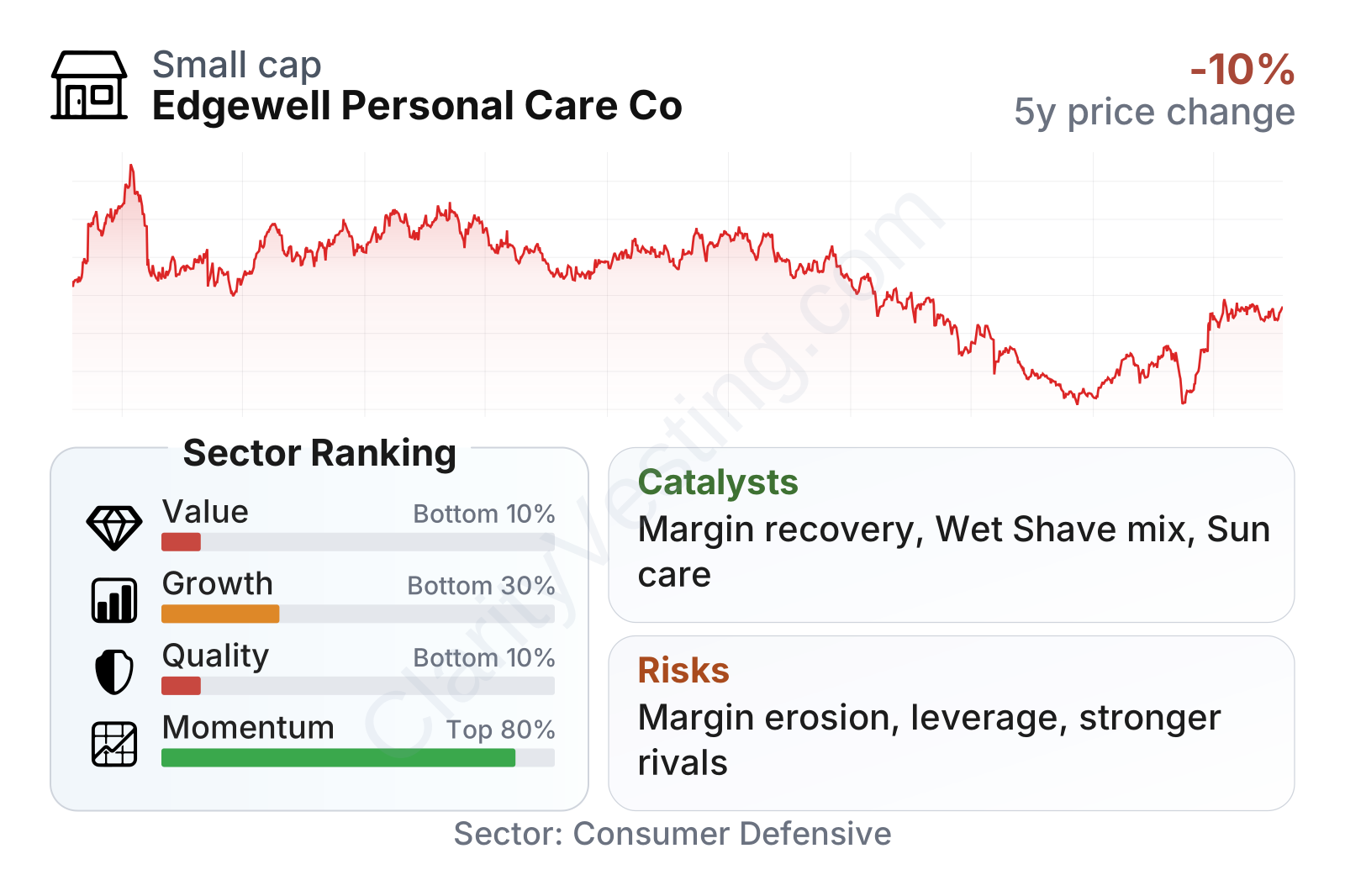
Edgewell is a small-cap consumer defensive company with unusually low share-price volatility for the stock market overall, as shown by a beta near 0.4. That can make the share price less reactive than many consumer names, but the operating fundamentals currently look weaker than the sector. Value, growth, and quality indicators all rank in the lower end of the household and personal products group, while recent price momentum has improved sharply after a difficult multiyear stretch.
The mixed picture is important. The market has recently become less pessimistic, yet profitability, returns on capital, and free cash flow generation remain below typical sector levels. In other words, the stock’s recent rebound appears to be running ahead of the company’s underlying business quality for now.
Growth
Edgewell operates in categories that are generally resilient rather than fast-growing. Shaving, sun care, and feminine care are recurring consumer needs, which can support steady demand over time. That makes the sector attractive for stability, but it also means growth usually depends less on explosive category expansion and more on market share gains, pricing, product innovation, premiumization, and better execution.
The company’s strategy broadly makes sense for this kind of market. Management has emphasized brand support, product refreshes, international expansion, e-commerce, and portfolio focus around stronger brands. In a mature industry, that is a practical path: protect shelf space, keep brand relevance high, and improve mix rather than rely on large volume growth.
Recent revenue trends, however, show why the growth case is still tentative. After periods of low-to-mid single-digit growth earlier in the cycle, sales momentum turned weaker and several recent quarterly readings moved into decline. The latest year-over-year pace is below the sector median, which suggests Edgewell is not currently growing faster than its peer group.
Cash generation also deserves close attention. Free cash flow has been positive, but it has been volatile and well below earlier peaks. The latest trailing twelve-month figure remains modest for a business with more than $2 billion in annual sales. For a mature staples company, stronger and more consistent cash conversion would usually be expected before calling the growth profile convincing.
Potential catalysts do exist. Sun care can benefit from seasonal strength and product innovation, while Wet Shave has room for mix improvement if premium systems and replacement blades perform well. If management is able to restore margins while keeping revenue stable, earnings could improve faster than sales. That is one of the more important levers for Edgewell because the business does not need very high top-line growth to produce better financial results.
Recent company updates and filings also point to ongoing restructuring, portfolio work, and efforts to improve execution. Those actions can create a meaningful opportunity if they simplify operations and lift profitability, but they still need to translate into visibly better margins and cash flow.
Risks
This article is for informational purposes only and does not constitute financial advice. Some content is AI-generated. See Disclaimer


