Stock Analysis · Emerald Resources NL (EOGSF)
Overview
Emerald Resources NL is an Australian gold producer focused on Cambodia, with additional development and exploration exposure in Cambodia and Australia. In simple terms, the company discovers gold deposits, builds and operates mines, and then sells the gold it produces. Its core asset has been the Okvau Gold Mine in Cambodia, which moved the business from being a developer to a cash-generating producer. More recently, Emerald has also been advancing a second Cambodian growth platform through the Bullseye Mining transaction and related Australian assets.
For now, the business is still heavily centered on gold mining rather than a broad mix of metals or services. That concentration makes the company easier to understand, but it also means results are closely tied to gold prices, mine performance, and successful reserve replacement.
The main revenue sources are approximately:
- Gold sales from operating mines: about 90% to 100% of revenue. This is the dominant source and primarily reflects ounces sold from the Okvau operation in Cambodia.
- Other mining-related income: likely a small residual share, when present. This can include items such as by-product, minor service, or accounting-related mining income, but it is not a major driver of the business.
- Exploration and development assets: 0% of recurring revenue today. These projects matter for future growth, but they do not yet contribute meaningful operating sales.
What stands out is how much the company’s economics have improved as production scaled up. Revenue has risen sharply over the last several years, and profitability has expanded even faster, helped by higher gold prices, stronger output, and lower financing pressure.
The profit flow has become much stronger over time. Revenue has grown from roughly $200 million to around $600 million over four years, while interest expense has dropped sharply and operating profit has widened much faster than sales. That combination suggests a business that has moved beyond the fragile early-production phase into a more financially mature operating position.
Key Figures
| Metric | Value | Sector ⓘ |
|---|---|---|
| Date | Oct 24, 2026 | |
| Context | ||
| Sector | Basic Materials | |
| Industry | Gold | |
| Market Cap ⓘ | $3.03B | |
| Beta ⓘ | 0.94 | |
Value (Cheapness) | ||
| P/E Ratio ⓘ | 17.54 | 16.92 |
| P/B Ratio ⓘ | 3.36 | 1.66 |
| FCF Yield ⓘ | 11.36% | 5.83% |
| Dividend Yield ⓘ | N/A | 2.07% |
| EBIT / EV ⓘ | N/A | 6.38% |
| PEG ⓘ | N/A | |
Growth (Business expansion) | ||
| Revenue Growth ⓘ | 79.40% | 11.25% |
| RPS Growth (5Y CAGR) ⓘ | 24.03% | 4.49% |
| EPS Growth (5Y CAGR) ⓘ | -17.74% | -15.24% |
| BVPS Growth (5Y CAGR) ⓘ | 31.79% | 5.49% |
| Margin Growth (5Y Trend) ⓘ | 22.50% | -1.54% |
| FCF Growth (5Y CAGR) ⓘ | 114.16% | 0.37% |
| DPS Growth (5Y CAGR) ⓘ | N/A | 5.91% |
Quality (Business durability) | ||
| ROIC (Latest) ⓘ | N/A | 9.59% |
| ROA (Latest) ⓘ | 31.62% | 4.92% |
| ROIC (5Y Median) ⓘ | 25.60% | 7.91% |
| ROA (5Y Median) ⓘ | 13.09% | 3.92% |
| Net Debt / EBIT (Latest) ⓘ | -0.86 | 1.36 |
| Net Debt / EBIT (5Y Median) ⓘ | -0.67 | 1.69 |
| Net Debt / EBITDA (Latest) ⓘ | -0.76 | 0.93 |
| Net Debt / Assets ⓘ | -34.91% | 13.69% |
| EBITDA / Interest ⓘ | N/A | 12.38 |
| Operating Margin (Latest) ⓘ | 52.18% | 13.24% |
| Operating Margin (5Y Median) ⓘ | 38.73% | 11.82% |
| Debt to Equity (Latest) ⓘ | 3.49% | 40.30% |
| Profit Margin (Latest) ⓘ | 42.38% | 6.38% |
| Free Cash Flow (Latest) ⓘ | $343.75M | |
Momentum (Price trend) | ||
| 3Y Return ⓘ | +164.16% | +73.47% |
| 12M Return (excl. last month) ⓘ | +71.83% | +27.59% |
| 6M Return ⓘ | -2.97% | -4.02% |
| Price vs. 200-Day MA ⓘ | +10.81% | -0.65% |
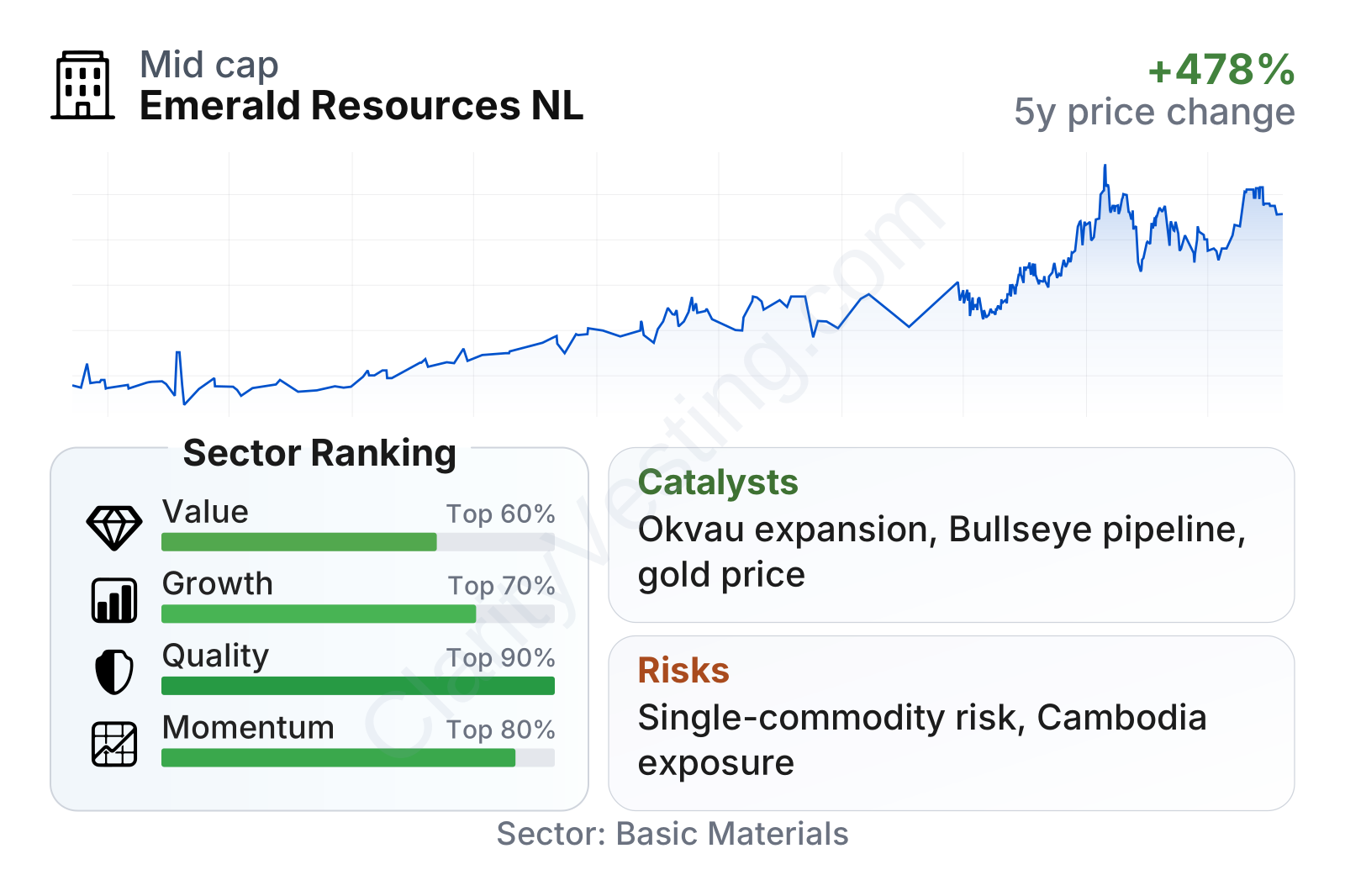
Emerald sits in the mid-sized range for a gold producer. The share price has had a very strong multi-year run, with gains far ahead of the sector, although there has also been some pullback from the recent peak. That pattern usually signals that the market has already noticed the company’s operational progress and improved earnings profile.
On valuation, the earnings multiple is close to the sector median, but the price-to-book ratio is clearly higher. That often happens when the market gives extra credit to a miner with better assets, stronger margins, or a cleaner balance sheet. Free cash flow generation appears stronger than the sector norm, which helps explain why the stock does not look stretched on every measure even after a strong rally.
Quality is where Emerald looks especially strong. Profit margin is above 40%, operating margin is above 50%, return on assets is far above the sector median, and leverage is very low. In fact, the company appears to be in a net cash position rather than relying on heavy debt, which is a valuable trait in mining because commodity cycles can turn quickly.
Growth metrics are also notable. Revenue growth over the last year has been exceptional, and the longer-term growth in revenue per share, book value per share, and free cash flow has been well ahead of typical gold peers. One weaker point is the five-year earnings-per-share trend, which reflects how uneven the early years of mine development and ramp-up can be in this industry. Even so, the broader picture shows a company that has improved materially in scale and profitability.
Growth
Gold is a mature commodity, but the sector is still benefiting from several supportive forces: central bank demand, geopolitical uncertainty, inflation hedging, and the difficulty of bringing large new mines into production. In that environment, existing producers with room to expand can grow faster than the industry as a whole.
Emerald’s strategy is fairly easy to follow. First, it operates an established producing asset that throws off cash. Second, it uses that cash and balance-sheet strength to extend mine life, expand resources, and add new production sources. Third, it keeps exposure to exploration upside, which matters in gold because reserve depletion is a constant challenge.
A major growth catalyst is the company’s ability to turn its Cambodian platform into more than a single-mine business. If production growth comes from additional deposits around Okvau or from nearby projects, the company could potentially benefit from shared infrastructure, local operating knowledge, and regional scale. That is usually more efficient than starting from scratch in a new country.
Another important opportunity is the integration and development pipeline connected to Bullseye Mining and other Australian assets. This broadens Emerald beyond one jurisdiction and adds future optionality. For a long-term view, that matters because the market often assigns higher value to miners that show a visible path from one producing mine to a multi-asset portfolio.
Recent operating momentum also supports the growth case. The company’s latest financial profile shows a large jump in revenue and net income, while financing costs have fallen sharply. That creates more internal funding capacity for exploration, development, and potential construction work without depending as heavily on new equity or debt.
One more tailwind is the gold price itself. Because Emerald’s cost base has not risen as fast as revenue, higher realized gold prices can translate into disproportionately higher margins and cash flow. That operating leverage can be powerful when market conditions are favorable.
Risks
This article is for informational purposes only and does not constitute financial advice. Some content is AI-generated. See Disclaimer


