Stock Analysis · The Ensign Group Inc (ENSG)
Overview
The Ensign Group is a healthcare operator focused mainly on post-acute care and long-term care services in the United States. In simple terms, it runs skilled nursing facilities, senior living operations, and related healthcare businesses that care for patients who need rehabilitation, nursing support, or longer-term assistance. The company has expanded for years by acquiring facilities, improving operations, and decentralizing management so local leaders run each operation with significant responsibility.
Its revenue is generated primarily from patient care and facility operations. Based on the company’s recent business mix described in its filings, the main sources of revenue are approximately:
- Skilled nursing services: about 80% to 85% — short-stay rehabilitation, nursing care, therapy services, and medically complex care provided in skilled nursing facilities.
- Senior living services: about 10% to 15% — assisted living, memory care, and other residential support services for seniors.
- Other ancillary and related services: about 5% — this can include mobile diagnostics, pharmacy-related support, real estate-related income within the broader group structure, and other healthcare-related offerings tied to facility operations.
The business is still centered on care delivery rather than a diversified healthcare platform, which makes results closely tied to occupancy, reimbursement rates, labor management, and the pace of acquisitions. A notable feature is that Ensign also has a real estate component through affiliated structures, but the core earnings engine remains facility-level healthcare operations.
The multi-year financial flow points to a company that has been scaling efficiently: revenue has risen strongly from 2021 through 2025, while operating income and net income have also grown. Costs naturally remain high in this industry because labor and care delivery are labor-intensive, but the company has still expanded profits as it grew.
Key Figures
| Metric | Value | Sector ⓘ |
|---|---|---|
| Date | Oct 24, 2026 | |
| Context | ||
| Sector | Healthcare | |
| Industry | Medical Care Facilities | |
| Market Cap ⓘ | $10.10B | |
| Beta ⓘ | 0.66 | |
Value (Cheapness) | ||
| P/E Ratio ⓘ | 27.60 | 25.42 |
| P/B Ratio ⓘ | 4.35 | 3.08 |
| FCF Yield ⓘ | 4.15% | 3.12% |
| Dividend Yield ⓘ | 0.15% | 1.85% |
| EBIT / EV ⓘ | 4.18% | 0.56% |
| PEG ⓘ | 1.38 | |
Growth (Business expansion) | ||
| Revenue Growth ⓘ | 17.30% | 7.50% |
| RPS Growth (5Y CAGR) ⓘ | 16.80% | 8.60% |
| EPS Growth (5Y CAGR) ⓘ | -3.88% | -17.73% |
| BVPS Growth (5Y CAGR) ⓘ | 20.57% | 3.72% |
| Margin Growth (5Y Trend) ⓘ | -0.91% | -0.57% |
| FCF Growth (5Y CAGR) ⓘ | 15.80% | 0.96% |
| DPS Growth (5Y CAGR) ⓘ | 4.81% | 6.69% |
Quality (Business durability) | ||
| ROIC (Latest) ⓘ | 15.84% | 3.17% |
| ROA (Latest) ⓘ | 6.90% | 2.98% |
| ROIC (5Y Median) ⓘ | 16.82% | 4.56% |
| ROA (5Y Median) ⓘ | 6.79% | 1.87% |
| Net Debt / EBIT (Latest) ⓘ | 3.92 | 1.34 |
| Net Debt / EBIT (5Y Median) ⓘ | 4.22 | 1.86 |
| Net Debt / EBITDA (Latest) ⓘ | 3.20 | 1.00 |
| Net Debt / Assets ⓘ | 34.58% | 5.06% |
| EBITDA / Interest ⓘ | 79.74 | 9.55 |
| Operating Margin (Latest) ⓘ | 9.24% | 9.25% |
| Operating Margin (5Y Median) ⓘ | 9.26% | 7.33% |
| Debt to Equity (Latest) ⓘ | 92.16% | 26.68% |
| Profit Margin (Latest) ⓘ | 6.90% | 3.34% |
| Free Cash Flow (Latest) ⓘ | $419.09M | |
Momentum (Price trend) | ||
| 3Y Return ⓘ | +87.40% | +51.61% |
| 12M Return (excl. last month) ⓘ | +5.85% | +19.90% |
| 6M Return ⓘ | -4.15% | +10.10% |
| Price vs. 200-Day MA ⓘ | -1.71% | +6.44% |
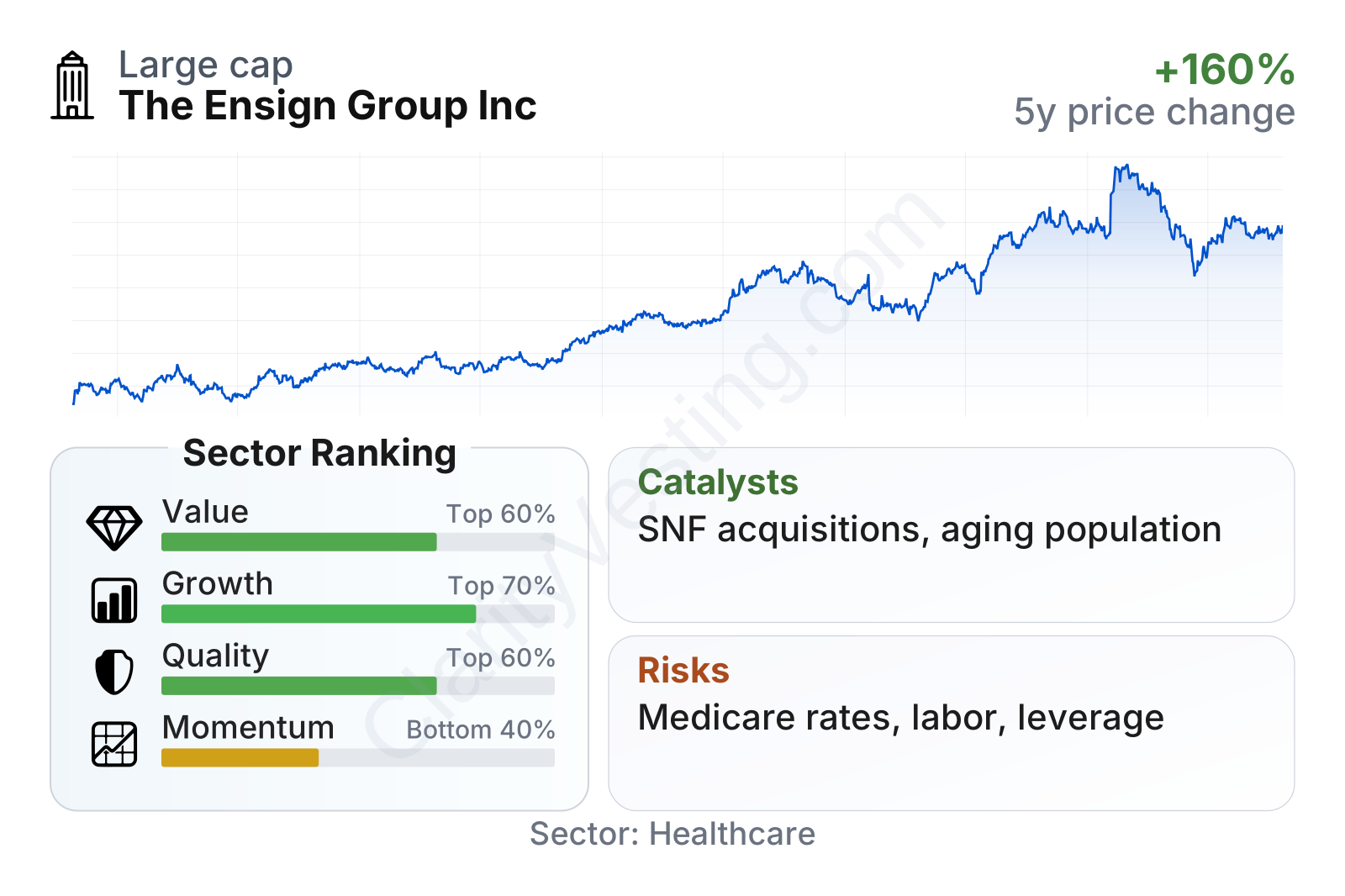
Ensign is now a large healthcare operator with a market value above $10 billion and a relatively low beta, which suggests the stock has historically moved less sharply than the broader market. On fundamentals, the picture is mixed but generally solid: growth ranks well versus much of the healthcare sector, profitability metrics are strong, and returns on capital are well above sector medians. The weaker area is short-term market momentum, as the stock has pulled back from recent highs even though the longer-term share price trend remains strong.
Growth
Ensign operates in a part of healthcare supported by long-duration demand. An aging U.S. population, longer life expectancy, and continued need for rehabilitation after hospital stays all support demand for skilled nursing and senior care services. This is not a fast-changing technology market, but it is a sector where steady demographic pressure can create a long runway for operators that execute well.
The company’s strategy also fits that environment. Ensign has built its business by acquiring facilities, especially properties or operations that may be underperforming, and then improving them through local accountability and tighter operating discipline. That approach has worked for years and remains a meaningful growth lever because the skilled nursing market is still fragmented, leaving room for consolidation.
Recent growth has remained notably stronger than the sector median, with year-over-year revenue growth still running in the high-teens. Over a five-year view, revenue per share growth has also been well ahead of typical healthcare peers. That matters because it suggests expansion has not relied only on issuing stock or financial engineering; the operating base itself has been getting bigger.
Cash generation has improved materially as well. Free cash flow has climbed sharply over time, reaching a much higher level than in earlier years. That gives the company more flexibility to fund acquisitions, support facility upgrades, and manage debt without depending entirely on outside capital. In a labor-heavy industry where execution can vary significantly, that kind of internal cash production is an important strength.
Another catalyst is Ensign’s operating model. The company is known for a decentralized structure that gives facility-level leaders responsibility for performance. In practice, that can help newly acquired facilities improve faster if local management is capable. It also makes the company more scalable than many healthcare businesses that rely on a more centralized corporate structure.
Recent company communications have also continued to highlight ongoing acquisitions, new facility additions, and geographic expansion. For Ensign, that is especially relevant because each successful transaction can add to both revenue and operating leverage, provided the acquired assets are integrated effectively.
Risks
This article is for informational purposes only and does not constitute financial advice. Some content is AI-generated. See Disclaimer


