Stock Analysis · Energizer Holdings Inc (ENR)
Overview
Energizer Holdings Inc is a consumer products company best known for batteries, portable lighting, and auto care products. Its brands are sold through mass retailers, e-commerce channels, grocery stores, drugstores, club stores, hardware outlets, and automotive retailers across the United States and internationally. The business is built around products that are bought repeatedly rather than once, which gives the company a relatively steady demand base.
The company reports two main operating segments. Based on recent annual reporting, revenue is primarily generated from the following sources:
- Batteries & Lights: approximately 60% to 65% of revenue. This segment includes household batteries, specialty batteries, rechargeables, chargers, flashlights, headlamps, lanterns, and related lighting products sold mainly under the Energizer brand.
- Auto Care: approximately 35% to 40% of revenue. This segment includes appearance, performance, refrigerant, and fragrance products sold under brands such as Armor All, STP, A/C Pro, Rain-X licensing arrangements in certain categories, and other automotive maintenance lines.
Geographically, North America remains the company’s largest market, with international markets also contributing a meaningful share. The product mix matters because batteries tend to offer strong brand recognition and recurring replacement demand, while auto care adds category diversification and exposure to a different consumer purchase cycle.
Operationally, the recent pattern has been mixed: total revenue has been fairly stable over time, but profitability has moved around more sharply. The business recovered from a weak 2022 period, and by fiscal 2025 gross profit and operating income had improved materially even though sales were still near the same general range seen a few years earlier. That suggests margin management, pricing, and cost control have become at least as important as pure volume growth.
A notable trend is that sales have stayed around the same broad level for several years, while gross profit improved more clearly in the latest full year. That points to better mix or pricing, but it also highlights that the company’s long-term debate is less about rapid expansion and more about whether it can consistently turn stable sales into stronger cash generation.
Key Figures
| Metric | Value | Sector ⓘ |
|---|---|---|
| Date | Oct 17, 2026 | |
| Context | ||
| Sector | Industrials | |
| Industry | Electrical Equipment & Parts | |
| Market Cap ⓘ | $1.50B | |
| Beta ⓘ | 0.78 | |
Value (Cheapness) | ||
| P/E Ratio ⓘ | 18.36 | 22.10 |
| P/B Ratio ⓘ | 7.46 | 1.97 |
| FCF Yield ⓘ | 10.06% | 6.38% |
| Dividend Yield ⓘ | 5.67% | 1.94% |
| EBIT / EV ⓘ | 5.86% | 4.79% |
| PEG ⓘ | 1.35 | |
Growth (Business expansion) | ||
| Revenue Growth ⓘ | 1.20% | 9.30% |
| RPS Growth (5Y CAGR) ⓘ | -1.73% | 7.81% |
| EPS Growth (5Y CAGR) ⓘ | -10.31% | -13.06% |
| BVPS Growth (5Y CAGR) ⓘ | -17.84% | 6.14% |
| Margin Growth (5Y Trend) ⓘ | 4.39% | 0.88% |
| FCF Growth (5Y CAGR) ⓘ | -13.86% | 11.01% |
| DPS Growth (5Y CAGR) ⓘ | -4.54% | 9.48% |
Quality (Business durability) | ||
| ROIC (Latest) ⓘ | 5.39% | 10.84% |
| ROA (Latest) ⓘ | 1.81% | 5.41% |
| ROIC (5Y Median) ⓘ | 7.64% | 9.38% |
| ROA (5Y Median) ⓘ | 3.00% | 4.95% |
| Net Debt / EBIT (Latest) ⓘ | 11.61 | 2.08 |
| Net Debt / EBIT (5Y Median) ⓘ | 9.96 | 2.27 |
| Net Debt / EBITDA (Latest) ⓘ | 8.04 | 1.39 |
| Net Debt / Assets ⓘ | 72.94% | 19.28% |
| EBITDA / Interest ⓘ | 2.47 | 9.58 |
| Operating Margin (Latest) ⓘ | 9.39% | 10.50% |
| Operating Margin (5Y Median) ⓘ | 10.46% | 10.29% |
| Debt to Equity (Latest) ⓘ | 1688.48% | 65.48% |
| Profit Margin (Latest) ⓘ | 2.73% | 6.67% |
| Free Cash Flow (Latest) ⓘ | $150.60M | |
Momentum (Price trend) | ||
| 3Y Return ⓘ | -18.37% | +61.68% |
| 12M Return (excl. last month) ⓘ | -26.98% | +12.58% |
| 6M Return ⓘ | +19.20% | 0.00% |
| Price vs. 200-Day MA ⓘ | +10.47% | +0.02% |
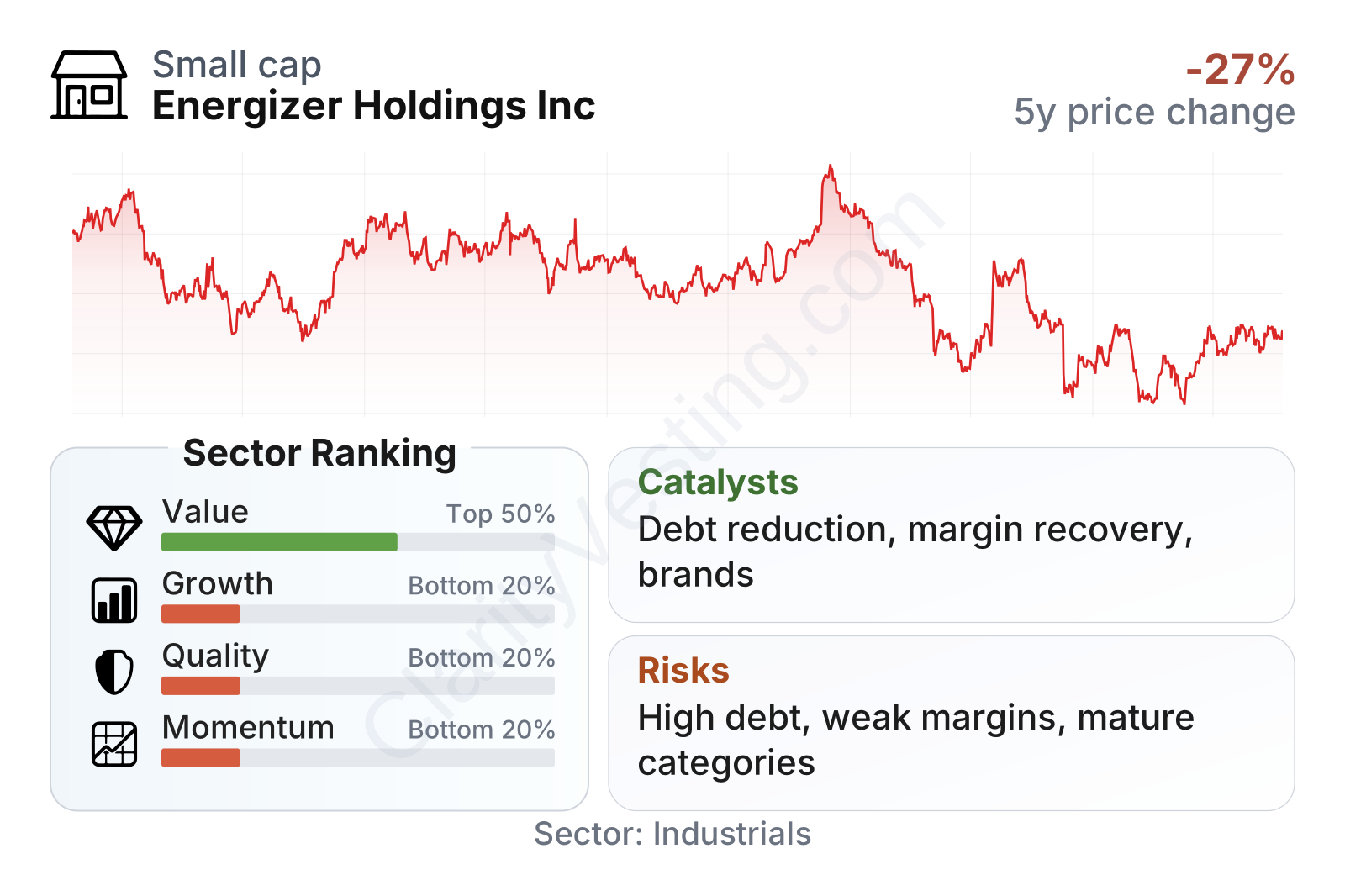
Energizer is a mid-sized company with a relatively low-beta stock, which can make trading swings somewhat less extreme than many industrial names. The most balanced part of the profile is valuation: earnings and cash-flow measures look better than the sector median in several areas, and the dividend yield is notably above the sector norm. The weaker side is business quality and growth. Returns on capital and assets are below typical sector levels, and leverage remains very high, which reduces financial flexibility.
Growth
Energizer operates in categories that are mature rather than fast-growing. Household batteries and flashlights are not high-expansion markets, and auto care tends to grow more with car parc trends, replacement needs, weather patterns, and brand execution than with major structural demand surges. That means the company’s growth path depends more on market share, pricing, product innovation, distribution gains, and efficiency than on a booming end market.
Its strategy still makes sense for long-term growth in a practical way. In batteries, brand strength and shelf presence matter, especially in categories where consumers often choose familiar names quickly. In auto care, the company can expand through product extensions, retailer partnerships, and cross-selling across maintenance and appearance categories. Management has also emphasized productivity, portfolio management, and debt reduction, which are important because a slow-growth company can still create value if it protects margins and converts earnings into cash.
Recent revenue growth has been uneven. The latest year-over-year readings show the company returning to low single-digit growth after several quarters of contraction and volatility. That is an improvement, but it still trails the broader sector, which means Energizer has not yet demonstrated a strong sustained expansion profile.
Cash generation remains one of the more important positive points. Free cash flow recovered sharply after the weak 2022 period and has stayed positive, although the trend has cooled from its peak. For a company like Energizer, steady free cash flow is especially important because it supports dividends, debt repayment, and resilience during softer demand periods.
A meaningful catalyst is balance-sheet repair. If the company can continue using cash flow to reduce borrowings while keeping margins stable, equity value can improve even without fast revenue growth. Another potential support is product innovation in specialty batteries, premium lighting, and auto care niches where brand trust and convenience can justify better pricing. Recent company updates have also centered on productivity and portfolio execution rather than major acquisitions, which is a more sensible approach given the current debt load.
Risks
This article is for informational purposes only and does not constitute financial advice. Some content is AI-generated. See Disclaimer


