Stock Analysis · Enovis Corp (ENOV)
Overview
Enovis Corp is a medical technology company focused mainly on orthopedics. In simple terms, it develops and sells products used to treat joint problems, bone injuries, and rehabilitation needs. Its portfolio spans reconstructive implants, surgical tools, braces, recovery equipment, and related technologies used by surgeons, hospitals, and rehabilitation providers. The company has expanded its orthopedic platform through acquisitions, with a particular emphasis on higher-growth niches such as foot and ankle, shoulder, and surgical enabling technologies.
Based on recent company filings, Enovis reports its business in two main segments. Revenue is concentrated in reconstruction and prevention/recovery products, with the larger contribution coming from its reconstructive and surgical businesses.
- Reconstructive segment: approximately 60% to 65% of revenue. This includes orthopedic implants and related products, especially for hips, knees, shoulders, foot and ankle procedures, as well as surgical technologies used in operating rooms.
- Prevention & Recovery segment: approximately 35% to 40% of revenue. This includes braces, supports, rehabilitation products, bone growth stimulation, and other recovery-oriented devices used before or after surgery and for non-surgical care.
The broader financial profile shows a business with rising sales over the past several years, but also unusually heavy operating costs and large losses tied to integration, restructuring, and non-cash charges. Revenue grew from roughly $1.4 billion in 2021 to about $2.25 billion in 2025, while gross profit also expanded. However, operating expenses climbed sharply enough to push reported earnings deeply negative, which is the central issue long-term readers need to understand.
The long-term pattern is clear: sales and gross profit have moved higher, but the benefit has been overwhelmed by much larger operating charges. Selling and administrative costs remain very large, and the gap between gross profit and operating income widened materially in 2024 and 2025. That suggests the core question is not demand, but whether management can convert scale into cleaner profitability.
Key Figures
| Metric | Value | Sector ⓘ |
|---|---|---|
| Date | Oct 17, 2026 | |
| Context | ||
| Sector | Healthcare | |
| Industry | Medical Devices | |
| Market Cap ⓘ | $1.10B | |
| Beta ⓘ | 1.48 | |
Value (Cheapness) | ||
| P/E Ratio ⓘ | N/A | 24.79 |
| P/B Ratio ⓘ | 0.76 | 3.08 |
| FCF Yield ⓘ | 5.80% | 3.15% |
| Dividend Yield ⓘ | N/A | 1.94% |
| EBIT / EV ⓘ | -41.69% | 0.57% |
| PEG ⓘ | 1.90 | |
Growth (Business expansion) | ||
| Revenue Growth ⓘ | 3.20% | 7.45% |
| RPS Growth (5Y CAGR) ⓘ | 9.15% | 8.61% |
| EPS Growth (5Y CAGR) ⓘ | -8.16% | -17.81% |
| BVPS Growth (5Y CAGR) ⓘ | -26.44% | 3.72% |
| Margin Growth (5Y Trend) ⓘ | N/A | -0.62% |
| FCF Growth (5Y CAGR) ⓘ | -46.97% | 1.04% |
| DPS Growth (5Y CAGR) ⓘ | 120.67% | 6.77% |
Quality (Business durability) | ||
| ROIC (Latest) ⓘ | -36.91% | 3.24% |
| ROA (Latest) ⓘ | -26.87% | 3.01% |
| ROIC (5Y Median) ⓘ | -8.17% | 4.60% |
| ROA (5Y Median) ⓘ | -0.76% | 1.89% |
| Net Debt / EBIT (Latest) ⓘ | N/A | 1.34 |
| Net Debt / EBIT (5Y Median) ⓘ | N/A | 1.84 |
| Net Debt / EBITDA (Latest) ⓘ | N/A | 1.00 |
| Net Debt / Assets ⓘ | 36.02% | 5.45% |
| EBITDA / Interest ⓘ | N/A | 9.64 |
| Operating Margin (Latest) ⓘ | -44.10% | 9.27% |
| Operating Margin (5Y Median) ⓘ | -6.50% | 7.38% |
| Debt to Equity (Latest) ⓘ | 92.69% | 28.58% |
| Profit Margin (Latest) ⓘ | -47.97% | 3.59% |
| Free Cash Flow (Latest) ⓘ | $63.66M | |
Momentum (Price trend) | ||
| 3Y Return ⓘ | -60.18% | +42.80% |
| 12M Return (excl. last month) ⓘ | -44.53% | +18.50% |
| 6M Return ⓘ | -23.61% | +7.57% |
| Price vs. 200-Day MA ⓘ | -17.33% | +5.12% |
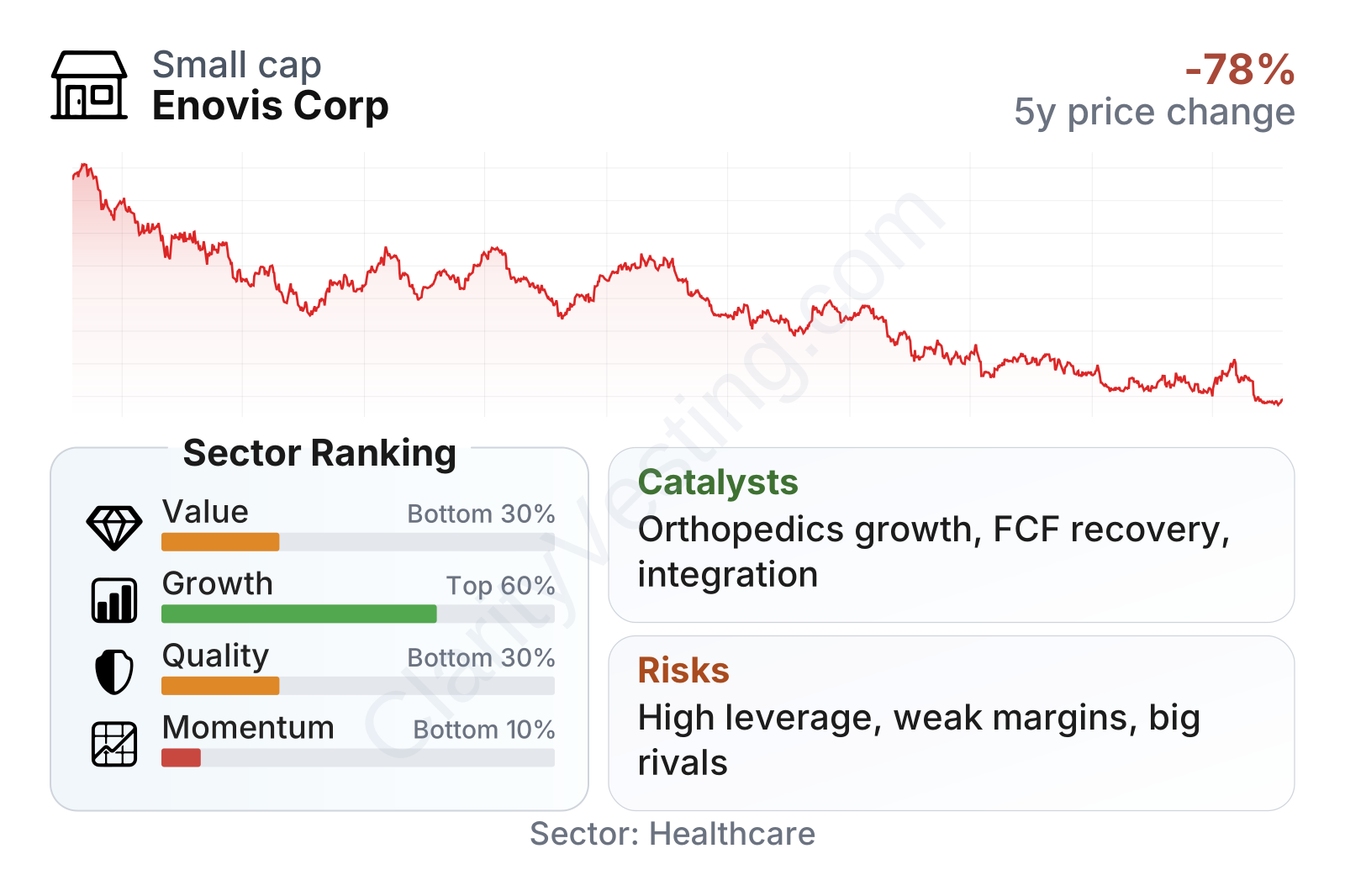
Enovis is currently a small-cap healthcare company with above-average share price volatility. The stock has fallen substantially over the last several years, which reflects weak sentiment around earnings quality, leverage, and integration execution. The metrics table also points to a mixed profile: valuation measures based on cash flow and book value look optically low, but profitability and balance-sheet quality rank poorly versus much of the medical device sector. Growth is not absent, yet it has not translated into strong returns on capital or stable earnings.
Growth
Enovis operates in a part of healthcare that benefits from durable long-term demand. Orthopedic procedures are supported by aging populations, sports injuries, obesity-related joint wear, and the increasing willingness of patients to seek mobility-preserving treatment. Those are favorable underlying trends because they are tied more to medical need than to short-term consumer spending.
The company’s strategy also makes industrial sense. It has been building a more specialized orthopedic platform, especially in areas where surgeons often value product design, workflow support, and sales relationships. Its combination of implants, soft-goods prevention products, and recovery tools creates some cross-selling opportunities across the care pathway, from injury management to surgery and rehabilitation.
Recent revenue growth appears positive but no longer exceptional. After a very strong period in 2024, growth cooled into the low-single-digit range by mid-2026. That does not mean the market opportunity disappeared, but it does suggest the company is now in a phase where execution matters more than simply adding scale. For a business that has already expanded through acquisitions, slower growth raises the importance of margin improvement.
Cash generation is one of the more constructive signs. Free cash flow was negative in earlier periods but has turned positive again more recently. Even though the absolute level is still modest for a company of this size, that improvement matters because it indicates the business is not only reporting accounting adjustments but is also beginning to convert operations into cash again. If this trend continues, it would strengthen the case that recent losses are at least partly tied to temporary items rather than a permanently impaired model.
A meaningful catalyst is the company’s ability to digest prior acquisitions and simplify its cost base. In medical devices, successful integration can improve purchasing efficiency, manufacturing utilization, and selling productivity. Another potential catalyst is continued adoption in targeted orthopedic categories where procedure growth can outpace the broader market, particularly foot and ankle and other less commoditized extremities segments. Recent company updates have also emphasized product launches and commercial execution in reconstruction, which could help support a steadier mix of recurring procedure-driven demand.
Risks
This article is for informational purposes only and does not constitute financial advice. Some content is AI-generated. See Disclaimer


