Stock Analysis · Engie SA (ENGQF)
Overview
Engie SA is a large French utility group active in electricity, natural gas, energy networks, renewable power, and energy services. Its business is spread across regulated infrastructure, power generation, and customer-facing services for cities, industries, and households. That mix matters for long-term analysis because it gives Engie exposure to both defensive utility activities and higher-growth areas tied to the energy transition.
In practical terms, Engie earns money from transporting and distributing gas and electricity through networks, producing power from renewables and flexible thermal assets, supplying energy to customers, and selling energy efficiency and facility management services. The company is especially present in Europe, but it also has operations in Latin America, North America, Asia, the Middle East, and Africa.
Based on the company’s recent reporting structure, the main revenue sources can be summarized approximately as follows:
- Supply and energy management: about 35% to 45% of revenue. This includes selling electricity and gas to residential, commercial, and industrial customers, plus trading and portfolio optimization activities.
- Networks: about 20% to 30%. This mainly covers regulated gas and electricity infrastructure, including transport and distribution assets that typically generate steadier earnings than commodity-linked businesses.
- Renewables and flexible generation: about 15% to 25%. This includes wind, solar, hydro, batteries, and flexible thermal generation used to support grid reliability.
- Energy solutions: about 10% to 20%. This activity includes district energy, on-site services, energy efficiency projects, and technical services for businesses and municipalities.
- Other activities: a smaller share tied to corporate items and portfolio effects.
Revenue can move sharply from year to year because energy prices pass through the income statement, so revenue alone does not fully describe business quality. A better reading is to look at operating profit, cash generation, and the balance between regulated and market-exposed businesses. Over the last few years, Engie’s reported revenue has come down from the 2022 peak as energy prices normalized, while profitability recovered after a weak 2022.
The multi-year pattern shows how unusual 2022 was for the energy sector. Revenue surged with energy prices, but net income was compressed. By 2024, revenue was lower, yet operating income and net income had improved materially, which points to a healthier earnings mix than headline sales alone would suggest.
Key Figures
| Metric | Value | Sector ⓘ |
|---|---|---|
| Date | Oct 10, 2026 | |
| Context | ||
| Sector | Utilities | |
| Industry | Utilities - Diversified | |
| Market Cap ⓘ | $68.16B | |
| Beta ⓘ | 0.56 | |
Value (Cheapness) | ||
| P/E Ratio ⓘ | 14.12 | 17.09 |
| P/B Ratio ⓘ | 2.67 | 1.51 |
| FCF Yield ⓘ | -10.20% | 0.65% |
| Dividend Yield ⓘ | 5.88% | 3.81% |
| EBIT / EV ⓘ | N/A | 5.01% |
| PEG ⓘ | 3.39 | |
Growth (Business expansion) | ||
| Revenue Growth ⓘ | -3.60% | 6.10% |
| RPS Growth (5Y CAGR) ⓘ | 4.49% | 3.87% |
| EPS Growth (5Y CAGR) ⓘ | 62.60% | -11.58% |
| BVPS Growth (5Y CAGR) ⓘ | -10.22% | 4.29% |
| Margin Growth (5Y Trend) ⓘ | 1.34% | 3.52% |
| FCF Growth (5Y CAGR) ⓘ | N/A | -8.84% |
| DPS Growth (5Y CAGR) ⓘ | 23.63% | 4.84% |
Quality (Business durability) | ||
| ROIC (Latest) ⓘ | 17.01% | 6.55% |
| ROA (Latest) ⓘ | 4.83% | 3.20% |
| ROIC (5Y Median) ⓘ | 6.48% | 5.98% |
| ROA (5Y Median) ⓘ | 1.93% | 2.75% |
| Net Debt / EBIT (Latest) ⓘ | 3.02 | 6.90 |
| Net Debt / EBIT (5Y Median) ⓘ | 4.72 | 7.23 |
| Net Debt / EBITDA (Latest) ⓘ | 1.99 | 4.32 |
| Net Debt / Assets ⓘ | 31.88% | 38.42% |
| EBITDA / Interest ⓘ | 7.37 | 4.47 |
| Operating Margin (Latest) ⓘ | 14.28% | 20.99% |
| Operating Margin (5Y Median) ⓘ | 10.46% | 20.08% |
| Debt to Equity (Latest) ⓘ | 226.96% | 138.21% |
| Profit Margin (Latest) ⓘ | 5.99% | 11.37% |
| Free Cash Flow (Latest) ⓘ | -$6.95B | |
Momentum (Price trend) | ||
| 3Y Return ⓘ | +128.78% | +52.56% |
| 12M Return (excl. last month) ⓘ | +36.29% | +11.56% |
| 6M Return ⓘ | -21.53% | -3.04% |
| Price vs. 200-Day MA ⓘ | -13.46% | -1.11% |
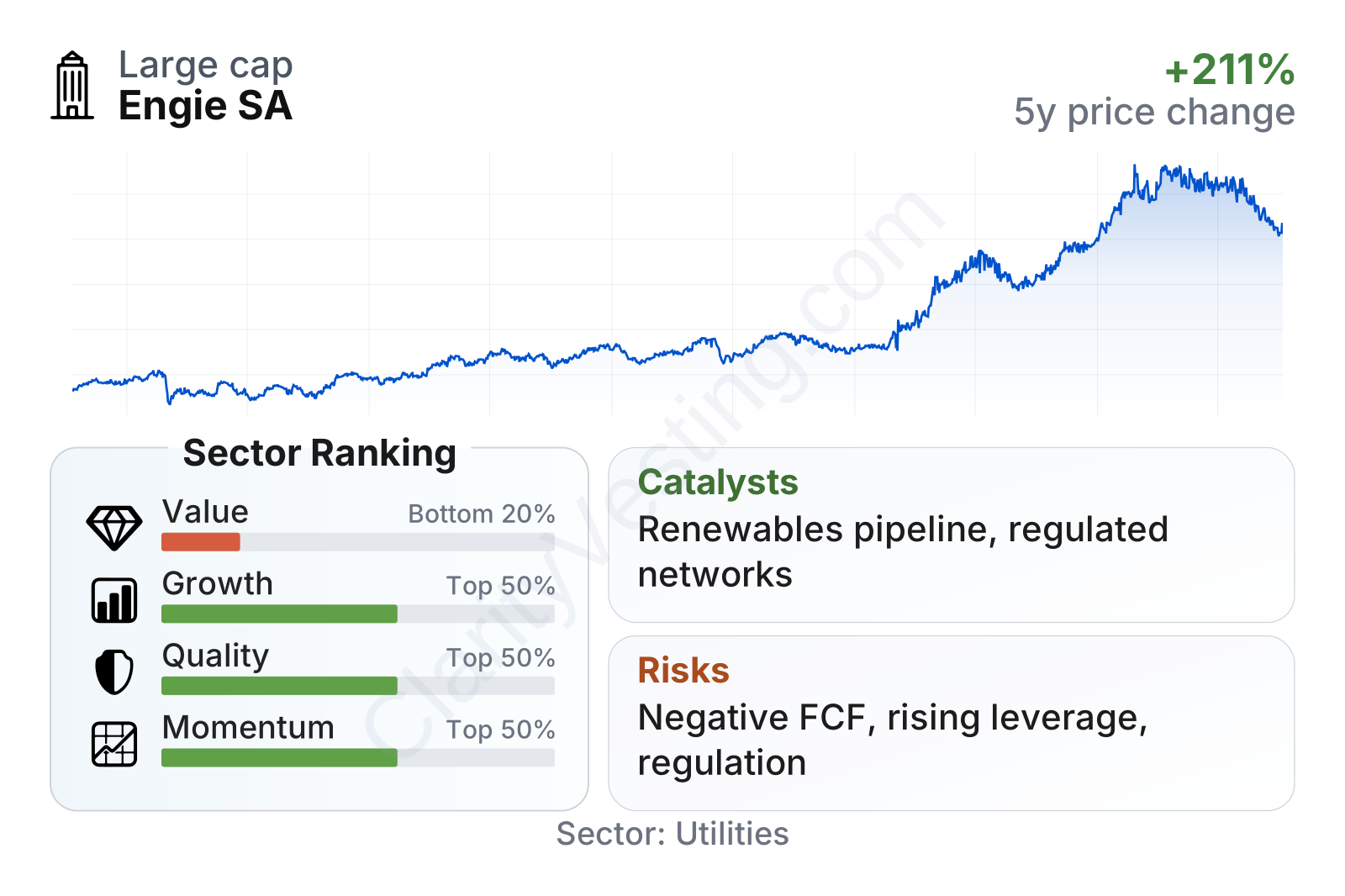
Engie is a very large utility with relatively low share-price volatility, as shown by its beta below 1. On profitability and balance-sheet efficiency, it ranks around the middle to better half of the utility universe, supported by return on invested capital well above the sector median and lower net debt relative to earnings than many peers. At the same time, the profile is not uniformly strong: free cash flow is currently negative, debt to equity is above the sector median, and margins remain lower than many utilities. The value picture is mixed as well, with a moderate trailing earnings multiple and an above-sector price-to-book ratio, reflecting the market’s willingness to pay more for its asset base and transition positioning.
The stock has also had a powerful multi-year run, climbing several times over from late 2021 levels before cooling slightly in recent months. That strong performance helps explain why valuation needs to be looked at carefully even if some standard utility metrics still appear reasonable.
Growth
Engie operates in a sector with durable long-term demand drivers. Electricity consumption is being supported by electrification of transport, heating, and industry, while Europe also continues to invest heavily in grid resilience, storage, renewables, and energy efficiency. Those are all areas where Engie already has an established presence. This does not make growth linear, but it places the company in parts of the utility market that are likely to remain strategically important for many years.
The company’s strategy broadly makes sense for that backdrop. Engie has been emphasizing renewables, flexible generation, and networks while continuing to develop customer solutions that help cities and companies reduce energy use and carbon emissions. That combination is important because renewables alone can be cyclical and capital-intensive, while networks and long-term service contracts can add stability.
Revenue per share rose strongly during the energy crisis period and has eased since then, which is consistent with falling commodity prices rather than a simple deterioration in the underlying business. Over a five-year period, growth still sits slightly above the sector median, and earnings per share growth has been unusually strong. Dividend growth has also been robust. The weaker point is that recent year-over-year revenue growth is negative, so the market is now looking for Engie to convert its energy-transition investments into more durable operating growth rather than relying on favorable price environments.
A meaningful catalyst is the company’s renewable and infrastructure pipeline. As new wind, solar, storage, and network projects enter service, they can lift recurring earnings over time. Another favorable element is Europe’s push for energy security and decarbonization, which supports investment in domestic generation, grids, and efficiency services. Engie’s integrated model gives it several ways to participate in that trend instead of depending on a single technology.
Recent company communications have also highlighted continued asset rotation and capital recycling. For a utility, that can be important: selling mature assets and reinvesting into higher-return projects may help improve portfolio quality over time, provided execution remains disciplined.
Risks
This article is for informational purposes only and does not constitute financial advice. Some content is AI-generated. See Disclaimer


