Stock Analysis · Energiedienst Holding AG (ENGDF)
Overview
Energiedienst Holding AG is a Swiss utility focused on electricity and energy services, with operations centered on southern Germany and Switzerland. The company is part of the broader renewable utilities space and is especially tied to hydropower production on the High Rhine. In simple terms, it produces electricity, distributes and sells power to households and businesses, and also provides related energy solutions such as grids, heat, and customer services.
Its business model is relatively straightforward for a utility: generate or procure electricity, move it through network infrastructure, and sell it to end customers. Compared with many fast-changing technology businesses, this usually creates more stable demand because electricity is an essential service.
The company’s revenue mix is not fully broken out in the same way as some larger listed utilities, but public company information indicates the main sources are the following:
- Electricity sales and trading — the largest source of revenue, likely representing a clear majority of group sales. This includes supplying retail and business customers as well as energy trading activities.
- Grid and network activities — a meaningful secondary contributor. This typically includes electricity distribution and regulated network services.
- Generation, mainly hydropower — an important earnings driver, although not always the largest revenue line because utilities can have high pass-through energy sales.
- Energy services and adjacent activities — a smaller source, including heat, efficiency solutions, and other customer-related services.
Over the last few years, sales moved sharply with electricity market prices, while profit improved more steadily. That matters because headline revenue at utilities can rise or fall with energy prices even when the underlying customer base and asset base remain fairly stable.
The financial flow over recent years shows that revenue peaked during the energy-price spike and then normalized, but operating income and net income held up much better than sales alone would suggest. That points to a business whose earnings were not purely driven by volume growth, but also by improved profitability and favorable operating conditions.
Key Figures
| Metric | Value | Sector ⓘ |
|---|---|---|
| Date | Oct 17, 2026 | |
| Context | ||
| Sector | Utilities | |
| Industry | Utilities - Renewable | |
| Market Cap ⓘ | $1.19B | |
| Beta ⓘ | 0.26 | |
Value (Cheapness) | ||
| P/E Ratio ⓘ | 6.16 | 17.28 |
| P/B Ratio ⓘ | 0.89 | 1.51 |
| FCF Yield ⓘ | 12.43% | 0.65% |
| Dividend Yield ⓘ | 2.68% | 3.77% |
| EBIT / EV ⓘ | N/A | 5.01% |
| PEG ⓘ | N/A | |
Growth (Business expansion) | ||
| Revenue Growth ⓘ | -18.30% | 6.10% |
| RPS Growth (5Y CAGR) ⓘ | 8.65% | 3.87% |
| EPS Growth (5Y CAGR) ⓘ | -13.59% | -11.30% |
| BVPS Growth (5Y CAGR) ⓘ | 14.48% | 4.23% |
| Margin Growth (5Y Trend) ⓘ | 4.10% | 3.57% |
| FCF Growth (5Y CAGR) ⓘ | -11.03% | -8.84% |
| DPS Growth (5Y CAGR) ⓘ | 9.16% | 4.84% |
Quality (Business durability) | ||
| ROIC (Latest) ⓘ | 18.61% | 6.53% |
| ROA (Latest) ⓘ | 12.61% | 3.20% |
| ROIC (5Y Median) ⓘ | 11.69% | 5.95% |
| ROA (5Y Median) ⓘ | 6.17% | 2.75% |
| Net Debt / EBIT (Latest) ⓘ | -0.67 | 7.13 |
| Net Debt / EBIT (5Y Median) ⓘ | -0.38 | 7.23 |
| Net Debt / EBITDA (Latest) ⓘ | -0.48 | 4.31 |
| Net Debt / Assets ⓘ | -9.84% | 38.42% |
| EBITDA / Interest ⓘ | N/A | 4.58 |
| Operating Margin (Latest) ⓘ | 12.98% | 20.83% |
| Operating Margin (5Y Median) ⓘ | 8.36% | 20.08% |
| Debt to Equity (Latest) ⓘ | N/A | 137.69% |
| Profit Margin (Latest) ⓘ | 11.32% | 11.37% |
| Free Cash Flow (Latest) ⓘ | $148.10M | |
Momentum (Price trend) | ||
| 3Y Return ⓘ | -14.05% | +52.37% |
| 12M Return (excl. last month) ⓘ | +6.54% | +8.84% |
| 6M Return ⓘ | +6.54% | -3.95% |
| Price vs. 200-Day MA ⓘ | +2.71% | -0.79% |
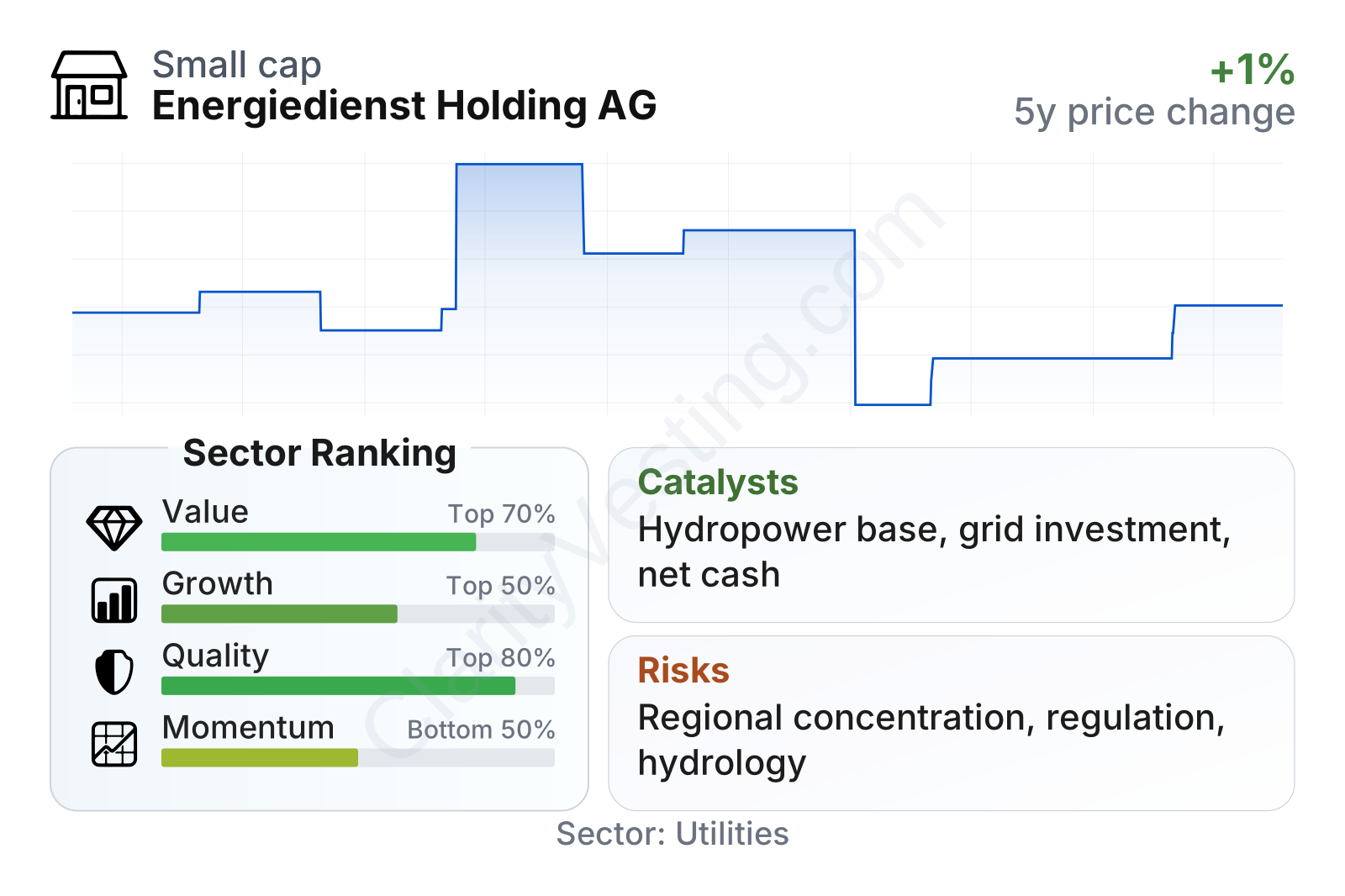
Energiedienst is a mid-sized utility with unusually low share-price volatility for a listed stock, reflected in a beta of about 0.23. On valuation, the stock screens cheaply against its sector, with a low earnings multiple, a price-to-book ratio below 1, and a free-cash-flow yield well above the sector median. On quality, the company stands out even more: returns on capital and assets are clearly ahead of many peers, and its balance sheet appears exceptionally conservative, with net cash rather than heavy net debt. Growth is more mixed. Longer-term revenue per share, book value per share, and dividend growth look solid, but recent year-over-year revenue declined as energy prices normalized. Market momentum has been weaker than the broader renewable utility group over three years, even though the shorter-term trend has improved.
The share-price history also fits the profile of a defensive utility: the stock has moved within a fairly contained range over several years, with a drop in 2025 followed by some recovery into 2026 rather than a sustained rerating.
Growth
Energiedienst operates in a sector with durable long-term support. Electricity demand is being reshaped by electrification, heat decarbonization, grid investment, and the broader transition toward lower-carbon power systems. Renewable generation and distribution infrastructure remain central to that process, especially in regions where hydropower and local grids already provide a strong starting position.
For Energiedienst, the strategy makes industrial sense because it is built around assets and capabilities that are hard to replicate quickly: regional customer relationships, regulated or semi-regulated infrastructure, and renewable generation with hydropower at its core. Hydropower is particularly valuable because it is renewable, established, and dispatchable compared with some intermittent sources.
The longer-term trend in revenue per share is still positive despite the recent pullback from unusually high energy-price periods. That suggests the business has expanded its economic footprint over time, even if annual comparisons can look noisy. The same pattern appears in book value growth and dividend growth, which together point to gradual value creation rather than rapid expansion.
A major catalyst is the company’s positioning in a region where grid stability, local generation, and clean electricity have structural importance. Utilities with owned renewable assets and network exposure can benefit from grid modernization, electrification of heating and transport, and rising demand for reliable low-carbon power. Another useful signal is that operating margins have improved over a five-year view, indicating that growth has not come only from higher sales but also from better operating performance.
Recent company developments have broadly reinforced this picture: the business has continued to emphasize renewable electricity, regional infrastructure, and energy solutions rather than pursuing unrelated diversification. For a utility, that kind of strategic consistency can be more valuable than aggressive expansion.
Risks
This article is for informational purposes only and does not constitute financial advice. Some content is AI-generated. See Disclaimer


