Stock Analysis · Emerson Electric Company (EMR)
Overview
Emerson Electric is an industrial technology company focused on automation. In simple terms, it sells the equipment, software, and engineering tools that help factories, energy sites, utilities, and other industrial facilities run more efficiently, safely, and with less downtime. Its products are used in areas such as process control, measurement, valves, test and inspection, power systems for critical equipment, and software that helps manufacturers design, monitor, and optimize operations.
After several portfolio changes in recent years, Emerson is more concentrated than it used to be. The company has been reshaped around automation and industrial software, especially after increasing its exposure to higher-value software and control systems. Based on its latest annual reporting structure, revenue is mainly generated from the following activities:
- Intelligent Devices: about 55% of revenue — This segment includes field instruments, final control products, pressure and temperature measurement, valves, regulators, and devices used to monitor and control industrial processes.
- Software and Control: about 45% of revenue — This segment includes industrial control systems, software, asset performance tools, simulation, operations technology, and test and measurement businesses, including the National Instruments platform now owned by Emerson.
That revenue mix matters because software, controls, and mission-critical automation typically carry better margins and stronger customer retention than more commoditized industrial hardware. Emerson’s transformation has made the business less of a broad conglomerate and more of a focused automation platform.
The long-term pattern is favorable: revenue has moved materially higher over the past five years, while gross profit has also expanded. Operating profit dipped in fiscal 2024 after portfolio changes and integration effects, but the latest period shows a rebound, suggesting the reshaped business is regaining earnings power.
Key Figures
| Metric | Value | Sector ⓘ |
|---|---|---|
| Date | Oct 03, 2026 | |
| Context | ||
| Sector | Industrials | |
| Industry | Specialty Industrial Machinery | |
| Market Cap ⓘ | $87.71B | |
| Beta ⓘ | 1.23 | |
Value (Cheapness) | ||
| P/E Ratio ⓘ | 34.86 | 22.45 |
| P/B Ratio ⓘ | 4.27 | 1.98 |
| FCF Yield ⓘ | 3.94% | 6.31% |
| Dividend Yield ⓘ | 1.38% | 1.96% |
| EBIT / EV ⓘ | 3.94% | 4.81% |
| PEG ⓘ | 1.78 | |
Growth (Business expansion) | ||
| Revenue Growth ⓘ | 7.00% | 9.10% |
| RPS Growth (5Y CAGR) ⓘ | 10.29% | 7.75% |
| EPS Growth (5Y CAGR) ⓘ | -2.68% | -13.59% |
| BVPS Growth (5Y CAGR) ⓘ | 21.60% | 6.22% |
| Margin Growth (5Y Trend) ⓘ | 3.53% | 0.72% |
| FCF Growth (5Y CAGR) ⓘ | -2.85% | 10.98% |
| DPS Growth (5Y CAGR) ⓘ | 1.13% | 9.48% |
Quality (Business durability) | ||
| ROIC (Latest) ⓘ | 8.99% | 10.92% |
| ROA (Latest) ⓘ | 6.12% | 5.41% |
| ROIC (5Y Median) ⓘ | 9.94% | 9.21% |
| ROA (5Y Median) ⓘ | 9.68% | 4.94% |
| Net Debt / EBIT (Latest) ⓘ | 3.03 | 2.07 |
| Net Debt / EBIT (5Y Median) ⓘ | 2.53 | 2.28 |
| Net Debt / EBITDA (Latest) ⓘ | 2.26 | 1.43 |
| Net Debt / Assets ⓘ | 27.54% | 19.27% |
| EBITDA / Interest ⓘ | 9.30 | 9.53 |
| Operating Margin (Latest) ⓘ | 20.57% | 10.50% |
| Operating Margin (5Y Median) ⓘ | 18.43% | 10.27% |
| Debt to Equity (Latest) ⓘ | 67.73% | 65.48% |
| Profit Margin (Latest) ⓘ | 13.83% | 6.62% |
| Free Cash Flow (Latest) ⓘ | $3.46B | |
Momentum (Price trend) | ||
| 3Y Return ⓘ | +69.31% | +58.56% |
| 12M Return (excl. last month) ⓘ | +17.30% | +15.63% |
| 6M Return ⓘ | +19.26% | +4.19% |
| Price vs. 200-Day MA ⓘ | +8.03% | +0.93% |
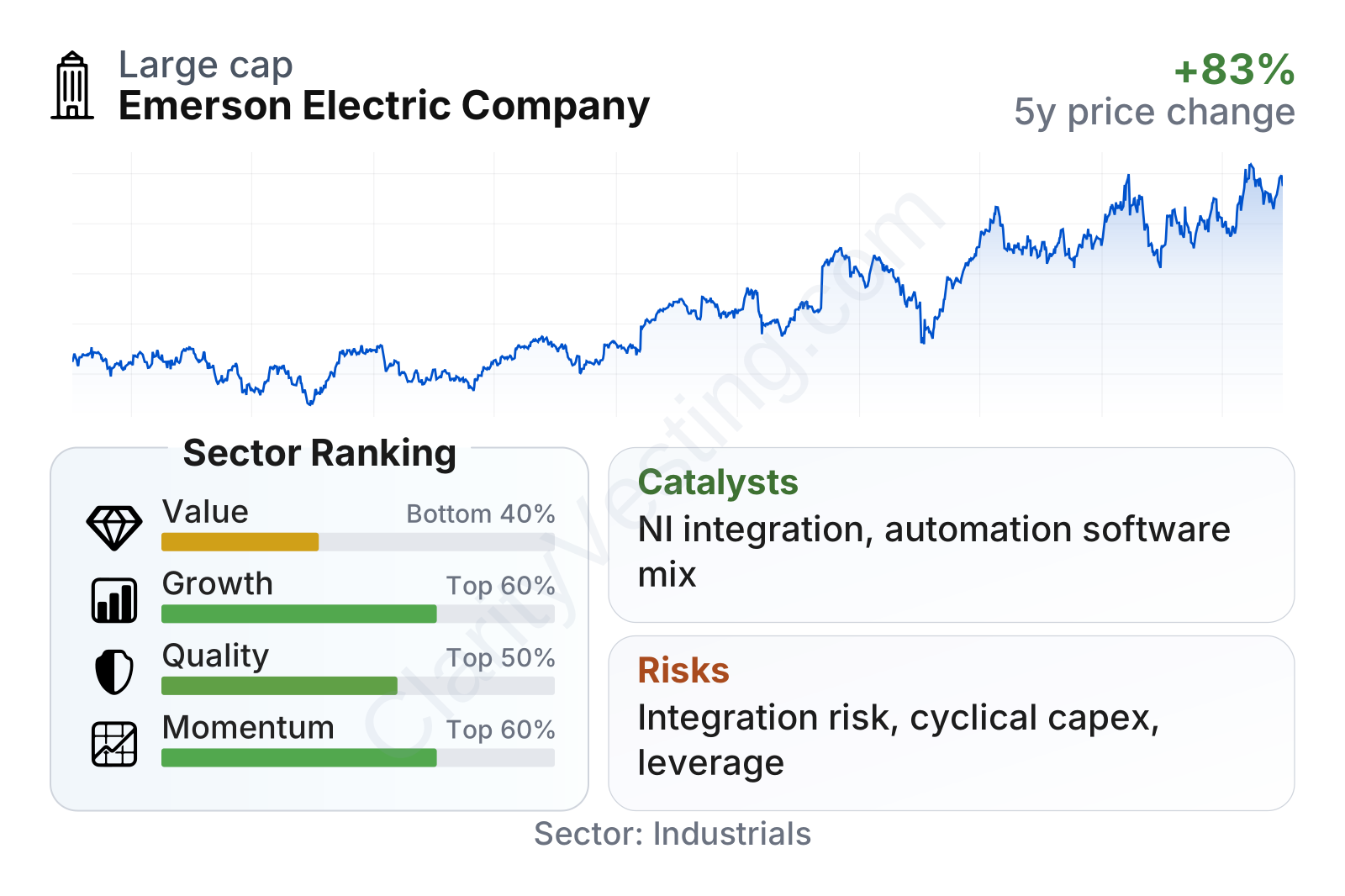
Emerson is a large industrial company with above-average market sensitivity, reflected in a beta a little above 1. On growth and market performance, the picture is solid: multi-year revenue per share growth has been stronger than the sector median, and the stock’s medium-term price performance has also outpaced much of the industrial group. On profitability, operating margin and profit margin stand well above typical sector levels, which supports the case that Emerson’s shift toward automation software and control systems has improved the business mix. The weaker area is valuation: earnings, book value, and cash flow multiples are elevated versus the sector median, so the market is already assigning a premium to the company’s quality and strategic repositioning.
Growth
Emerson operates in a part of industry that still has structural growth drivers. Manufacturers, energy operators, chemical plants, utilities, and life sciences facilities are under pressure to improve productivity, reduce labor intensity, cut energy use, and modernize aging assets. Automation, industrial software, digital monitoring, and test systems are all tied to those needs. This is not a short-lived theme. It is linked to long-cycle capital spending, reshoring of production, grid modernization, and broader adoption of data-driven industrial operations.
Emerson’s strategy is aligned with that direction. The company has spent the past few years simplifying the portfolio and increasing exposure to automation software and control technologies. The National Instruments acquisition added test and measurement capabilities, while earlier deals and partnerships expanded Emerson’s reach in software, analytics, and plant optimization. That combination can create more cross-selling opportunities: a customer that starts with hardware and control systems can later add software, analytics, or test platforms, which can deepen relationships and raise switching costs.
Revenue growth has not been perfectly smooth, partly because acquisitions and divestitures changed the shape of the company. Still, the recent trend shows a return to positive year-over-year growth, with the latest pace improving into the high single digits. That is not the fastest growth in the industrial sector, but it is respectable for a company of Emerson’s size and fits the profile of a mature industrial leader that is upgrading its mix rather than simply chasing volume.
Cash generation is another important support. Free cash flow fell sharply during the integration and portfolio transition period, then recovered strongly to more than $3 billion on a trailing basis. That recovery matters because it gives Emerson room to invest in product development, absorb integration costs, support dividends, and manage debt without relying entirely on external financing.
A recent opportunity is the company’s push to build a more connected automation stack across hardware, control, and software. If management executes well, Emerson can benefit from customers wanting fewer vendors and more integrated systems. In an environment where uptime, cybersecurity, and real-time production data matter more, that kind of platform approach can be attractive.
Risks
This article is for informational purposes only and does not constitute financial advice. Some content is AI-generated. See Disclaimer