Stock Analysis · Embraer S.A (EMBJ)
Overview
Embraer S.A. is a Brazilian aerospace company that designs, manufactures, and supports aircraft and related systems. It is best known for regional jets, business jets, and defense aircraft. Unlike the two largest commercial aircraft makers, which mainly focus on larger narrow-body and wide-body planes, Embraer has built its position around smaller commercial aircraft and a broad after-sales support network. That makes it a more specialized aerospace company rather than a broad market leader across every category.
Its revenue is diversified across several operating segments, which is important in an industry where deliveries can move sharply from one quarter to another. Based on recent company reporting, the main sources of revenue are approximately:
- Commercial Aviation: about 35% to 45% — regional jets for airlines, especially the E-Jets family and the newer E2 aircraft.
- Executive Aviation: about 25% to 35% — business jets sold to corporations, charter operators, and wealthy individuals.
- Services & Support: about 20% to 30% — maintenance, spare parts, training, repairs, and fleet support. This is usually the most recurring part of the business.
- Defense & Security: about 10% to 20% — military aircraft, defense systems, and support contracts, including the KC-390 transport aircraft.
This mix matters because Embraer is not relying on a single airplane program. Commercial aviation drives scale, executive jets add profitability and customer diversity, services create recurring revenue, and defense can bring long-duration contracts with governments.
The long-term financial picture has improved meaningfully. Revenue has moved materially higher since 2023, while the path from gross profit to net income shows that profitability recovered after a weak 2021-2022 period. Interest costs are still meaningful, but the business has clearly shifted from losses to positive earnings and stronger cash generation.
Key Figures
| Metric | Value | Sector ⓘ |
|---|---|---|
| Date | Nov 01, 2026 | |
| Context | ||
| Sector | Industrials | |
| Industry | Aerospace & Defense | |
| Market Cap ⓘ | $13.06B | |
| Beta ⓘ | 0.68 | |
Value (Cheapness) | ||
| P/E Ratio ⓘ | 29.72 | 21.83 |
| P/B Ratio ⓘ | 0.73 | 1.97 |
| FCF Yield ⓘ | 42.65% | 6.33% |
| Dividend Yield ⓘ | 1.29% | 1.88% |
| EBIT / EV ⓘ | 21.10% | 4.83% |
| PEG ⓘ | 28.22 | |
Growth (Business expansion) | ||
| Revenue Growth ⓘ | 10.40% | 9.50% |
| RPS Growth (5Y CAGR) ⓘ | 16.38% | 7.67% |
| EPS Growth (5Y CAGR) ⓘ | 45.32% | -11.52% |
| BVPS Growth (5Y CAGR) ⓘ | 5.50% | 6.14% |
| Margin Growth (5Y Trend) ⓘ | 2.16% | 0.71% |
| FCF Growth (5Y CAGR) ⓘ | 71.04% | 11.01% |
| DPS Growth (5Y CAGR) ⓘ | N/A | 9.31% |
Quality (Business durability) | ||
| ROIC (Latest) ⓘ | N/A | 10.63% |
| ROA (Latest) ⓘ | 4.09% | 5.41% |
| ROIC (5Y Median) ⓘ | N/A | 9.33% |
| ROA (5Y Median) ⓘ | 1.50% | 4.94% |
| Net Debt / EBIT (Latest) ⓘ | 2.15 | 2.03 |
| Net Debt / EBIT (5Y Median) ⓘ | 3.80 | 2.28 |
| Net Debt / EBITDA (Latest) ⓘ | 1.45 | 1.38 |
| Net Debt / Assets ⓘ | 9.02% | 19.16% |
| EBITDA / Interest ⓘ | 3.21 | 9.73 |
| Operating Margin (Latest) ⓘ | 6.35% | 10.49% |
| Operating Margin (5Y Median) ⓘ | 6.13% | 10.30% |
| Debt to Equity (Latest) ⓘ | 74.77% | 65.91% |
| Profit Margin (Latest) ⓘ | 5.28% | 6.61% |
| Free Cash Flow (Latest) ⓘ | $5.57B | |
Momentum (Price trend) | ||
| 3Y Return ⓘ | +433.79% | +69.18% |
| 12M Return (excl. last month) ⓘ | +26.19% | +12.04% |
| 6M Return ⓘ | +18.25% | +0.25% |
| Price vs. 200-Day MA ⓘ | +9.12% | +0.19% |
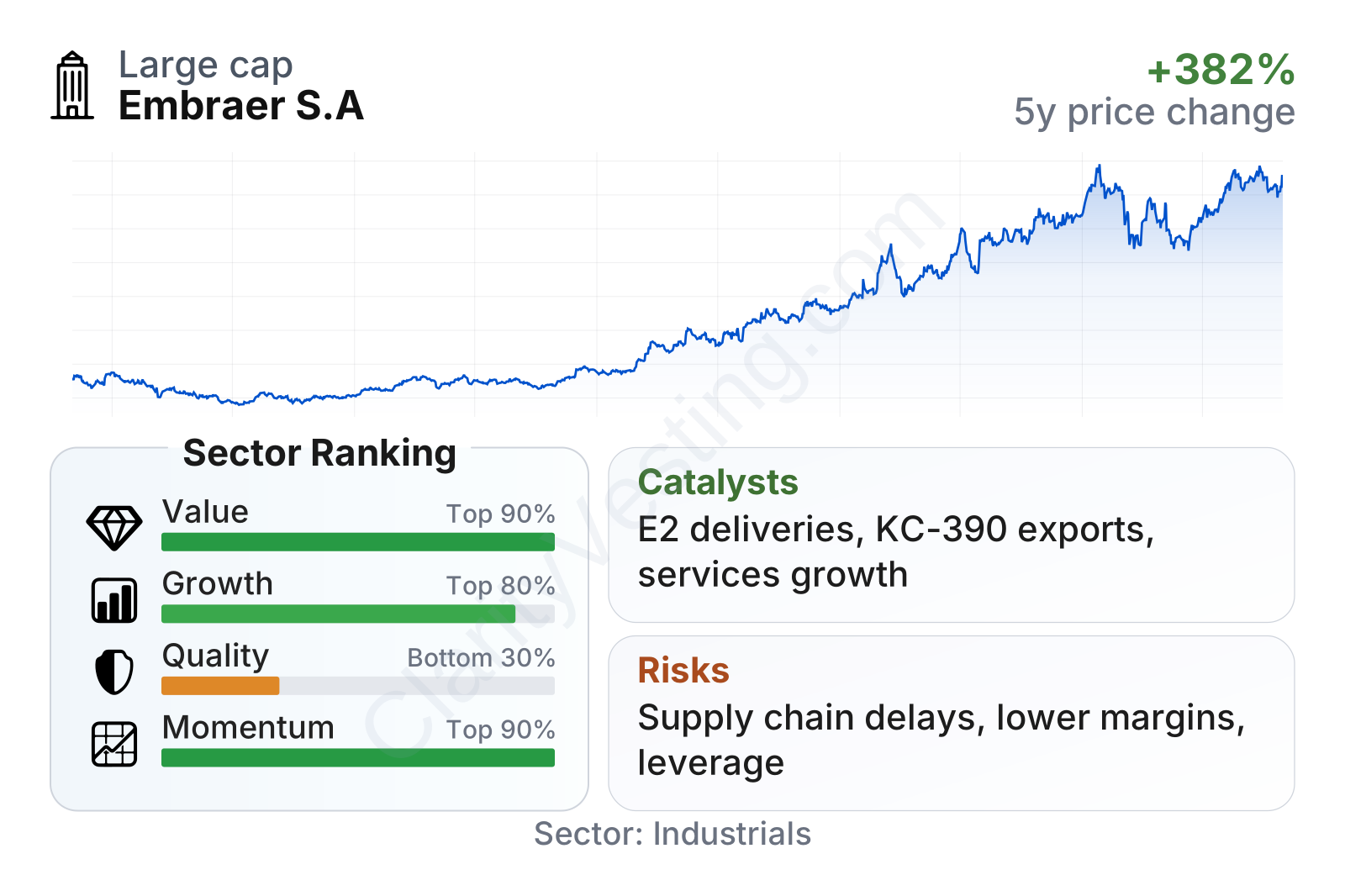
Embraer is now a mid-sized aerospace company by market value, with a relatively low beta of about 0.68, meaning the stock has recently moved less aggressively than the broader market. The share price trend has been exceptionally strong over the last three years, far ahead of the sector median, which shows that the market has already recognized much of the company’s operational recovery.
The overall metric profile is mixed but understandable for a company coming out of a restructuring and margin recovery phase. Value indicators rank very well versus the sector, helped by strong free cash flow yield and EBIT relative to enterprise value, while growth indicators also rank in the upper tier. The weaker area is quality: returns on assets and operating margins remain below many aerospace peers, and interest coverage is still modest for a cyclical manufacturer.
Growth
Embraer operates in segments that have favorable long-term demand drivers. Regional air travel remains important because airlines need to connect smaller cities profitably, and not every route can support larger aircraft. Business aviation also has structural support from fleet replacement, corporate travel flexibility, and demand for newer, more efficient jets. Defense adds another growth layer as countries in Europe, Latin America, the Middle East, and Asia continue to modernize transport fleets.
The company’s strategy makes sense for that environment. In commercial aviation, Embraer focuses on the 70- to 150-seat range, a niche where it has strong product credibility and where direct competition is narrower than in larger jets. In executive aviation, it remains active across light and midsize categories. In defense, the KC-390 is an especially important platform because it gives Embraer access to a market where customers value payload, operational flexibility, and lower operating cost relative to older military transports.
Revenue growth has been volatile quarter to quarter, which is normal in aerospace because aircraft deliveries are uneven, but the broader trend has been positive. The latest yearly growth rate is slightly above the sector median, and the five-year revenue-per-share growth rate is notably stronger than the industry midpoint. That suggests the recovery is not just a one-quarter event.
Cash generation has also improved after a period of weakness. Free cash flow moved from negative territory in 2024 to solidly positive levels more recently, which is a meaningful sign in aircraft manufacturing. For a company like Embraer, cash flow often matters as much as accounting profit because production timing, inventory build, customer advances, and delivery schedules can heavily affect financial strength.
A major catalyst is the company’s order backlog and its exposure to fleet renewal. Airlines are looking for efficient aircraft that can serve thin routes, while governments and defense customers are re-evaluating transport and tactical lift fleets. Recent company updates have also highlighted continued commercial momentum for the E2 family, executive jet demand, and international interest in the KC-390. Another important opportunity is services expansion: once aircraft are delivered, maintenance and support can create longer-lasting revenue streams than the initial sale.
Risks
This article is for informational purposes only and does not constitute financial advice. Some content is AI-generated. See Disclaimer


