Stock Analysis · Evolution Metals & Technologies Corp (EMAT)
Overview
Evolution Metals & Technologies Corp is a very small basic materials company focused on battery-related and critical-mineral projects rather than on a mature, revenue-producing mining operation. Public filings show a business centered on acquiring, developing, and financing mineral assets tied to metals used in energy storage and advanced technologies. In practical terms, this means the company is trying to build value through exploration, project development, corporate transactions, and positioning around materials that could benefit from long-term electrification demand.
At this stage, the business appears to have little to no recurring operating revenue. Recent annual and interim filings indicate that the company is still in a pre-commercial phase, with reported revenue effectively at 0% in the latest periods available. That is a crucial point for long-term analysis: EMAT is not currently being judged on stable sales or mining cash generation, but on whether its asset base can eventually become commercially relevant.
Main sources of revenue currently appear to be:
- Operating revenue from core business: approximately 0% recently, indicating no meaningful commercial production or product sales.
- Potential non-operating or financing-related inflows: not a stable revenue source and not sufficient to characterize the business as self-funding.
- Future project monetization potential: this is strategic rather than current revenue, and would depend on partnerships, asset sales, processing agreements, or eventual production.
The company’s expense profile is more informative than its revenue mix right now. Over the last several years, operating losses and selling, general, and administrative costs have been the dominant features of the financial picture. That is typical of an early-stage resource company, but it also means the investment case depends heavily on execution, financing, and asset quality rather than present-day earnings.
The operating flow highlights a business that has not yet transitioned into commercial scale. Revenue has remained negligible while corporate costs have continued, resulting in recurring losses rather than visible operating leverage.
Key Figures
| Metric | Value | Sector ⓘ |
|---|---|---|
| Date | Oct 17, 2026 | |
| Context | ||
| Sector | Basic Materials | |
| Industry | Other Industrial Metals & Mining | |
| Market Cap ⓘ | $1.20B | |
| Beta ⓘ | 0.15 | |
Value (Cheapness) | ||
| P/E Ratio ⓘ | N/A | 16.90 |
| P/B Ratio ⓘ | N/A | 1.65 |
| FCF Yield ⓘ | -1.90% | 5.76% |
| Dividend Yield ⓘ | N/A | 2.13% |
| EBIT / EV ⓘ | N/A | 6.30% |
| PEG ⓘ | N/A | |
Growth (Business expansion) | ||
| Revenue Growth ⓘ | N/A | 11.10% |
| RPS Growth (5Y CAGR) ⓘ | N/A | 4.49% |
| EPS Growth (5Y CAGR) ⓘ | -37.92% | -13.47% |
| BVPS Growth (5Y CAGR) ⓘ | N/A | 5.51% |
| Margin Growth (5Y Trend) ⓘ | N/A | -1.54% |
| FCF Growth (5Y CAGR) ⓘ | N/A | 0.37% |
| DPS Growth (5Y CAGR) ⓘ | N/A | 6.08% |
Quality (Business durability) | ||
| ROIC (Latest) ⓘ | N/A | 9.26% |
| ROA (Latest) ⓘ | -891.16% | 4.91% |
| ROIC (5Y Median) ⓘ | N/A | 7.70% |
| ROA (5Y Median) ⓘ | -5.56% | 3.86% |
| Net Debt / EBIT (Latest) ⓘ | N/A | 1.40 |
| Net Debt / EBIT (5Y Median) ⓘ | N/A | 1.70 |
| Net Debt / EBITDA (Latest) ⓘ | N/A | 0.95 |
| Net Debt / Assets ⓘ | 23.44% | 13.69% |
| EBITDA / Interest ⓘ | N/A | 12.34 |
| Operating Margin (Latest) ⓘ | N/A | 13.20% |
| Operating Margin (5Y Median) ⓘ | N/A | 11.80% |
| Debt to Equity (Latest) ⓘ | -146.12% | 40.56% |
| Profit Margin (Latest) ⓘ | N/A | 6.43% |
| Free Cash Flow (Latest) ⓘ | -$22.92M | |
Momentum (Price trend) | ||
| 3Y Return ⓘ | N/A | +68.89% |
| 12M Return (excl. last month) ⓘ | N/A | +30.21% |
| 6M Return ⓘ | -78.37% | -4.16% |
| Price vs. 200-Day MA ⓘ | N/A | -1.27% |
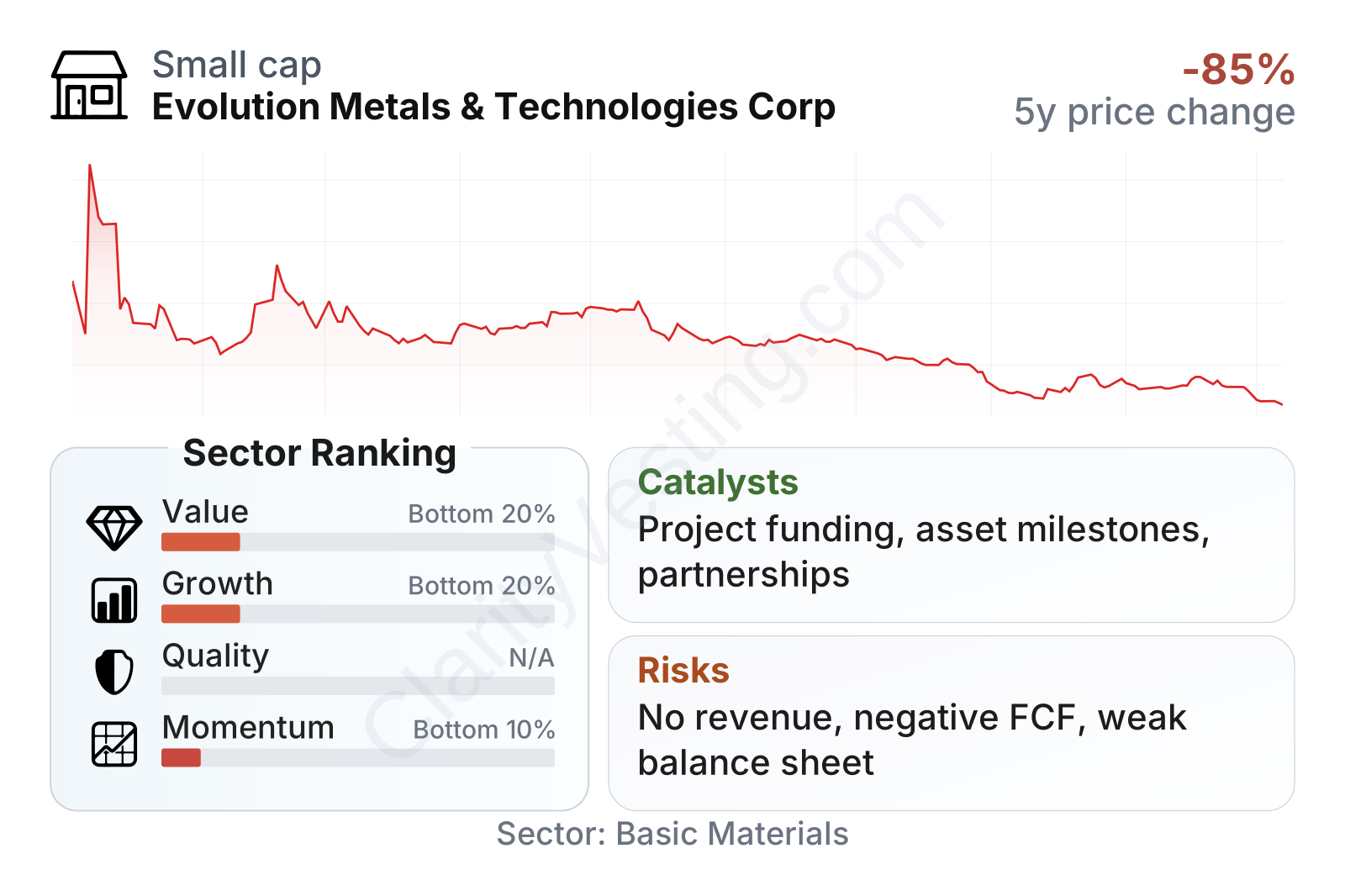
The broad picture is weak on traditional fundamentals. EMAT ranks in the bottom 20% of its sector on value measures and in the bottom 10% on momentum, while growth and quality metrics are difficult to read cleanly because the company is still pre-revenue. The market value is in small-cap territory, and the stock’s very low beta suggests price behavior that does not closely track the broader market, which can happen in thinly followed names driven more by company-specific developments than by sector trends.
The recent share-price trend has been sharply negative, with the stock down by more than 50% over six months. Profitability measures are also weak: return on assets is deeply negative compared with a sector that is broadly profitable, and free cash flow remains negative. In short, the company does not currently look inexpensive on standard operating metrics because those metrics are not yet supported by an established revenue base.
Growth
EMAT is positioned in an area that, in theory, benefits from long-term structural demand. Battery metals, critical minerals, and technology-linked materials remain strategically important because of electric vehicles, stationary energy storage, grid investment, and supply-chain diversification in North America and allied markets. That sector backdrop is favorable at a high level, even though individual project developers often face long timelines and uneven financing conditions.
The company’s strategy makes sense only if its projects can move from concept to economically viable development. For a business like EMAT, the main growth path is not incremental sales expansion; it is the conversion of mineral assets into something that can attract capital, strategic partners, or eventual production. That can create significant upside if successful, but it also means growth is event-driven rather than steady.
Possible catalysts therefore tend to be very specific: resource updates, technical studies, permitting progress, joint ventures, processing agreements, or funding arrangements. Any credible announcement that reduces uncertainty around asset quality or project economics could matter more than a normal quarterly result. By contrast, the absence of such milestones can leave the company in a prolonged waiting period.
Cash generation remains a clear constraint. Free cash flow has recently become more negative, which suggests the company still depends on external funding to advance its plans. For long-term analysis, that means sector growth alone is not enough; EMAT also needs a visible path from strategic positioning to funded execution.
Risks
This article is for informational purposes only and does not constitute financial advice. Some content is AI-generated. See Disclaimer


