Stock Analysis · Elevance Health Inc (ELV)
Overview
Elevance Health is one of the largest health benefits companies in the United States. Its core business is managing health insurance plans and related healthcare services for individuals, employers, Medicaid members, Medicare beneficiaries, and government agencies. The company operates Blue Cross and Blue Shield plans in many states, which gives it broad geographic reach and a large membership base. Over time, it has also expanded beyond insurance into pharmacy, care delivery support, and other health services.
The business is mainly organized around two large segments: Health Benefits and Carelon. Health Benefits is the traditional insurance operation, while Carelon includes pharmacy services, care management, behavioral health, and other healthcare-focused service activities sold both internally and to outside customers.
Based on recent annual reporting, Elevance Health’s revenue mix is still heavily centered on insurance premiums and government-sponsored plans, with services becoming a meaningful secondary contributor. Approximate revenue sources can be described as follows:
- Premium revenue: about 88% to 90% — monthly premiums collected from commercial employer plans, individual ACA plans, Medicare Advantage, Medicare Supplement, Medicaid, and other government programs.
- Product revenue and other service revenue: about 8% to 10% — primarily pharmacy-related activity, care management, and healthcare services, much of it connected to the Carelon platform.
- Investment income and other revenue: about 1% to 2% — income earned on invested insurance assets and smaller miscellaneous sources.
Within the insurance operation, government programs have become especially important. Medicaid and Medicare together represent a large share of membership and revenue, while employer-sponsored commercial coverage remains a major pillar. This mix gives Elevance Health both scale and diversification, but it also means policy changes and medical cost trends matter greatly.
The broader financial flow shows a business with very large revenue, but naturally thin margins because healthcare claims consume most of each premium dollar. Revenue has expanded strongly over the last several years, while net income has been steadier, showing that scale has grown faster than profitability.
Key Figures
| Metric | Value | Sector ⓘ |
|---|---|---|
| Date | Oct 24, 2026 | |
| Context | ||
| Sector | Healthcare | |
| Industry | Healthcare Plans | |
| Market Cap ⓘ | $94.15B | |
| Beta ⓘ | 0.71 | |
Value (Cheapness) | ||
| P/E Ratio ⓘ | 18.43 | 25.42 |
| P/B Ratio ⓘ | 2.17 | 3.08 |
| FCF Yield ⓘ | 6.92% | 3.12% |
| Dividend Yield ⓘ | N/A | 1.85% |
| EBIT / EV ⓘ | 6.89% | 0.56% |
| PEG ⓘ | 1.30 | |
Growth (Business expansion) | ||
| Revenue Growth ⓘ | 1.40% | 7.50% |
| RPS Growth (5Y CAGR) ⓘ | 12.44% | 8.60% |
| EPS Growth (5Y CAGR) ⓘ | -1.91% | -17.73% |
| BVPS Growth (5Y CAGR) ⓘ | 7.83% | 3.72% |
| Margin Growth (5Y Trend) ⓘ | -2.22% | -0.57% |
| FCF Growth (5Y CAGR) ⓘ | -18.73% | 0.96% |
| DPS Growth (5Y CAGR) ⓘ | 11.42% | 6.69% |
Quality (Business durability) | ||
| ROIC (Latest) ⓘ | 8.55% | 3.17% |
| ROA (Latest) ⓘ | 4.12% | 2.98% |
| ROIC (5Y Median) ⓘ | 10.88% | 4.56% |
| ROA (5Y Median) ⓘ | 5.66% | 1.87% |
| Net Debt / EBIT (Latest) ⓘ | -1.35 | 1.34 |
| Net Debt / EBIT (5Y Median) ⓘ | 2.30 | 1.86 |
| Net Debt / EBITDA (Latest) ⓘ | -1.12 | 1.00 |
| Net Debt / Assets ⓘ | -7.80% | 5.06% |
| EBITDA / Interest ⓘ | 7.81 | 9.55 |
| Operating Margin (Latest) ⓘ | 3.66% | 9.25% |
| Operating Margin (5Y Median) ⓘ | 5.14% | 7.33% |
| Debt to Equity (Latest) ⓘ | 0.84% | 26.68% |
| Profit Margin (Latest) ⓘ | 2.47% | 3.34% |
| Free Cash Flow (Latest) ⓘ | $6.51B | |
Momentum (Price trend) | ||
| 3Y Return ⓘ | +3.63% | +51.61% |
| 12M Return (excl. last month) ⓘ | +29.11% | +19.90% |
| 6M Return ⓘ | +36.82% | +10.10% |
| Price vs. 200-Day MA ⓘ | +20.91% | +6.44% |
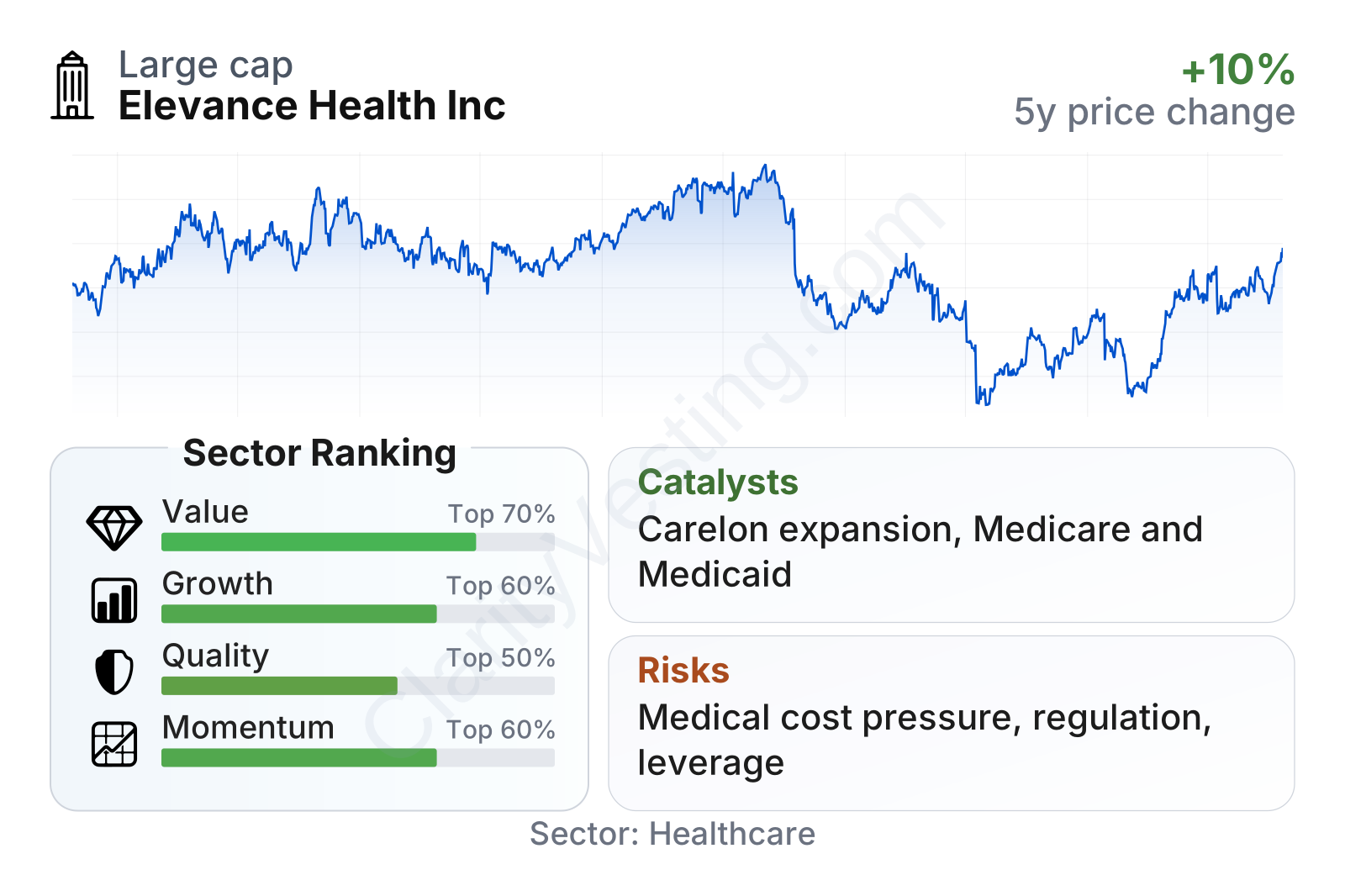
Elevance Health is a very large healthcare company with a market value in the tens of billions of dollars, and its share price has historically moved less sharply than the broader market, as reflected by a beta below 1. The company’s overall profile looks mixed but understandable for a major health insurer: valuation metrics sit below many healthcare peers, quality measures such as return on capital are solid, and recent price momentum has improved. The weaker areas are slower near-term revenue growth, declining margins, and a balance sheet that uses more leverage than the sector median.
Growth
Elevance Health operates in a sector with durable long-term demand. Healthcare spending tends to rise over time because of aging populations, chronic disease prevalence, higher utilization, and the growing complexity of care. In the United States, Medicare and Medicaid remain especially important growth areas, and companies that can manage cost, network quality, and member experience at scale are positioned to participate in that expansion.
The company’s strategy also makes sense for the next phase of the industry. Instead of relying only on insurance premiums, Elevance Health has been building out Carelon as a broader services platform. That matters because insurers are under constant pressure to control medical costs, and owning more of the pharmacy, behavioral health, and care coordination chain can improve both economics and customer retention. It also creates a second engine of growth outside the traditional underwriting business.
Revenue growth has clearly slowed from the double-digit pace seen in earlier periods to low single digits more recently. That moderation suggests the business is now in a more mature phase and facing a tougher comparison base. Even so, the longer view is still constructive: five-year revenue per share growth remains ahead of the sector median, showing that the company has compounded its top line effectively over time even if the most recent pace is less impressive.
Cash generation has been uneven rather than smooth. Free cash flow dropped sharply after a stronger period, then recovered into 2026. For a health insurer, this volatility is not unusual because working capital, claims timing, and government program settlements can move cash results around from year to year. The encouraging point is that free cash flow remains substantial in absolute dollars, which supports acquisitions, debt service, dividends, and share repurchases when conditions allow.
A major catalyst is continued growth in Medicare and Medicaid-related services, especially where Elevance Health can pair insurance enrollment with Carelon’s pharmacy and care management tools. Another meaningful opportunity is the company’s ability to deepen relationships with state governments and large employers through integrated offerings rather than stand-alone coverage. Recent corporate updates have also continued to emphasize digital tools, value-based care arrangements, and service expansion inside Carelon, all of which fit the industry’s direction.
Risks
This article is for informational purposes only and does not constitute financial advice. Some content is AI-generated. See Disclaimer


