Stock Analysis · Equity Lifestyle Properties Inc (ELS)
Overview
Equity LifeStyle Properties, Inc. is a real estate investment trust, or REIT, focused on niche forms of housing and outdoor lodging. Instead of owning traditional apartment towers or office buildings, it owns and operates manufactured home communities, RV resorts, and marinas across the United States and parts of Canada. The company earns recurring income from residents who lease home sites, guests who stay at RV properties, and customers who rent slips, storage, and related services at marinas.
This business mix matters because a large share of ELS revenue comes from long-duration site rents and fees that tend to be steadier than hotel-style lodging. Manufactured housing communities are especially important because residents often face high moving costs, which can support occupancy and pricing power. RV resorts and marinas add a more travel- and leisure-oriented element, giving ELS exposure to outdoor recreation and seasonal demand.
Based on the company’s recent annual reporting, revenue is primarily generated from the following areas:
- Property operations and rental income from manufactured home communities: approximately 45% to 55% of total revenue. This includes site rental income and other community-based charges tied to manufactured housing residents.
- RV and campground operations: approximately 25% to 35% of total revenue. This includes transient and seasonal RV stays, campsite-related fees, and other resort income.
- Marina operations: approximately 10% to 20% of total revenue. This generally includes wet slips, dry storage, service-related fees, and other marina income.
- Home sales, brokerage, membership-related, and other revenues: approximately 5% to 10% of total revenue. These tend to be smaller and can be more variable than recurring rental income.
Over the last several years, total revenue has moved gradually higher, and profitability improved meaningfully through 2024 before becoming less clean to read in 2025 because of cost mix changes. Even so, net income continued to rise, which suggests the portfolio still has underlying earnings strength despite some pressure on operating flow-through.
Key Figures
| Metric | Value | Sector ⓘ |
|---|---|---|
| Date | Oct 24, 2026 | |
| Context | ||
| Sector | Real Estate | |
| Industry | REIT - Residential | |
| Market Cap ⓘ | $11.85B | |
| Beta ⓘ | 0.64 | |
Value (Cheapness) | ||
| P/E Ratio ⓘ | 29.29 | 17.85 |
| P/B Ratio ⓘ | 7.00 | 0.87 |
| FCF Yield ⓘ | 2.92% | 7.30% |
| Dividend Yield ⓘ | 0.83% | 4.83% |
| EBIT / EV ⓘ | 2.81% | 3.78% |
| PEG ⓘ | 4.39 | |
Growth (Business expansion) | ||
| Revenue Growth ⓘ | 3.80% | 5.35% |
| RPS Growth (5Y CAGR) ⓘ | 2.92% | 6.02% |
| EPS Growth (5Y CAGR) ⓘ | 8.59% | -10.65% |
| BVPS Growth (5Y CAGR) ⓘ | 3.70% | 0.43% |
| Margin Growth (5Y Trend) ⓘ | -3.14% | -0.69% |
| FCF Growth (5Y CAGR) ⓘ | 2.32% | 5.40% |
| DPS Growth (5Y CAGR) ⓘ | 9.08% | 5.07% |
Quality (Business durability) | ||
| ROIC (Latest) ⓘ | N/A | 5.69% |
| ROE (Latest) ⓘ | 22.70% | 7.37% |
| ROA (Latest) ⓘ | 6.80% | 2.85% |
| ROIC (5Y Median) ⓘ | 8.81% | 4.26% |
| ROE (5Y Median) ⓘ | 22.41% | 6.04% |
| ROA (5Y Median) ⓘ | 5.66% | 2.45% |
| Net Debt / EBIT (Latest) ⓘ | 7.86 | 7.55 |
| Net Debt / EBIT (5Y Median) ⓘ | 8.15 | 8.26 |
| Net Debt / EBITDA (Latest) ⓘ | 5.16 | 5.26 |
| Net Debt / Assets ⓘ | 56.95% | 37.45% |
| EBITDA / Interest ⓘ | 5.82 | 4.11 |
| Operating Margin (Latest) ⓘ | 25.74% | 33.86% |
| Operating Margin (5Y Median) ⓘ | 30.21% | 37.49% |
| Debt to Equity (Latest) ⓘ | 189.12% | 88.76% |
| Profit Margin (Latest) ⓘ | 24.66% | 18.94% |
| Free Cash Flow (Latest) ⓘ | $346.75M | |
Momentum (Price trend) | ||
| 3Y Return ⓘ | +3.94% | +36.33% |
| 12M Return (excl. last month) ⓘ | +3.27% | +4.32% |
| 6M Return ⓘ | -0.88% | -1.74% |
| Price vs. 200-Day MA ⓘ | -2.23% | -1.42% |
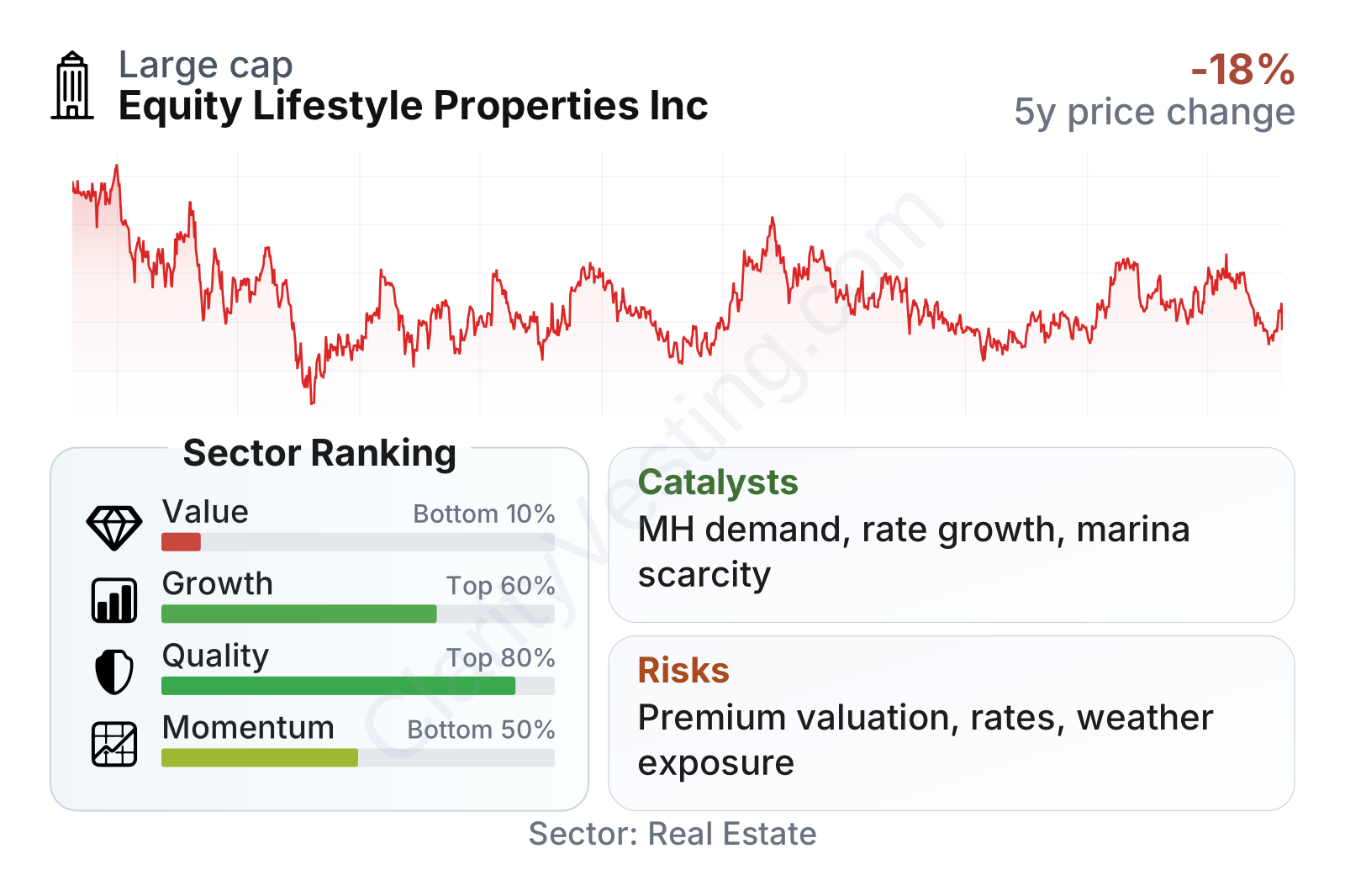
ELS is a large specialized residential REIT with relatively low share-price volatility, as shown by a beta well below 1. On quality, it stands out: returns on equity and assets are comfortably above the sector median, and profit margin is also stronger than many peers. Growth is more mixed. Recent year-over-year revenue growth has been slightly ahead of the sector median, but the longer-term pace in revenue per share and free cash flow has been more moderate. On valuation, the shares screen as expensive versus the broader real estate group, with higher earnings and book multiples and a lower cash flow yield than typical sector levels. Price momentum has also been muted, with the stock largely moving sideways over several years.
Growth
ELS operates in parts of real estate with attractive long-term demand drivers. Manufactured housing remains one of the more affordable housing options in the United States, which supports demand for well-located communities. RV resorts and campgrounds benefit from continued consumer interest in outdoor travel, while marinas gain from high-end recreation trends and limited waterfront supply. These are not hypergrowth markets, but they can produce durable expansion through rent increases, occupancy optimization, redevelopment, and selective acquisitions.
The company’s strategy is broadly consistent with that backdrop. ELS emphasizes assets with supply constraints, recurring customer relationships, and the ability to raise rates over time. In manufactured housing, adding new competing supply is often difficult because of zoning and local opposition. In marinas, waterfront locations are naturally scarce. That combination can help protect occupancy and support steady internal growth even without rapid unit expansion.
Revenue per share has trended upward over the last five years, although the pace has been measured rather than fast. That profile fits the company’s business model: ELS is more about compounding through stable rent growth, property upgrades, and selective expansion than dramatic top-line jumps.
Dividend per share has risen at a clearly faster pace than revenue per share in recent years, which signals confidence in cash-generation durability. The current dividend yield is still below the sector median, so the market appears to value ELS more for portfolio quality and consistency than for headline yield alone.
A notable catalyst is the company’s positioning in supply-constrained categories. Affordable housing shortages can support manufactured home demand, while aging demographics and lifestyle preferences may continue to benefit RV and marina usage. Another catalyst is capital recycling and redevelopment: upgrading sites, expanding amenity offerings, and improving rate mix can lift returns without requiring major greenfield development. Recent company communications have also pointed to continued focus on same-property income growth and disciplined capital allocation, which is usually important in a rate-sensitive real estate environment.
Risks
This article is for informational purposes only and does not constitute financial advice. Some content is AI-generated. See Disclaimer


