Stock Analysis · Elkem ASA (ELKEF)
Overview
Elkem ASA is a Norwegian materials company that makes silicon-based products used in a wide range of industrial and consumer applications. Its products go into construction materials, electronics, electric vehicles, renewable energy systems, personal care products, medical products, packaging, foundry applications, and metal alloys. In simple terms, Elkem sits in the middle of many supply chains: it turns quartz, energy, and chemical processing know-how into specialized materials that other manufacturers need.
The business is mainly organized around three operating areas that are also its main revenue sources. Based on the latest annual reporting structure, the mix is approximately as follows:
- Silicones: about 45% to 50% of revenue. This includes silicone fluids, elastomers, resins, and specialty blends used in construction, automotive, electronics, healthcare, personal care, and industrial uses.
- Silicon Products: about 30% to 35% of revenue. This covers silicon, ferrosilicon, microsilica, and related materials sold to aluminum, chemicals, solar, battery, and industrial customers.
- Carbon Solutions: about 15% to 20% of revenue. This division supplies carbon materials and electrode-related products used in metallurgical processes and other industrial applications.
Geographically, Elkem is diversified across Europe, Asia, and the Americas, with an especially important industrial footprint in Norway, China, and several other manufacturing hubs. That matters because the company operates in energy-intensive activities where plant location, electricity cost, logistics, and access to raw materials can strongly affect profitability.
One useful way to view Elkem is as a hybrid between a commodity-exposed producer and a specialty materials company. Some of its earnings move with silicon and alloy cycles, while other activities, especially more specialized silicone products, can earn better margins and have more stable end-market demand.
The long-term financial pattern shows how cyclical the business can be. Revenue and operating profit surged in 2022 during unusually strong market conditions, then retreated sharply in 2023 and stayed subdued through 2024 and 2025. Even so, gross profit held up better than net income, which suggests that weaker bottom-line results were not only about sales decline but also about pressure from overhead, financing costs, and a less favorable market mix.
Key Figures
| Metric | Value | Sector ⓘ |
|---|---|---|
| Date | Nov 21, 2026 | |
| Context | ||
| Sector | Basic Materials | |
| Industry | Specialty Chemicals | |
| Market Cap ⓘ | $1.23B | |
| Beta ⓘ | 0.98 | |
Value (Cheapness) | ||
| P/E Ratio ⓘ | 24.29 | 15.60 |
| P/B Ratio ⓘ | N/A | 2.20 |
| FCF Yield ⓘ | 8.30% | 5.22% |
| Dividend Yield ⓘ | N/A | 1.93% |
| EBIT / EV ⓘ | 7.12% | 8.17% |
| PEG ⓘ | N/A | |
Growth (Business expansion) | ||
| Revenue Growth ⓘ | -2.50% | 10.90% |
| RPS Growth (5Y CAGR) ⓘ | -15.96% | 4.49% |
| EPS Growth (5Y CAGR) ⓘ | 33.23% | -9.13% |
| BVPS Growth (5Y CAGR) ⓘ | 4.69% | 5.53% |
| Margin Growth (5Y Trend) ⓘ | -10.74% | -1.54% |
| FCF Growth (5Y CAGR) ⓘ | N/A | 0.37% |
| DPS Growth (5Y CAGR) ⓘ | -12.98% | 5.68% |
Quality (Business durability) | ||
| ROIC (Latest) ⓘ | 3.44% | 8.91% |
| ROA (Latest) ⓘ | -1.57% | 5.01% |
| ROIC (5Y Median) ⓘ | N/A | 7.91% |
| ROA (5Y Median) ⓘ | 0.94% | 3.90% |
| Net Debt / EBIT (Latest) ⓘ | 4.67 | 1.33 |
| Net Debt / EBIT (5Y Median) ⓘ | 3.07 | 1.69 |
| Net Debt / EBITDA (Latest) ⓘ | 1.60 | 0.95 |
| Net Debt / Assets ⓘ | 21.15% | 12.22% |
| EBITDA / Interest ⓘ | 8.01 | 12.78 |
| Operating Margin (Latest) ⓘ | 8.72% | 13.23% |
| Operating Margin (5Y Median) ⓘ | 16.77% | 11.87% |
| Debt to Equity (Latest) ⓘ | N/A | 40.11% |
| Profit Margin (Latest) ⓘ | -3.75% | 7.03% |
| Free Cash Flow (Latest) ⓘ | $102.27M | |
Momentum (Price trend) | ||
| 3Y Return ⓘ | +104.56% | +45.33% |
| 12M Return (excl. last month) ⓘ | +30.77% | +16.67% |
| 6M Return ⓘ | +11.72% | -8.36% |
| Price vs. 200-Day MA ⓘ | +3.53% | -8.36% |
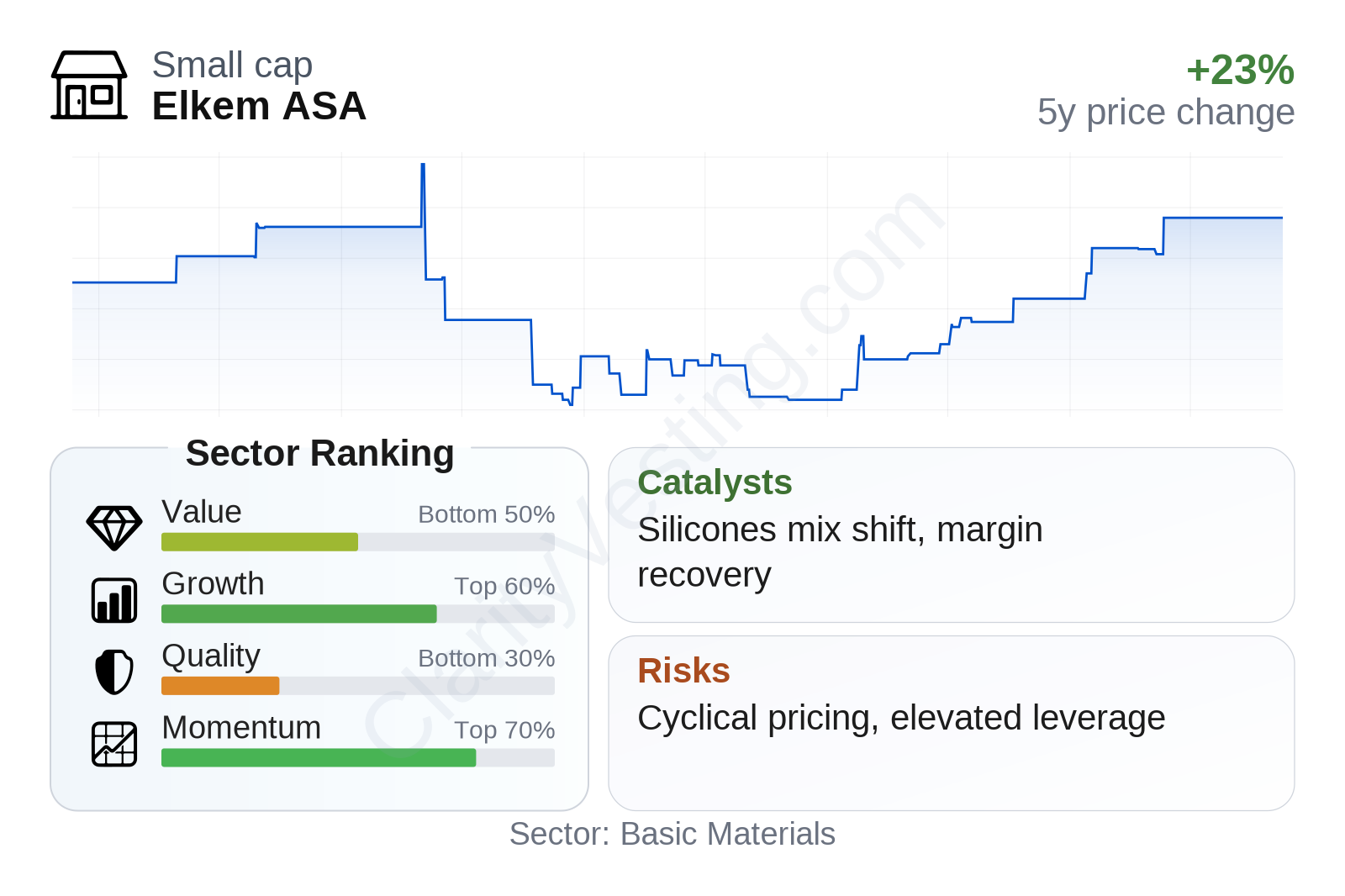
Elkem is a mid-sized materials company with a stock that has recently recovered strongly from its 2023 trough. The share price trend over the last 12 months, 3 years, and 6 months has been better than the sector median, showing that the market has become more constructive on the company despite still-mixed fundamentals.
The latest metrics paint a split picture. On valuation, free cash flow yield stands out as relatively strong versus the sector median, but earnings-based valuation is less obviously attractive because the P/E ratio sits above the sector median while profitability remains weak. That combination usually means the market is looking through a depressed earnings period and giving more weight to future normalization than to current profits.
Quality measures are the softest part of the profile. Returns on capital and assets are below sector norms, operating margin is currently lower than the industry median, net debt relative to earnings is elevated, and interest coverage is thinner than many peers. At the same time, free cash flow is still positive, which gives the company some operating flexibility even during a downcycle.
Growth indicators are also mixed. Recent revenue is slightly down year over year and the five-year revenue trend is weak, but five-year earnings per share growth remains strong because profits were much higher during the earlier upcycle. In short, the current picture is not one of steady compounding; it is one of a cyclical company trying to move back toward stronger profitability after a difficult period.
Growth
Elkem operates in end markets that should remain relevant for years: construction chemicals, electric mobility, electronics, renewable power systems, and advanced industrial materials. That does not mean the company is in a pure high-growth niche, but it does mean demand is tied to several structural themes that can support long-term volume growth over time.
The strategic logic is fairly clear. Elkem has spent years building a more integrated silicon-to-silicones platform, with the goal of capturing value across more steps of the chain rather than relying only on lower-margin upstream production. For long-term analysis, that is an important point: specialty silicones generally offer a more differentiated profile than standard metallurgical silicon products, and that can improve resilience when industrial cycles weaken.
Another growth angle is product exposure to greener technologies. Silicon materials are used in solar-related applications, batteries, electric vehicles, and energy infrastructure, while silicones are used in insulation, durability solutions, and electronics. These are not guaranteed profit engines, but they do create a credible link between Elkem’s portfolio and the broader push toward electrification and efficiency.
Recent corporate updates have also pointed to continued focus on specialization, operational efficiency, and portfolio optimization. For a company like Elkem, margin recovery can come not only from higher sales volumes but also from better product mix, lower costs, and disciplined capital allocation. That matters because in cyclical industries, operational improvement often has as much impact as headline revenue growth.
The recent rebound in the stock price suggests the market sees a path to improved conditions. If silicon and silicone demand strengthens while energy and input costs remain manageable, earnings can recover meaningfully from depressed levels. That operating leverage is one of the main reasons the company remains relevant for long-term market participants despite uneven recent financial results.
Risks
This article is for informational purposes only and does not constitute financial advice. Some content is AI-generated. See Disclaimer