Stock Analysis · Elia Group SA/NV (ELIAF)
Overview
Elia Group SA/NV is a high-voltage electricity grid operator. In simple terms, it owns and runs the large transmission networks that move electricity over long distances from power plants, offshore wind farms, and interconnections between countries to regional distribution networks and major industrial users. The group operates mainly through Elia Transmission Belgium in Belgium and 50Hertz in northeastern Germany. It is also involved in international electricity interconnection projects and energy system development linked to Europe’s transition toward more renewable power.
This is not a typical utility focused on selling electricity directly to households. Its role is more like the backbone of the power system. Revenue is largely tied to regulated tariffs, grid access, congestion management, balancing services, and compensation mechanisms approved by regulators. That usually makes the business more predictable than many industrial companies, although returns are also shaped by regulatory decisions and financing costs.
Based on the group’s annual reporting structure, the main revenue sources are approximately:
- Germany transmission activities: about 55% to 65% of group revenue in recent years. This mainly comes from 50Hertz, which operates a major electricity transmission network in Germany and is heavily exposed to renewable integration and grid expansion.
- Belgium transmission activities: about 25% to 35% of group revenue. This includes domestic transmission services, balancing, ancillary services, and regulated infrastructure income through Elia Transmission Belgium.
- Non-regulated and Nemo Link / other activities: generally about 5% to 10%. This includes interconnection-related activities and selected energy system services outside the core regulated businesses.
There is an important nuance for Elia Group: reported revenue can move a lot because some cost pass-through items, such as energy balancing and congestion-related mechanisms, flow through the income statement. That means revenue growth does not always translate one-for-one into stronger profitability. For a grid operator, regulated asset growth, allowed returns, and execution of investment plans often matter more than simple top-line expansion.
Over the last few years, the business mix has also been supported by a larger contribution from Germany, where renewable buildout and cross-border power flows require major transmission investment. Belgium remains strategically important, especially for offshore wind connections and security of supply.
The broader financial pattern is encouraging: revenue and operating income have trended upward over the last five years, and net income has also improved. At the same time, interest expense has risen materially, which reflects the capital-intensive nature of the business and the heavier financing burden that comes with large grid expansion programs.
Key Figures
| Metric | Value | Sector ⓘ |
|---|---|---|
| Date | Oct 17, 2026 | |
| Context | ||
| Sector | Utilities | |
| Industry | Utilities - Regulated Electric | |
| Market Cap ⓘ | $15.10B | |
| Beta ⓘ | 0.78 | |
Value (Cheapness) | ||
| P/E Ratio ⓘ | 20.44 | 17.28 |
| P/B Ratio ⓘ | 1.79 | 1.51 |
| FCF Yield ⓘ | N/A | 0.65% |
| Dividend Yield ⓘ | 1.48% | 3.77% |
| EBIT / EV ⓘ | 0.34% | 5.01% |
| PEG ⓘ | N/A | |
Growth (Business expansion) | ||
| Revenue Growth ⓘ | 18.00% | 6.10% |
| RPS Growth (5Y CAGR) ⓘ | 2.44% | 3.87% |
| EPS Growth (5Y CAGR) ⓘ | -35.43% | -11.30% |
| BVPS Growth (5Y CAGR) ⓘ | -1.48% | 4.23% |
| Margin Growth (5Y Trend) ⓘ | 12.93% | 3.57% |
| FCF Growth (5Y CAGR) ⓘ | N/A | -8.84% |
| DPS Growth (5Y CAGR) ⓘ | -12.09% | 4.84% |
Quality (Business durability) | ||
| ROIC (Latest) ⓘ | N/A | 6.53% |
| ROA (Latest) ⓘ | N/A | 3.20% |
| ROIC (5Y Median) ⓘ | 3.91% | 5.95% |
| ROA (5Y Median) ⓘ | 1.86% | 2.75% |
| Net Debt / EBIT (Latest) ⓘ | N/A | 7.13 |
| Net Debt / EBIT (5Y Median) ⓘ | 12.18 | 7.23 |
| Net Debt / EBITDA (Latest) ⓘ | N/A | 4.31 |
| Net Debt / Assets ⓘ | N/A | 38.42% |
| EBITDA / Interest ⓘ | N/A | 4.58 |
| Operating Margin (Latest) ⓘ | N/A | 20.83% |
| Operating Margin (5Y Median) ⓘ | 18.70% | 20.08% |
| Debt to Equity (Latest) ⓘ | N/A | 137.69% |
| Profit Margin (Latest) ⓘ | 13.89% | 11.37% |
| Free Cash Flow (Latest) ⓘ | N/A | |
Momentum (Price trend) | ||
| 3Y Return ⓘ | +48.21% | +52.37% |
| 12M Return (excl. last month) ⓘ | +15.78% | +8.84% |
| 6M Return ⓘ | -0.97% | -3.95% |
| Price vs. 200-Day MA ⓘ | -2.12% | -0.79% |
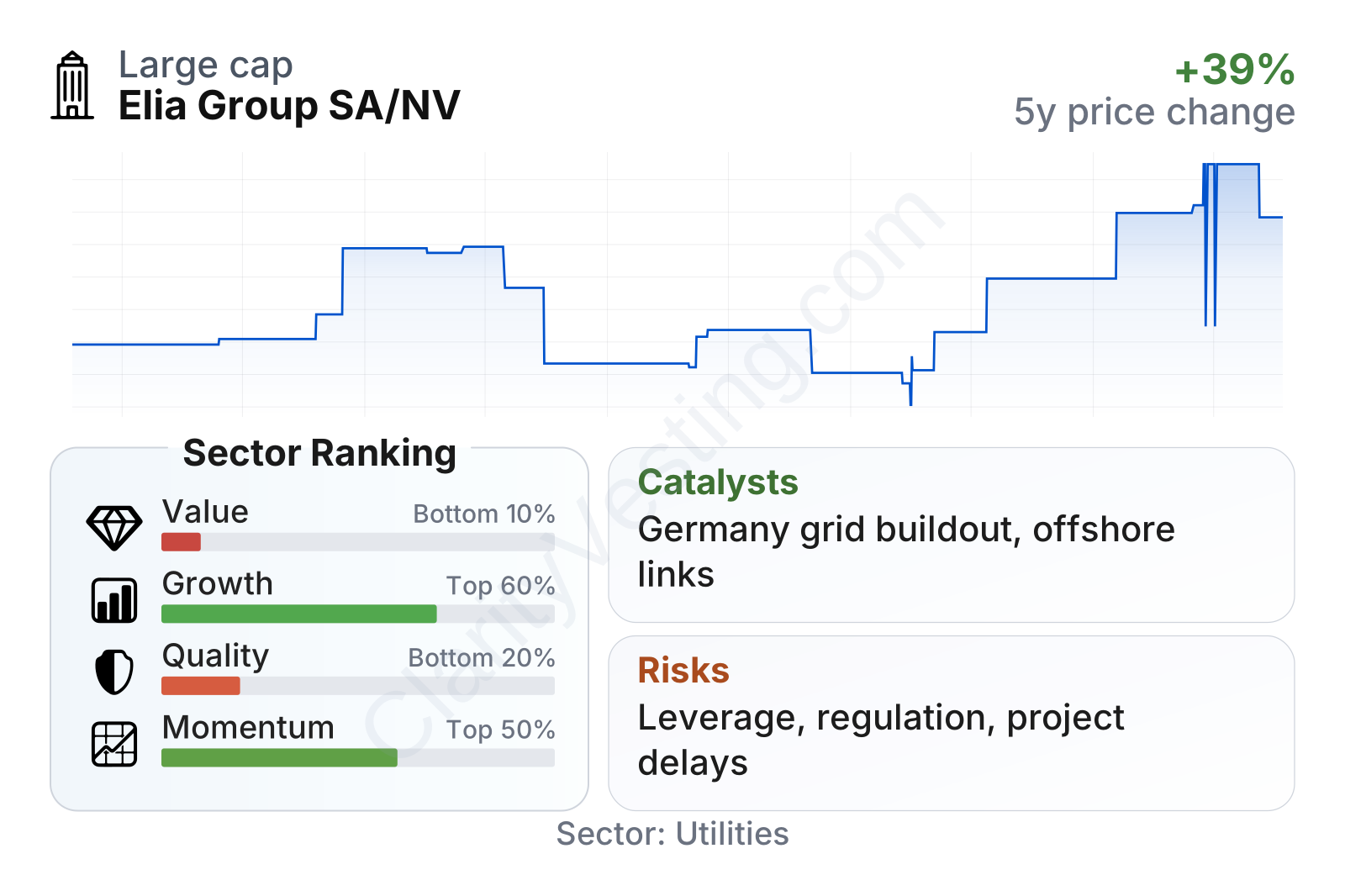
Elia Group sits in the larger end of the regulated utility universe and its share price has shown relatively low volatility, with a beta below 1. The recent market trend has been stronger than the sector over the last year, although the longer three-year share performance still trails the median utility peer. On valuation, the stock screens as expensive versus the sector on earnings, book value, and operating yield, while the dividend yield is clearly below the sector median. On business fundamentals, growth is mixed but not weak: recent revenue growth is ahead of many peers, yet longer-term earnings and book value trends are less favorable. Quality indicators are the soft spot, mainly because leverage is elevated and returns on capital remain below sector norms.
Growth
Elia Group operates in a part of the power industry that is structurally supported by long-term trends rather than short product cycles. Europe needs a much larger and smarter transmission grid to connect offshore wind, solar, industrial electrification, electric vehicles, heat pumps, batteries, and cross-border electricity trading. In that context, transmission owners are essential infrastructure providers. This gives Elia Group exposure to one of the clearest investment themes in European utilities: grids are becoming more valuable because decarbonization cannot happen without them.
The company’s strategy is broadly aligned with that opportunity. In both Belgium and Germany, the group is investing heavily to reinforce onshore grids, connect offshore renewable generation, and expand interconnections with neighboring markets. Germany is especially important. 50Hertz serves a region with high renewable penetration, so the need for new lines, system balancing, and transport capacity is substantial. Belgium also has a meaningful pipeline tied to offshore wind expansion and broader energy security needs.
Revenue per share has been uneven rather than steadily rising, which is a reminder that accounting revenue is not the cleanest way to judge a transmission operator. Even so, the broader direction of the business remains linked to a growing regulated asset base. For this kind of company, that is often the more relevant engine of future earnings than short-term fluctuations in reported sales.
A key catalyst is the scale of planned grid investment across Europe. Elia Group has repeatedly pointed to very large capital expenditure needs to support the energy transition, and regulators broadly recognize the necessity of these programs. If projects are approved on time and incorporated into the regulated asset base with acceptable returns, earnings capacity can expand over many years. Another supportive factor is that transmission networks are extremely difficult to replicate, so the growth opportunity tends to stay with incumbent operators rather than being competed away.
Recent company communications have also highlighted the strategic importance of transmission expansion in Germany and Belgium, including offshore development and cross-border projects. That does not remove execution risk, but it does reinforce that Elia Group is working on assets that policymakers consider critical for the region’s energy system.
Risks
This article is for informational purposes only and does not constitute financial advice. Some content is AI-generated. See Disclaimer


