Stock Analysis · Element Fleet Management Corp (ELEEF)
Overview
Element Fleet Management Corp is a fleet management company. In simple terms, it helps businesses outsource the work of running vehicle fleets: buying or leasing vehicles, financing them, handling maintenance and fuel programs, managing accidents and risk, and increasingly supporting electric vehicle transitions. Its customers are mainly large corporations, government entities, and other organizations that operate many vehicles and want lower costs, less administrative burden, and better control over their fleet.
The business model is more service- and finance-oriented than a traditional vehicle rental company. Element does not rely mainly on walk-in consumer rentals. Instead, it earns money by managing commercial fleets over long relationships, often combining financing income with recurring service fees tied to the number of vehicles under management.
Public filings show a revenue mix that is not always presented in a perfectly simple consumer-style breakdown, but the main economic sources can be summarized as follows:
- Net financing revenue: typically the largest earnings engine. This comes from lease-related financing and interest spread earned on assets and funding activities tied to client fleets.
- Service revenue and management fees: recurring fees for maintenance coordination, accident management, fuel programs, telematics-related support, registration, and other outsourced fleet services.
- Vehicle and end-of-lease related activity: gains, remarketing, and other income connected to vehicle disposals or lease terminations, usually a smaller and more variable contributor.
Because reporting formats can vary by period and accounting presentation, a precise percentage split is not always consistently comparable across all revenue lines. At a high level, Element’s economics are driven primarily by financing income and service-based fleet management revenue, with vehicle disposal-related contributions adding variability from year to year.
What stands out is that this is a scale business. The larger the managed fleet, the more useful Element becomes to clients and the more operating leverage it can extract from technology, procurement, and service networks.
The multi-year picture points to a business that has expanded meaningfully in revenue since 2021, while preserving a relatively high share of income after direct costs. At the same time, interest expense has become a more important item, which matters because Element’s model depends heavily on efficient funding.
Key Figures
| Metric | Value | Sector ⓘ |
|---|---|---|
| Date | Oct 24, 2026 | |
| Context | ||
| Sector | Industrials | |
| Industry | Rental & Leasing Services | |
| Market Cap ⓘ | $5.98B | |
| Beta ⓘ | 0.48 | |
Value (Cheapness) | ||
| P/E Ratio ⓘ | 20.42 | 22.29 |
| P/B Ratio ⓘ | 2.25 | 1.98 |
| FCF Yield ⓘ | 13.37% | 6.26% |
| Dividend Yield ⓘ | 2.64% | 1.92% |
| EBIT / EV ⓘ | 4.97% | 4.83% |
| PEG ⓘ | N/A | |
Growth (Business expansion) | ||
| Revenue Growth ⓘ | 7.70% | 9.30% |
| RPS Growth (5Y CAGR) ⓘ | 19.51% | 7.76% |
| EPS Growth (5Y CAGR) ⓘ | -16.79% | -13.17% |
| BVPS Growth (5Y CAGR) ⓘ | 4.25% | 6.13% |
| Margin Growth (5Y Trend) ⓘ | 8.61% | 0.74% |
| FCF Growth (5Y CAGR) ⓘ | N/A | 10.79% |
| DPS Growth (5Y CAGR) ⓘ | 11.82% | 9.41% |
Quality (Business durability) | ||
| ROIC (Latest) ⓘ | 3.90% | 10.75% |
| ROA (Latest) ⓘ | 2.11% | 5.41% |
| ROIC (5Y Median) ⓘ | 4.12% | 9.37% |
| ROA (5Y Median) ⓘ | 2.29% | 4.95% |
| Net Debt / EBIT (Latest) ⓘ | 11.30 | 2.04 |
| Net Debt / EBIT (5Y Median) ⓘ | 12.64 | 2.27 |
| Net Debt / EBITDA (Latest) ⓘ | 5.89 | 1.39 |
| Net Debt / Assets ⓘ | 67.23% | 19.27% |
| EBITDA / Interest ⓘ | 2.98 | 9.58 |
| Operating Margin (Latest) ⓘ | 33.46% | 10.49% |
| Operating Margin (5Y Median) ⓘ | 38.82% | 10.30% |
| Debt to Equity (Latest) ⓘ | 357.23% | 64.82% |
| Profit Margin (Latest) ⓘ | 11.98% | 6.67% |
| Free Cash Flow (Latest) ⓘ | $799.77M | |
Momentum (Price trend) | ||
| 3Y Return ⓘ | +17.66% | +67.77% |
| 12M Return (excl. last month) ⓘ | -34.31% | +12.05% |
| 6M Return ⓘ | -37.25% | 0.00% |
| Price vs. 200-Day MA ⓘ | -28.42% | +0.67% |
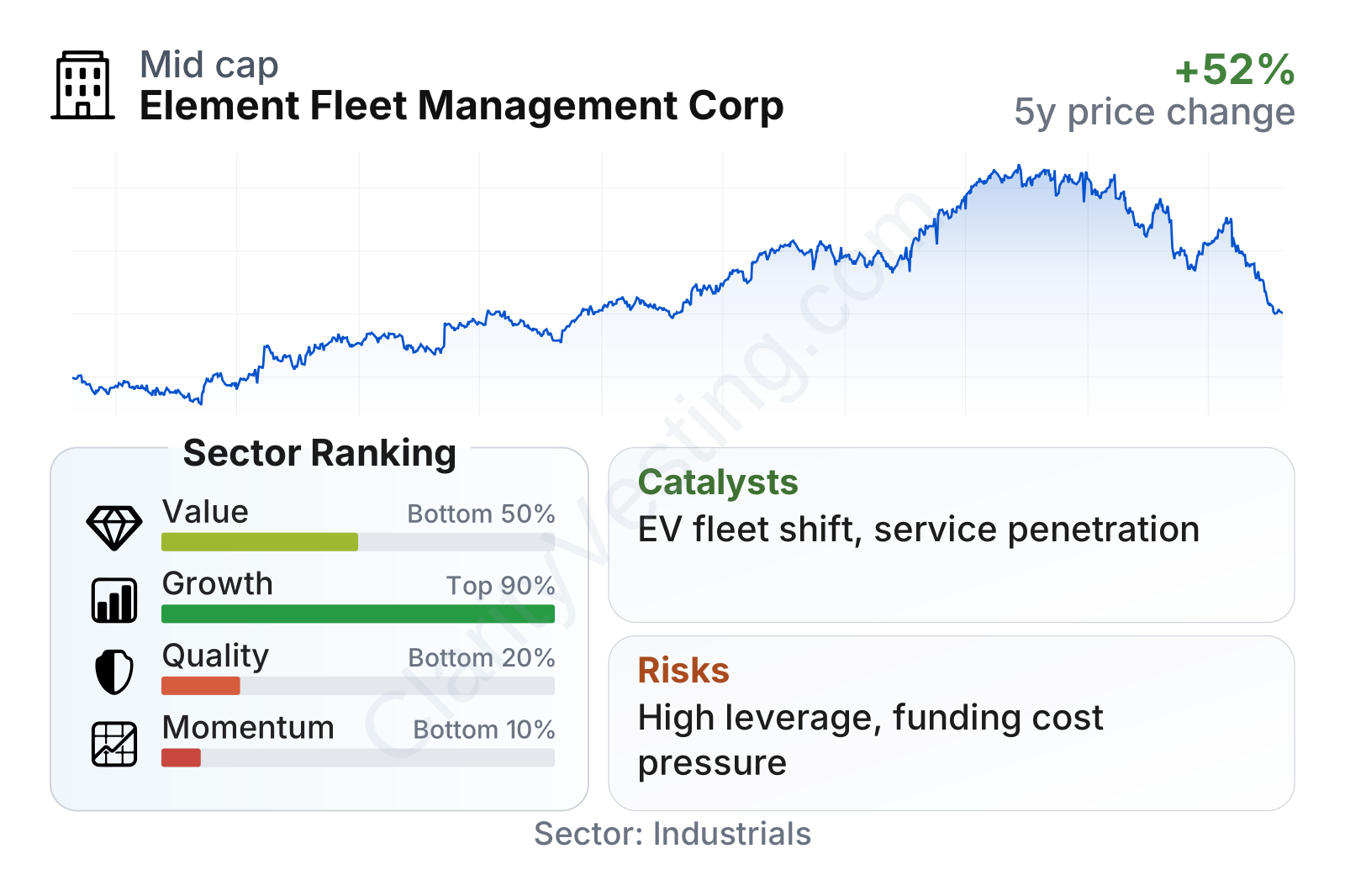
Element sits in the mid-cap range and has shown relatively low share-price volatility, with a beta well below 1. In the factor breakdown, growth metrics are strong versus the broader industrial sector, while quality and momentum look weaker. That combination suggests a company with solid business expansion and margin structure, but also with balance-sheet pressure and a stock that has recently lost market favor.
Valuation measures are near or below sector medians on several points, while free cash flow yield and dividend yield screen better than many peers. The weak momentum profile reflects a notable retreat from the 2025 highs even though the longer-term stock trend since 2021 is still positive overall.
Growth
Element operates in a part of the market with durable structural demand. Large organizations continue to outsource fleet administration because it reduces complexity, improves purchasing discipline, and gives access to better maintenance, fuel, safety, and resale processes. This tends to create sticky customer relationships. On top of that, fleets are becoming more complex as companies add telematics, emissions targets, and electric vehicles. That makes outsourced fleet expertise more valuable, not less.
The strategy also appears aligned with future demand. Element has emphasized customer retention, deeper service penetration, and technology-enabled fleet optimization rather than chasing growth at any cost. For a long-term business, that is generally more attractive than relying only on cyclical vehicle volumes.
Revenue growth has been uneven, which is not unusual for a company exposed to lease accounting effects, vehicle cycles, and interest-rate conditions. After a very strong expansion phase in 2022 and 2023, growth turned negative during much of 2024 before stabilizing and returning to modest positive territory in 2025 and 2026. The bigger takeaway is that the company’s five-year revenue-per-share growth has been far better than the sector median, even though the most recent year has been calmer.
Cash generation has also been volatile, but the latest direction is better than the trough period. Free cash flow moved from deeply negative levels to positive territory again, and the latest trailing figure in the metrics table is substantial. For Element, this is important because strong cash conversion supports debt servicing, dividends, and business flexibility.
A meaningful catalyst is fleet electrification. Companies with large fleets need help choosing vehicles, planning charging, controlling total cost of ownership, and managing the operational shift from internal combustion engines to EVs. Element already has the client relationships and fleet data needed to participate in that transition. Another favorable point is its North American scale, which can help it negotiate with OEMs, maintenance providers, and funding sources more effectively than smaller specialists.
Recent company communications have also pointed to ongoing capital return and continued focus on operational efficiency. That does not remove cyclicality, but it supports the view that management is trying to grow through better client economics, not just bigger asset balances.
Risks
This article is for informational purposes only and does not constitute financial advice. Some content is AI-generated. See Disclaimer


