Stock Analysis · El Al Israel Airlines Ltd (ELALF)
Overview
El Al Israel Airlines Ltd is Israel’s flag carrier and one of the country’s most important transportation companies. It operates passenger flights, cargo services, and related travel activities, connecting Israel with destinations in Europe, North America, Asia, and nearby regions. The company’s role is broader than that of a typical airline because it also carries strategic importance for Israel’s connectivity during periods when foreign airlines reduce or suspend service.
Like most airlines, El Al’s revenue is driven mainly by ticket sales, with additional contributions from freight and ancillary services. Based on the company’s recent annual reporting and management disclosures, the revenue mix is centered on air transportation activity.
- Passenger revenue: approximately 80% to 90% of total revenue. This includes economy, premium economy, and business-class ticket sales on scheduled flights, plus related passenger fees.
- Cargo revenue: approximately 10% to 20% of total revenue. This covers freight carried both on dedicated capacity and in the belly space of passenger aircraft.
- Other revenue: generally a small share of total revenue. This includes items such as loyalty-related activity, maintenance or service-related income, and other travel-linked fees where applicable.
Recent results show a company that has become much larger and more profitable than it was just a few years ago. Revenue has climbed from under $1 billion in 2021 to well above $3 billion in 2025, while profitability has improved sharply after the pandemic recovery and a period of unusually favorable industry conditions for El Al. Costs still absorb most of revenue, as is normal in the airline business, but the gap between sales and operating profit widened meaningfully in 2024 and 2025.
The operating picture improved dramatically from heavy losses in 2021 to strong positive earnings and cash generation more recently. The most notable change is not just higher sales, but also much stronger gross profit and lower interest burden relative to revenue, which helped turn the business into a meaningful cash producer.
Key Figures
| Metric | Value | Sector ⓘ |
|---|---|---|
| Date | Oct 24, 2026 | |
| Context | ||
| Sector | Industrials | |
| Industry | Airlines | |
| Market Cap ⓘ | $3.69B | |
| Beta ⓘ | 0.24 | |
Value (Cheapness) | ||
| P/E Ratio ⓘ | 11.98 | 22.29 |
| P/B Ratio ⓘ | 3.48 | 1.98 |
| FCF Yield ⓘ | 8.24% | 6.26% |
| Dividend Yield ⓘ | 2.87% | 1.92% |
| EBIT / EV ⓘ | 16.88% | 4.83% |
| PEG ⓘ | N/A | |
Growth (Business expansion) | ||
| Revenue Growth ⓘ | 27.00% | 9.30% |
| RPS Growth (5Y CAGR) ⓘ | 11.99% | 7.76% |
| EPS Growth (5Y CAGR) ⓘ | N/A | -13.17% |
| BVPS Growth (5Y CAGR) ⓘ | N/A | 6.13% |
| Margin Growth (5Y Trend) ⓘ | 51.64% | 0.74% |
| FCF Growth (5Y CAGR) ⓘ | N/A | 10.79% |
| DPS Growth (5Y CAGR) ⓘ | 14.46% | 9.41% |
Quality (Business durability) | ||
| ROIC (Latest) ⓘ | 17.57% | 10.75% |
| ROA (Latest) ⓘ | 5.87% | 5.41% |
| ROIC (5Y Median) ⓘ | 26.54% | 9.37% |
| ROA (5Y Median) ⓘ | 3.60% | 4.95% |
| Net Debt / EBIT (Latest) ⓘ | 0.79 | 2.04 |
| Net Debt / EBIT (5Y Median) ⓘ | 3.64 | 2.27 |
| Net Debt / EBITDA (Latest) ⓘ | 0.47 | 1.39 |
| Net Debt / Assets ⓘ | 5.81% | 19.27% |
| EBITDA / Interest ⓘ | N/A | 9.58 |
| Operating Margin (Latest) ⓘ | 11.92% | 10.49% |
| Operating Margin (5Y Median) ⓘ | 10.11% | 10.30% |
| Debt to Equity (Latest) ⓘ | 105.21% | 64.82% |
| Profit Margin (Latest) ⓘ | 8.80% | 6.67% |
| Free Cash Flow (Latest) ⓘ | $303.83M | |
Momentum (Price trend) | ||
| 3Y Return ⓘ | +545.53% | +67.77% |
| 12M Return (excl. last month) ⓘ | +44.71% | +12.05% |
| 6M Return ⓘ | +12.66% | 0.00% |
| Price vs. 200-Day MA ⓘ | +22.22% | +0.67% |
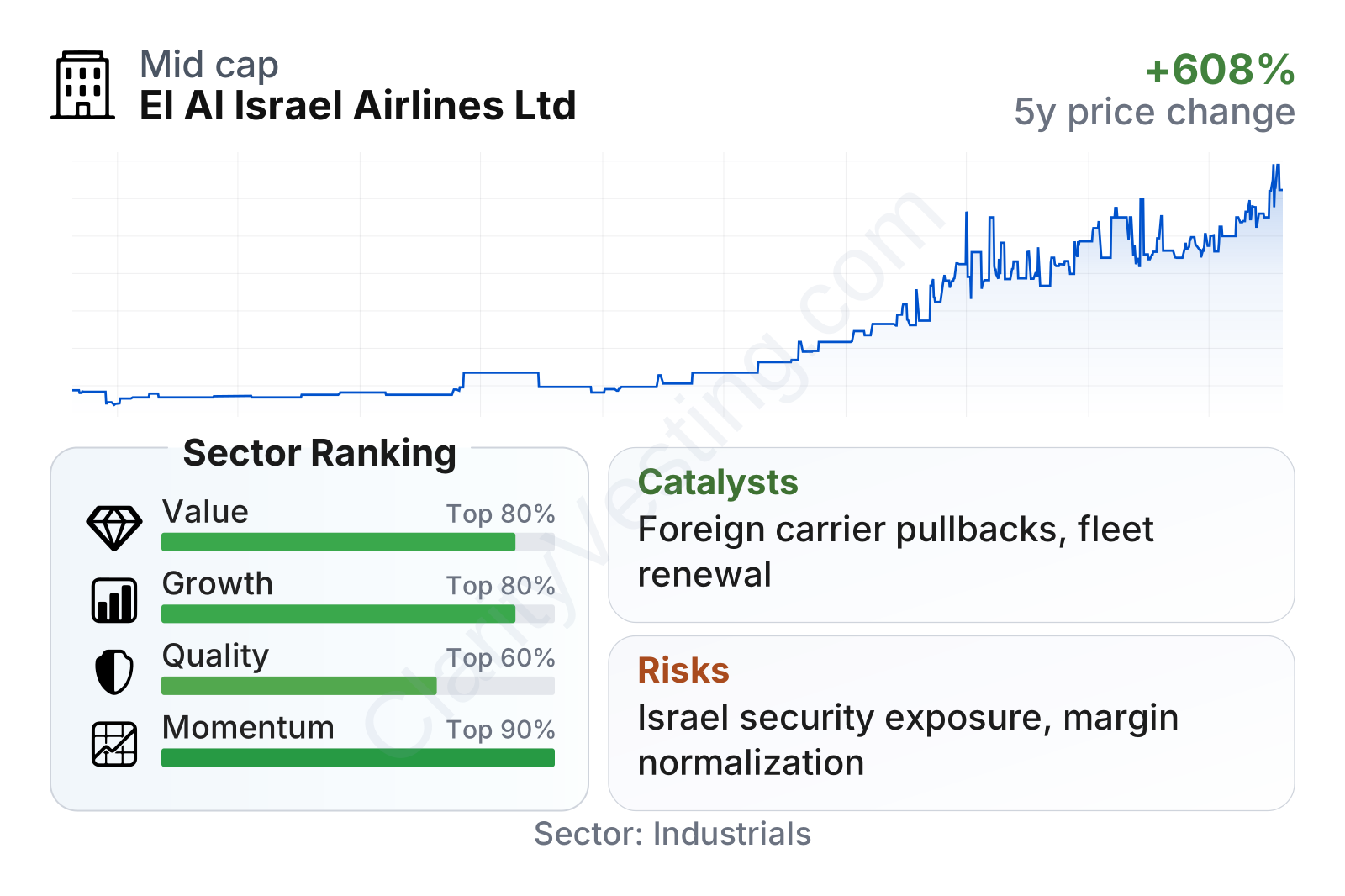
El Al is now a mid-sized public company by market value, and its latest factor profile is unusually strong for an airline. On valuation measures, it screens better than much of the sector, helped by a price-to-earnings ratio around 11 versus a sector median above 22 and a free cash flow yield above the industry median. Growth and momentum also rank well, reflecting strong recent business performance and a major re-rating in the stock over the last three years. Quality is more mixed: returns on invested capital and net debt relative to earnings look solid, but leverage compared with equity remains elevated for the sector.
Growth
The airline industry is structurally tied to long-term growth in travel demand, tourism, migration, and business connectivity, but it is not a smooth growth sector in the way software or medical devices can be. Demand can rise over time, yet results are often shaped by fuel prices, geopolitics, and shifts in available capacity. For El Al, the more important question is not whether global air travel grows, but whether Israel-bound air traffic remains undersupplied and whether the company can keep its seat capacity and pricing power in place.
El Al’s recent strategy appears coherent for its position. The company has been refreshing parts of its fleet, expanding and optimizing routes, strengthening premium and transatlantic offerings, and using its home-market importance to capture demand when foreign competitors scale back. Its Matmid frequent-flyer ecosystem and strong brand recognition in Israel also support repeat demand, especially among customers who prioritize nonstop service and an Israeli carrier.
Growth has been exceptionally strong since the pandemic recovery, with annual revenue expansion far ahead of the broader sector over the last few years. That said, the quarterly pattern shows that growth rates have started to normalize. After a very strong 2024, 2025 moved closer to flat-to-moderate expansion in some periods, which suggests the business is now cycling past a very favorable comparison base rather than entering a new phase of explosive demand.
Cash generation is one of the most important positives in the current profile. Free cash flow expanded sharply through 2025, showing that recent profits were not just accounting-based. For an airline, that matters because fleet spending, debt service, and periodic shocks can consume cash quickly. Stronger cash production gives El Al more room to reduce leverage, fund fleet investments, and absorb volatility.
A major catalyst is the company’s unusual positioning on routes to and from Israel. In periods when international carriers limit operations because of security concerns, El Al can gain market share, improve load factors, and maintain firmer pricing. Another potential support is continued normalization in tourism and business travel if regional conditions become more stable while capacity remains disciplined. Recent company communications and public disclosures also point to continued operational focus on fleet modernization and route economics, which can help margins over time if demand remains healthy.
Risks
This article is for informational purposes only and does not constitute financial advice. Some content is AI-generated. See Disclaimer


