Stock Analysis · Estee Lauder Companies Inc (EL)
Overview
Estée Lauder Companies is a global beauty business focused on prestige products rather than mass-market cosmetics. Its portfolio includes skin care, makeup, fragrance, and hair care sold through department stores, specialty beauty retailers, travel retail, brand websites, and selected pharmacies. The group owns a large stable of brands, including Estée Lauder, Clinique, M·A·C, La Mer, Bobbi Brown, Jo Malone London, Aveda, and The Ordinary through DECIEM.
The company’s revenue mix is led by skin care, which has historically been its largest category, followed by makeup, fragrance, and hair care. Based on the latest annual company reporting, the business can be summarized approximately as follows:
- Skin care: about 52% of sales. This includes moisturizers, serums, cleansers, masks, and treatment products across brands such as Estée Lauder, La Mer, Clinique, Origins, and Dr.Jart+.
- Makeup: about 28% of sales. This covers foundation, lipstick, eye products, and related cosmetics led by M·A·C, Estée Lauder, Bobbi Brown, Clinique, and Too Faced.
- Fragrance: about 15% of sales. This includes designer and luxury fragrances such as Jo Malone London, Le Labo, Tom Ford Beauty fragrance lines, and brand extensions from Estée Lauder and Clinique.
- Hair care: about 5% of sales. This is mainly Aveda and Bumble and bumble products.
Geographically, Estée Lauder is widely diversified across the Americas, Europe, the Middle East & Africa, and Asia/Pacific, but its results in recent years have been heavily influenced by travel retail in Asia and demand conditions in mainland China. That concentration matters because these channels were central to both the company’s earlier growth and its later slowdown.
The business model still shows the appeal of prestige beauty: gross margins remain high because consumers pay for branding, formulation, packaging, and perceived efficacy. At the same time, the company’s expense base is large, especially in advertising, merchandising, retail support, and corporate overhead. Over the last several years, revenue declined from the 2022 peak, while selling and administrative costs remained stubbornly high, which sharply compressed operating profit and net income before showing signs of stabilization in 2026.
The long-term picture is therefore mixed. Estée Lauder remains a major global beauty franchise with premium positioning, but the gap between strong brand economics and weaker recent execution is the central issue to watch.
Key Figures
| Metric | Value | Sector ⓘ |
|---|---|---|
| Date | Nov 06, 2026 | |
| Context | ||
| Sector | Consumer Defensive | |
| Industry | Household & Personal Products | |
| Market Cap ⓘ | $39.00B | |
| Beta ⓘ | 1.23 | |
Value (Cheapness) | ||
| P/E Ratio ⓘ | 112.14 | 18.58 |
| P/B Ratio ⓘ | 9.76 | 1.17 |
| FCF Yield ⓘ | 3.89% | 12.24% |
| Dividend Yield ⓘ | 1.25% | 2.75% |
| EBIT / EV ⓘ | 2.33% | 6.40% |
| PEG ⓘ | 2.12 | |
Growth (Business expansion) | ||
| Revenue Growth ⓘ | 6.70% | 4.10% |
| RPS Growth (5Y CAGR) ⓘ | -4.02% | 6.18% |
| EPS Growth (5Y CAGR) ⓘ | -38.23% | -12.34% |
| BVPS Growth (5Y CAGR) ⓘ | -9.16% | 3.13% |
| Margin Growth (5Y Trend) ⓘ | -12.40% | -0.27% |
| FCF Growth (5Y CAGR) ⓘ | -9.93% | 4.65% |
| DPS Growth (5Y CAGR) ⓘ | -11.81% | 6.56% |
Quality (Business durability) | ||
| ROIC (Latest) ⓘ | 5.36% | 11.79% |
| ROA (Latest) ⓘ | 1.86% | 6.30% |
| ROIC (5Y Median) ⓘ | 4.55% | 10.51% |
| ROA (5Y Median) ⓘ | 1.73% | 5.44% |
| Net Debt / EBIT (Latest) ⓘ | 5.54 | 1.94 |
| Net Debt / EBIT (5Y Median) ⓘ | 4.65 | 2.32 |
| Net Debt / EBITDA (Latest) ⓘ | 3.21 | 1.37 |
| Net Debt / Assets ⓘ | 30.07% | 20.45% |
| EBITDA / Interest ⓘ | 5.65 | 9.75 |
| Operating Margin (Latest) ⓘ | 7.09% | 8.88% |
| Operating Margin (5Y Median) ⓘ | 7.37% | 9.57% |
| Debt to Equity (Latest) ⓘ | 227.84% | 70.87% |
| Profit Margin (Latest) ⓘ | 2.41% | 5.40% |
| Free Cash Flow (Latest) ⓘ | $1.52B | |
Momentum (Price trend) | ||
| 3Y Return ⓘ | +0.95% | +18.58% |
| 12M Return (excl. last month) ⓘ | +6.80% | +1.75% |
| 6M Return ⓘ | +25.11% | +2.80% |
| Price vs. 200-Day MA ⓘ | +18.33% | +2.96% |
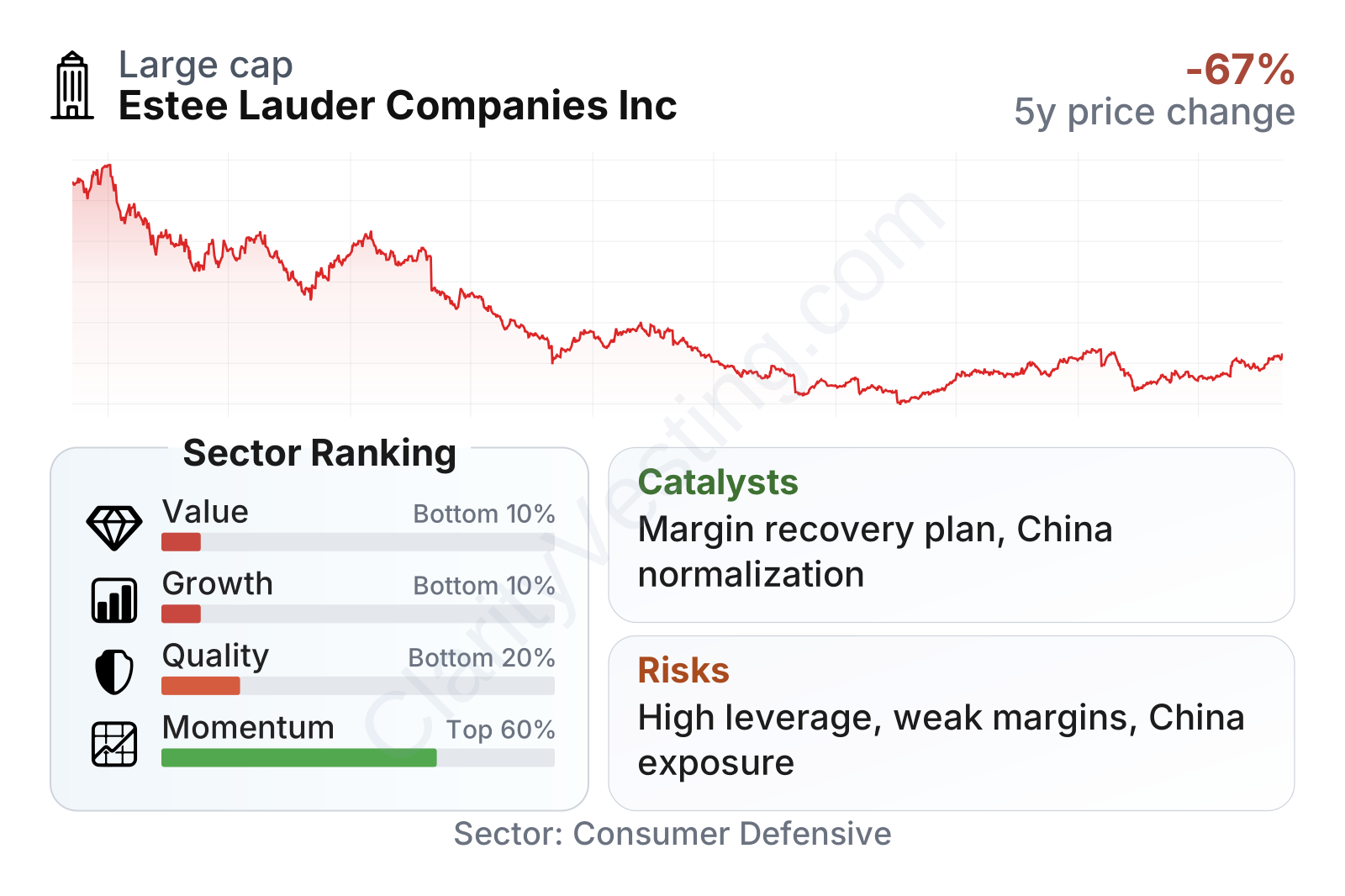
Estée Lauder is still a large global company, but the current financial profile looks weaker than what many consumers might expect from such a well-known beauty group. On relative measures, valuation sits near the bottom of the sector ranking, meaning the stock trades at much richer multiples than most peers despite reduced profitability. Quality and growth indicators also rank in the lower part of the sector because returns on capital, margin levels, and multi-year growth trends have deteriorated. One area that has improved is share-price momentum over the last several months, suggesting the market has started to price in a possible recovery even though the underlying fundamentals are not yet fully repaired.
Growth
Prestige beauty remains an attractive category over the long run. Demand is supported by recurring product use, premiumization, rising interest in skincare routines, and global beauty consumption growth, especially in digital channels and parts of Asia. Within that broader market, Estée Lauder has real exposure to higher-end skin care and fragrance, two categories that can grow faster than the wider personal care industry when consumer sentiment is healthy.
The company’s strategy for renewed growth is centered on a few practical levers: rebuilding momentum in travel retail, improving execution in mainland China, expanding online and specialty retail distribution, and cutting costs through its profit recovery plan. The logic makes sense. Estée Lauder does not need to invent a new category to recover; it needs to restore sales productivity in channels where it was already strong and improve cost discipline after several years of disappointing operating leverage.
Recent revenue trends suggest the business has moved out of its weakest phase. Year-over-year sales growth turned positive again and has recently been running in the mid-single-digit range. That is a meaningful change after a long stretch of declines. It does not yet prove a full turnaround, but it indicates that demand and channel inventory conditions are becoming less hostile.
Cash generation has also improved from the low point. Free cash flow turned deeply negative during the downturn, then recovered back into positive territory and now stands above $1 billion on a trailing basis. That recovery matters because it gives the company more flexibility to fund restructuring, maintain brand investment, and manage debt without relying purely on accounting earnings.
A notable catalyst is the company’s restructuring and profit recovery program, which management has framed around simplifying the organization and lowering costs. If that plan produces lasting savings while sales continue to recover, earnings could improve faster than revenue. Another opportunity comes from prestige fragrance and hero skin care lines, where brand strength tends to support pricing power better than in more promotional categories.
Recent company communications have also emphasized stronger performance in select developed markets and online channels, along with ongoing efforts to reset inventory and improve regional execution. For a business that suffered from channel disruption and overexposure to specific geographies, even a return to steadier, more balanced growth would be a meaningful step forward.
Risks
This article is for informational purposes only and does not constitute financial advice. Some content is AI-generated. See Disclaimer