Stock Analysis · easyJet plc (EJTTF)
Overview
easyJet plc is a European low-cost airline. Its core business is carrying short-haul passengers across Europe and between Europe and nearby leisure destinations. The group also sells related travel services, especially holidays, using its airline network as the backbone. In simple terms, easyJet tries to fill a large number of seats, keep aircraft in frequent use, and add extra revenue from services attached to each trip.
The business is still mainly an airline, but it is no longer only an airline. Based on the company’s recent annual reporting structure, revenue comes primarily from ticket sales and then from additional airline products such as baggage, seat selection, onboard services, and other fees. A smaller but growing contribution comes from easyJet holidays, which packages flights with hotels and other travel services.
- Passenger ticket revenue: approximately 60% to 70% of total revenue. This is the base airfare paid for seats on easyJet flights.
- Ancillary revenue: approximately 20% to 30%. This includes baggage fees, seat assignment, onboard sales, and other optional travel-related charges.
- easyJet holidays and other non-ticket activity: approximately 10% to 15%. This mainly includes package holidays built around the airline’s route network.
That mix matters for long-term analysis because airline tickets are typically low-margin, while extras and holiday packages can improve profitability if they scale well. Over the last few years, easyJet has also shown a strong rebound in revenue and earnings after the pandemic disruption, with total revenue rising from about £5.8 billion in fiscal 2022 to about £13.6 billion in fiscal 2025, while net income moved from a loss to a meaningful profit. That points to a business that has recovered demand and improved operating leverage, even though airlines remain cyclical by nature.
The multi-year operating picture shows a clear recovery: revenue expanded sharply from 2022 through 2025, operating income turned positive, and net profit improved materially. It also shows a familiar airline pattern: very large direct operating costs absorb most revenue, so even solid sales growth can still leave margins sensitive to fuel, labor, and disruption.
Key Figures
| Metric | Value | Sector ⓘ |
|---|---|---|
| Date | Oct 17, 2026 | |
| Context | ||
| Sector | Industrials | |
| Industry | Airlines | |
| Market Cap ⓘ | $6.65B | |
| Beta ⓘ | 1.67 | |
Value (Cheapness) | ||
| P/E Ratio ⓘ | 12.18 | 22.10 |
| P/B Ratio ⓘ | 1.83 | 1.97 |
| FCF Yield ⓘ | 18.05% | 6.38% |
| Dividend Yield ⓘ | 1.48% | 1.94% |
| EBIT / EV ⓘ | N/A | 4.79% |
| PEG ⓘ | 3.06 | |
Growth (Business expansion) | ||
| Revenue Growth ⓘ | 11.90% | 9.30% |
| RPS Growth (5Y CAGR) ⓘ | 60.12% | 7.81% |
| EPS Growth (5Y CAGR) ⓘ | N/A | -13.06% |
| BVPS Growth (5Y CAGR) ⓘ | -1.66% | 6.14% |
| Margin Growth (5Y Trend) ⓘ | 71.03% | 0.88% |
| FCF Growth (5Y CAGR) ⓘ | N/A | 11.01% |
| DPS Growth (5Y CAGR) ⓘ | -12.51% | 9.48% |
Quality (Business durability) | ||
| ROIC (Latest) ⓘ | 20.82% | 10.84% |
| ROA (Latest) ⓘ | 8.37% | 5.41% |
| ROIC (5Y Median) ⓘ | 11.29% | 9.38% |
| ROA (5Y Median) ⓘ | 3.19% | 4.95% |
| Net Debt / EBIT (Latest) ⓘ | 0.57 | 2.08 |
| Net Debt / EBIT (5Y Median) ⓘ | 1.30 | 2.27 |
| Net Debt / EBITDA (Latest) ⓘ | 0.25 | 1.39 |
| Net Debt / Assets ⓘ | 5.68% | 19.28% |
| EBITDA / Interest ⓘ | 9.73 | 9.58 |
| Operating Margin (Latest) ⓘ | 5.34% | 10.50% |
| Operating Margin (5Y Median) ⓘ | 7.48% | 10.29% |
| Debt to Equity (Latest) ⓘ | 82.36% | 65.48% |
| Profit Margin (Latest) ⓘ | 3.93% | 6.67% |
| Free Cash Flow (Latest) ⓘ | $1.20B | |
Momentum (Price trend) | ||
| 3Y Return ⓘ | +75.08% | +61.68% |
| 12M Return (excl. last month) ⓘ | +32.77% | +12.58% |
| 6M Return ⓘ | +93.68% | 0.00% |
| Price vs. 200-Day MA ⓘ | +32.04% | +0.02% |
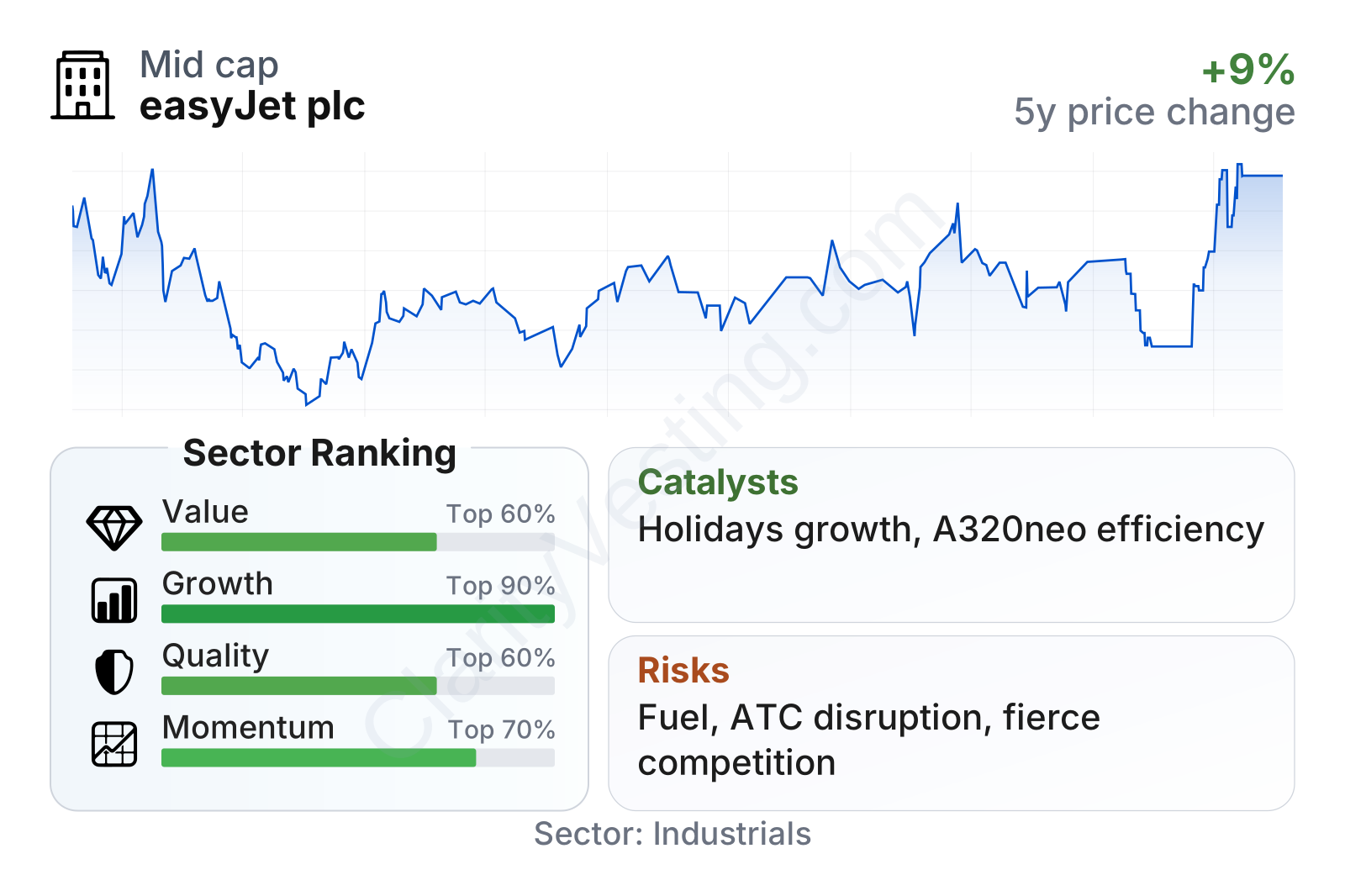
easyJet currently sits in the stronger part of the airline sector on growth, with revenue growth ahead of the sector median and a sharp improvement in operating margin over the last five years. Profitability quality is more mixed: returns on capital and assets are solid relative to peers, and leverage looks controlled with low net debt compared with earnings, but operating and net margins remain below sector medians. The valuation profile looks moderate rather than stretched, helped by a low earnings multiple and strong free cash flow yield. Share price momentum has also been strong, which suggests the market has recently become more constructive on the recovery and earnings outlook.
Growth
easyJet operates in a sector that still has long-term demand drivers, even if it is not a straight-line growth industry. European short-haul air travel benefits from tourism, visiting friends and relatives, and cross-border mobility inside Europe. Low-cost carriers have also continued to take share in many markets because price remains a major factor for travelers. That broader backdrop supports easyJet’s model, especially when consumers look for lower fares but still want direct flights from primary or well-known airports.
The company’s strategy makes sense if viewed as a combination of disciplined airline expansion and higher-value add-ons. easyJet has been using its route network to support easyJet holidays, which is important because package travel can earn better margins than a standalone seat. This gives the group another avenue for profit growth beyond simply adding more passengers. Fleet modernization is another useful pillar. The company has continued adding Airbus A320neo family aircraft, which are designed to improve fuel efficiency and lower unit costs over time.
One of the strongest catalysts is the continued scaling of easyJet holidays. This business uses the airline’s existing customer traffic, airports, and digital booking channels, which can create cross-selling benefits without requiring a completely separate infrastructure. Another catalyst is cost efficiency from newer aircraft and network optimization. If these gains continue while travel demand remains resilient, earnings can improve faster than revenue.
Recent company updates have also pointed to sustained customer demand for leisure travel and network expansion at selected bases. easyJet has been active in reallocating capacity toward stronger-performing routes and markets, which is especially important in Europe where conditions can vary significantly by country and airport. For a long-term view, the most notable opportunity is that easyJet still has room to increase profit per customer, not only customer volume.
Risks
This article is for informational purposes only and does not constitute financial advice. Some content is AI-generated. See Disclaimer


