Stock Analysis · Energy Resources of Australia Ltd (EGRAF)
Overview
Energy Resources of Australia Ltd is an Australian uranium company best known for the Ranger mine in the Northern Territory. Ranger stopped production several years ago, so the business is no longer operating as a conventional uranium producer. Today, the company’s main role is site rehabilitation and closure work at Ranger, alongside managing its remaining mineral interests and financial obligations. In practical terms, this means the company is spending heavily to restore and secure a former mining area rather than generating meaningful income from ongoing extraction.
That distinction matters for long-term analysis: EGRAF is tied to the uranium industry, but its economics currently look much more like a rehabilitation and liability management case than a growth-stage miner.
Recent annual reporting shows revenue is now very limited and irregular. The available public disclosures indicate that the business has only a small amount of operating revenue left, with the overwhelming majority of its financial profile driven by rehabilitation funding, closure costs, provisions, and balance-sheet movements rather than normal sales of uranium.
The revenue mix is therefore unusually narrow:
- Residual operating and other revenue: nearly 100% — This appears to consist mainly of minor remaining receipts and accounting items rather than material uranium sales.
- Uranium product sales: approximately 0% — Ranger is no longer producing, so this historical source of revenue is effectively absent.
This makes EGRAF very different from most listed uranium names. It still belongs to a sector with long-term strategic importance, but the company itself is not currently capturing that theme through active production growth.
The financial flow over recent years shows a sharp collapse in revenue from earlier periods and continuing losses driven by very large non-operating and rehabilitation-related charges. Even when accounting effects temporarily improved operating income, the business still remained under pressure because cash generation and profitability were weak relative to its obligations.
Key Figures
| Metric | Value | Sector ⓘ |
|---|---|---|
| Date | Oct 17, 2026 | |
| Context | ||
| Sector | Energy | |
| Industry | Uranium | |
| Market Cap ⓘ | $2.27B | |
| Beta ⓘ | 1.11 | |
Value (Cheapness) | ||
| P/E Ratio ⓘ | N/A | 15.44 |
| P/B Ratio ⓘ | N/A | 1.73 |
| FCF Yield ⓘ | -16.95% | 8.20% |
| Dividend Yield ⓘ | N/A | 3.59% |
| EBIT / EV ⓘ | N/A | 7.46% |
| PEG ⓘ | N/A | |
Growth (Business expansion) | ||
| Revenue Growth ⓘ | -20.60% | 26.90% |
| RPS Growth (5Y CAGR) ⓘ | -89.41% | 6.90% |
| EPS Growth (5Y CAGR) ⓘ | -81.35% | -15.73% |
| BVPS Growth (5Y CAGR) ⓘ | -24.41% | 6.07% |
| Margin Growth (5Y Trend) ⓘ | N/A | 0.58% |
| FCF Growth (5Y CAGR) ⓘ | N/A | 1.86% |
| DPS Growth (5Y CAGR) ⓘ | -37.87% | 16.79% |
Quality (Business durability) | ||
| ROIC (Latest) ⓘ | N/A | 11.40% |
| ROA (Latest) ⓘ | -29.87% | 6.06% |
| ROIC (5Y Median) ⓘ | N/A | 10.30% |
| ROA (5Y Median) ⓘ | -22.63% | 5.42% |
| Net Debt / EBIT (Latest) ⓘ | N/A | 1.64 |
| Net Debt / EBIT (5Y Median) ⓘ | N/A | 1.83 |
| Net Debt / EBITDA (Latest) ⓘ | N/A | 1.08 |
| Net Debt / Assets ⓘ | -27.12% | 17.29% |
| EBITDA / Interest ⓘ | N/A | 9.64 |
| Operating Margin (Latest) ⓘ | -232.76% | 16.27% |
| Operating Margin (5Y Median) ⓘ | -312.36% | 20.39% |
| Debt to Equity (Latest) ⓘ | N/A | 54.76% |
| Profit Margin (Latest) ⓘ | N/A | 8.82% |
| Free Cash Flow (Latest) ⓘ | -$384.87M | |
Momentum (Price trend) | ||
| 3Y Return ⓘ | -77.60% | +67.38% |
| 12M Return (excl. last month) ⓘ | +493.33% | +49.19% |
| 6M Return ⓘ | +86.67% | +7.07% |
| Price vs. 200-Day MA ⓘ | -31.46% | +9.56% |
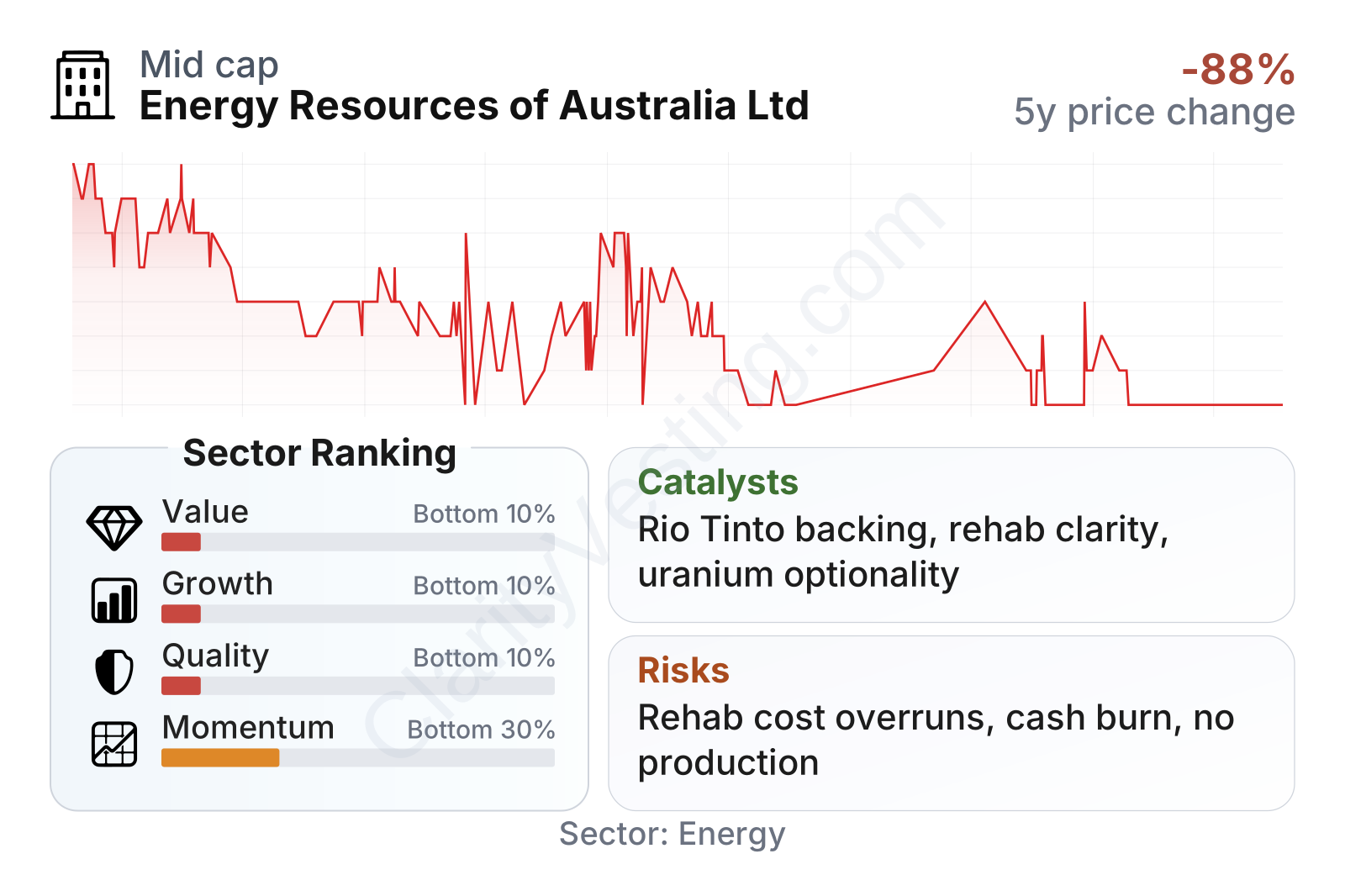
The market profile is that of a mid-sized company by quoted equity value, but the operating fundamentals rank near the bottom of the broader energy sector on value, growth, and quality measures. Revenue has been shrinking, margins are deeply negative, and free cash flow remains significantly negative. Return on assets is also sharply below sector norms, reflecting a business that is consuming capital rather than earning attractive returns from productive operations.
The balance sheet has one unusual feature that looks better than the income statement: net debt metrics benefit from a sizable cash position relative to debt, which is common when a company has raised or retained funding for large future rehabilitation needs. That is helpful for liquidity, but it does not offset the underlying issue that the company is not currently running a strong cash-producing asset base.
Share-price behavior has also been highly unstable. The stock has fallen dramatically over the last three years despite periods of sharp short-term rebounds. That pattern usually points to event-driven trading rather than steady confidence in the operating outlook.
Growth
Uranium as a sector still has long-term support. Governments in many regions continue to view nuclear power as a reliable low-carbon electricity source, and that creates a constructive backdrop for uranium demand over time. In that sense, EGRAF operates in an industry with strategic relevance.
The problem is that sector growth does not automatically translate into company growth. Energy Resources of Australia is not currently positioned like an expanding uranium producer with rising output, reserve conversion, or visible project development milestones. Its core strategic task remains rehabilitation of Ranger. That work is important and necessary, but it is not the same as building a larger earnings base.
The main future catalyst is therefore not higher production, but improved clarity around liabilities, funding, and any remaining asset optionality. If rehabilitation execution progresses well, cost certainty improves, and residual mineral interests retain value, market perception can change materially. A stronger uranium market can also increase interest in any company connected to the fuel cycle, especially one with established mining history and strategic land position.
Another point to watch is support from major shareholder Rio Tinto, which has historically played a central role in funding and oversight. Continued backing can reduce near-term financing uncertainty and gives the company more capacity to complete its obligations. For EGRAF, that kind of support is more important than a traditional production catalyst.
Risks
This article is for informational purposes only and does not constitute financial advice. Some content is AI-generated. See Disclaimer


