Stock Analysis · Eagle Bancorp Inc (EGBN)
Overview
Eagle Bancorp Inc. is the holding company for EagleBank, a regional bank centered on the Washington, D.C. metropolitan area. It provides traditional banking services to businesses, real estate investors, professionals, and consumers. In simple terms, the bank gathers deposits from customers, lends that money out at higher rates, and also earns fees from related banking services.
Its business is still mainly a classic community and commercial bank model, with a strong emphasis on commercial real estate, commercial lending, and relationship-based banking in its local market. That makes Eagle Bancorp much more tied to local economic conditions, credit quality, and interest-rate trends than a large national bank with broad product diversification.
The main revenue sources are typically organized this way for Eagle Bancorp:
- Net interest income: approximately 80% to 90% of total revenue in most periods. This is the spread between interest earned on loans and securities and interest paid on deposits and borrowings.
- Noninterest income: approximately 10% to 20% of total revenue. This usually includes service charges on deposits, gains on loan sales if any, wealth or treasury-related fees, and other banking service income.
On the asset side, the loan book is the core engine of the company, and commercial real estate has historically been the largest lending category. Construction and development loans, commercial and industrial loans, and consumer lending are also part of the mix, but they are smaller than the commercial real estate exposure. On the funding side, customer deposits are the main source used to support lending activity.
The recent financial flow shows a business that has kept generating sizable revenue, but rising funding costs and weaker profitability have put pressure on earnings. Revenue expanded sharply between 2021 and 2024, yet that did not translate into better bottom-line results because interest expense and operating pressure climbed much faster.
Key Figures
| Metric | Value | Sector ⓘ |
|---|---|---|
| Date | Oct 31, 2026 | |
| Context | ||
| Sector | Financial Services | |
| Industry | Banks - Regional | |
| Market Cap ⓘ | $1.02B | |
| Beta ⓘ | 0.97 | |
Value (Cheapness) | ||
| P/E Ratio ⓘ | N/A | 12.20 |
| P/B Ratio ⓘ | 0.89 | 1.26 |
| FCF Yield ⓘ | 5.18% | 9.87% |
| Dividend Yield ⓘ | 0.12% | 2.87% |
| EBIT / EV ⓘ | N/A | 8.17% |
| PEG ⓘ | 1.71 | |
Growth (Business expansion) | ||
| Revenue Growth ⓘ | 35.30% | 8.40% |
| RPS Growth (5Y CAGR) ⓘ | 13.47% | 12.31% |
| EPS Growth (5Y CAGR) ⓘ | -27.28% | -4.03% |
| BVPS Growth (5Y CAGR) ⓘ | -2.76% | 4.96% |
| Margin Growth (5Y Trend) ⓘ | -85.59% | -4.14% |
| FCF Growth (5Y CAGR) ⓘ | -45.44% | 4.70% |
| DPS Growth (5Y CAGR) ⓘ | -22.40% | 8.85% |
Quality (Business durability) | ||
| ROIC (Latest) ⓘ | N/A | 9.35% |
| ROE (Latest) ⓘ | 4.65% | 13.95% |
| ROA (Latest) ⓘ | 0.54% | 1.57% |
| ROIC (5Y Median) ⓘ | 5.56% | 7.78% |
| ROE (5Y Median) ⓘ | 8.03% | 12.12% |
| ROA (5Y Median) ⓘ | 0.88% | 1.28% |
| Net Debt / EBIT (Latest) ⓘ | N/A | 0.99 |
| Net Debt / EBIT (5Y Median) ⓘ | 4.38 | 0.73 |
| Net Debt / EBITDA (Latest) ⓘ | 1.45 | 0.79 |
| Operating Margin (Latest) ⓘ | N/A | 22.61% |
| Operating Margin (5Y Median) ⓘ | 19.71% | 24.52% |
| Debt to Equity (Latest) ⓘ | 9.56% | 58.76% |
| Profit Margin (Latest) ⓘ | 17.42% | 26.18% |
| Free Cash Flow (Latest) ⓘ | $52.87M | |
Momentum (Price trend) | ||
| 3Y Return ⓘ | +81.23% | +95.34% |
| 12M Return (excl. last month) ⓘ | +38.72% | +16.22% |
| 6M Return ⓘ | +29.82% | +7.41% |
| Price vs. 200-Day MA ⓘ | +23.75% | +5.48% |
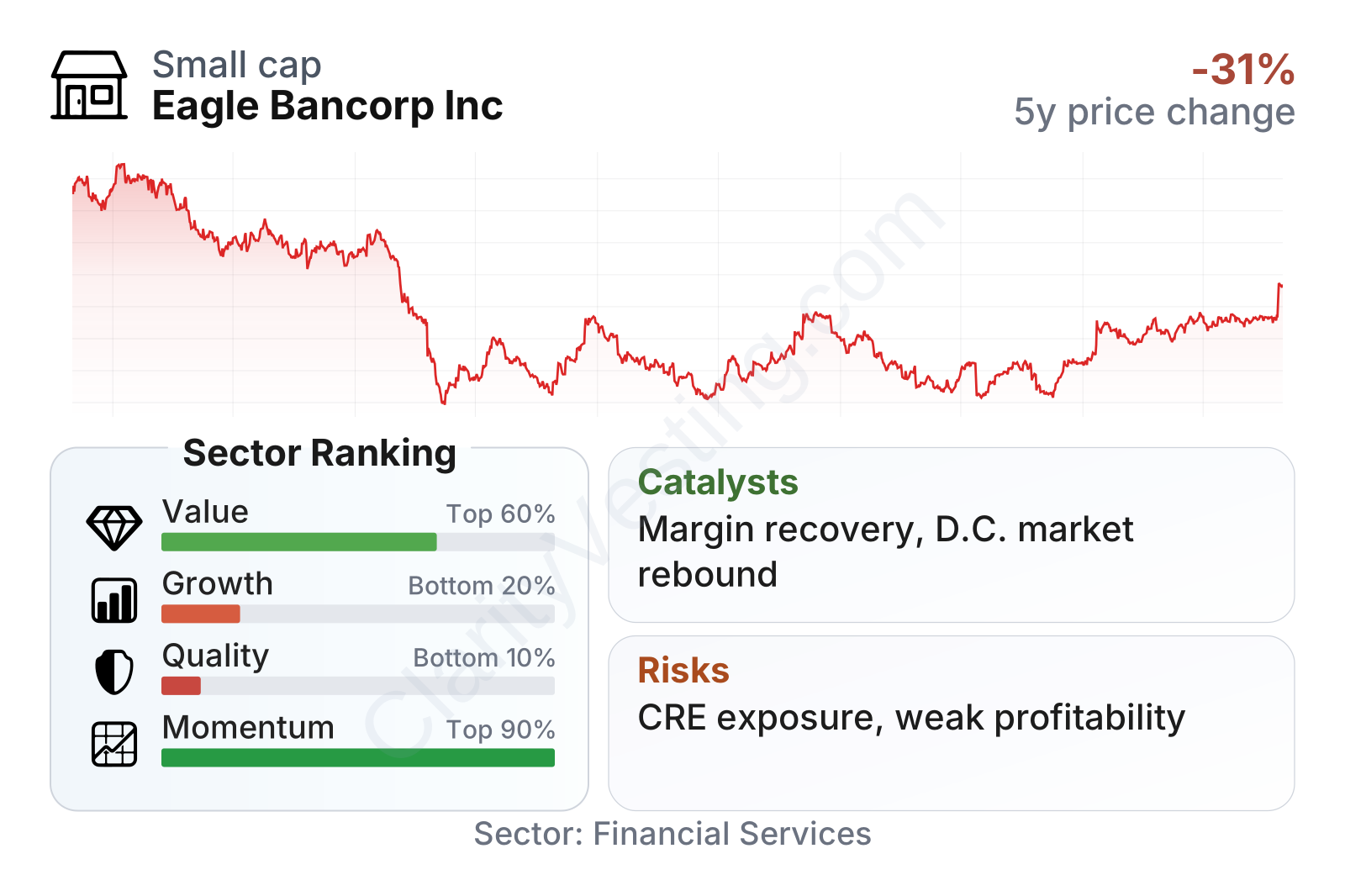
Eagle Bancorp is a mid-sized regional bank with a market value around $1 billion and a share price that has been highly volatile since the 2023 regional banking shock. The stock has recovered strongly over the last year and has outperformed much of the regional bank group in recent months, which explains the very strong momentum ranking.
At the same time, the broader fundamental profile is mixed. The value profile looks acceptable rather than exceptional, helped by a price-to-book ratio below the sector median. Growth and quality rankings are much weaker. Recent revenue growth has been strong, but longer-term earnings, book value, margins, and dividend trends have been much less favorable, which suggests that the rebound in headline numbers has not yet turned into a full operating recovery.
Growth
Regional banking is not a fast-growing sector in the same way as software or semiconductors, but it remains an essential part of the economy. Growth usually comes from gathering low-cost deposits, expanding loans prudently, winning business in attractive local markets, and improving spreads when interest-rate conditions are favorable. For Eagle Bancorp, the Washington, D.C. region remains an important advantage because it is a large, relatively affluent market with a stable base of government, professional services, nonprofits, and commercial activity.
The company’s strategy still makes sense in principle: focus on local relationships, commercial clients, and specialized lending niches where a regional bank can compete through service and speed rather than scale. If deposit costs stabilize and credit performance remains manageable, that model can recover earnings power without requiring dramatic balance-sheet expansion.
A major point to watch is whether the recent earnings recovery becomes durable. Earnings per share fell sharply from the strong 2021 level, turned negative in 2025, and have moved back into positive territory on a trailing basis in 2026. That pattern points to a bank emerging from a difficult period rather than one delivering smooth compounding.
Book value per share has also been under pressure over the last five years, which matters for banks because book value is a key measure of balance-sheet strength and long-term value creation. A return to steady book value growth would be one of the clearest signs that the business has moved beyond its recent reset.
One clear catalyst is a more normal interest-rate environment. If deposit pricing pressure eases faster than loan yields decline, net interest margin can improve. Another possible catalyst is operating normalization after elevated losses and profitability disruption. The company has also shown strong recent share-price momentum, which often reflects improving expectations around earnings stabilization, capital preservation, or credit outcomes.
Recent company updates in 2026 point mainly to ongoing efforts to strengthen profitability, manage credit exposure, and preserve capital rather than pursuing aggressive expansion. For a bank in Eagle Bancorp’s position, that is a sensible near-term priority. The most significant opportunity is not rapid transformation, but a return to more normal returns on assets and equity.
Risks
This article is for informational purposes only and does not constitute financial advice. Some content is AI-generated. See Disclaimer


