Stock Analysis · Everest Group Ltd (EG)
Overview
Everest Group Ltd is a global property and casualty insurer focused mainly on reinsurance and specialty insurance. In simple terms, reinsurance is insurance for insurance companies: Everest helps primary insurers absorb large losses from events such as hurricanes, earthquakes, liability claims, and other major risks. Its insurance arm works more directly with businesses, offering protection in areas such as casualty, property, professional lines, and other specialty coverages. The company operates internationally and earns money both from underwriting policies and from investing the premium float it holds before claims are paid.
Its revenue mix can move from year to year because catastrophe losses, pricing conditions, and investment income all affect the totals. Based on recent company disclosures, the business is primarily organized around two main underwriting engines:
- Reinsurance: approximately 55% to 65% of gross written premium in recent periods. This includes property catastrophe, property per-risk, casualty, specialty, and other treaty and facultative reinsurance lines.
- Insurance: approximately 35% to 45% of gross written premium in recent periods. This includes specialty commercial insurance written through wholesale, retail, and international channels.
Beyond underwriting, Everest also generates a meaningful contribution from net investment income, which comes from its large portfolio of bonds and other invested assets. For insurers, this is an important earnings source, especially when interest rates are higher. Over the last several years, total revenue has generally trended upward, but profitability has been uneven because large catastrophe years can sharply reduce margins.
The business model is attractive when insurance pricing is firm: premiums can rise faster than expected losses, while investment income adds another layer of earnings power. That combination is one reason Everest remains closely watched in the global reinsurance market.
The long-term picture shows a company with expanding revenue, but not in a straight line. Operating and net income have swung meaningfully from year to year, which is typical for catastrophe-exposed insurers. The most recent full-year figures suggest revenue stayed near peak levels while profitability recovered from the weaker 2024 level, helped by better underwriting and continued support from investment income.
Key Figures
| Metric | Value | Sector ⓘ |
|---|---|---|
| Date | Oct 17, 2026 | |
| Context | ||
| Sector | Financial Services | |
| Industry | Insurance - Reinsurance | |
| Market Cap ⓘ | $14.40B | |
| Beta ⓘ | 0.26 | |
Value (Cheapness) | ||
| P/E Ratio ⓘ | 7.93 | 12.26 |
| P/B Ratio ⓘ | 1.00 | 1.23 |
| FCF Yield ⓘ | 14.36% | 10.40% |
| Dividend Yield ⓘ | 2.13% | 3.02% |
| EBIT / EV ⓘ | 14.27% | 8.14% |
| PEG ⓘ | 0.97 | |
Growth (Business expansion) | ||
| Revenue Growth ⓘ | -11.30% | 9.35% |
| RPS Growth (5Y CAGR) ⓘ | 9.82% | 12.19% |
| EPS Growth (5Y CAGR) ⓘ | 3.66% | -9.53% |
| BVPS Growth (5Y CAGR) ⓘ | 9.68% | 4.99% |
| Margin Growth (5Y Trend) ⓘ | -2.53% | -3.86% |
| FCF Growth (5Y CAGR) ⓘ | -2.94% | 4.81% |
| DPS Growth (5Y CAGR) ⓘ | 6.52% | 8.79% |
Quality (Business durability) | ||
| ROIC (Latest) ⓘ | 10.57% | 9.49% |
| ROE (Latest) ⓘ | 12.42% | 13.90% |
| ROA (Latest) ⓘ | 3.08% | 1.55% |
| ROIC (5Y Median) ⓘ | 9.20% | 7.86% |
| ROE (5Y Median) ⓘ | 10.85% | 12.17% |
| ROA (5Y Median) ⓘ | 2.68% | 1.30% |
| Net Debt / EBIT (Latest) ⓘ | 1.03 | 0.96 |
| Net Debt / EBIT (5Y Median) ⓘ | 1.88 | 0.73 |
| Net Debt / EBITDA (Latest) ⓘ | 0.93 | 0.92 |
| Operating Margin (Latest) ⓘ | 14.31% | 22.30% |
| Operating Margin (5Y Median) ⓘ | 11.77% | 24.63% |
| Debt to Equity (Latest) ⓘ | 23.26% | 58.56% |
| Profit Margin (Latest) ⓘ | 11.38% | 26.57% |
| Free Cash Flow (Latest) ⓘ | $2.07B | |
Momentum (Price trend) | ||
| 3Y Return ⓘ | +0.47% | +88.33% |
| 12M Return (excl. last month) ⓘ | +14.40% | +19.38% |
| 6M Return ⓘ | +11.60% | +4.75% |
| Price vs. 200-Day MA ⓘ | +9.99% | +3.50% |
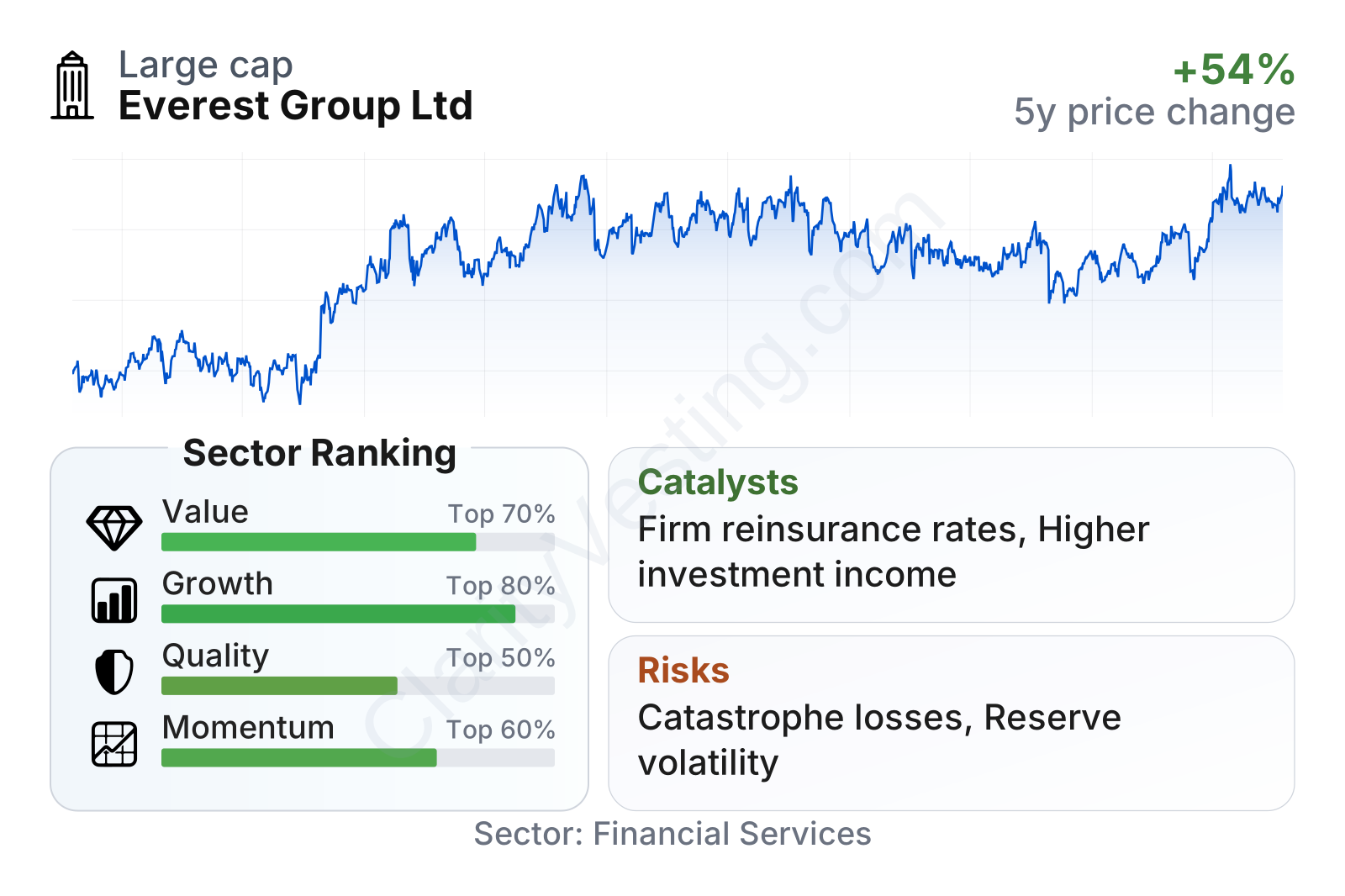
Everest is a large insurer by market value, but not one of the very largest global groups. The stock has shown a relatively low beta, which means its share price has historically moved less than the broader market. On valuation, several measures sit below sector medians, including price-to-earnings and price-to-book, while cash generation and earnings relative to enterprise value appear stronger than many peers. Growth indicators are more mixed: the latest year-over-year revenue reading is weak, yet longer-term growth in earnings per share and book value per share remains solid. Quality metrics point to a business that uses assets efficiently and carries moderate leverage, though margins remain below many financial-sector peers. Price momentum has improved recently, but over a multi-year view the stock has lagged a large part of the sector.
Growth
Everest operates in a part of the financial sector that has favorable long-term demand drivers. Reinsurance and specialty insurance benefit from rising insured values, more complex commercial risks, growing demand for cyber and liability coverage, and a world where natural catastrophes appear more frequent and costly. Those trends increase the need for risk transfer, especially for corporate clients and primary insurers looking to protect their balance sheets.
Its strategy also makes sense for future growth. Everest has been emphasizing underwriting discipline rather than chasing volume at any price, which is especially important in reinsurance. In recent years, industry pricing in catastrophe and specialty lines has generally improved after periods of heavy losses. That creates room for better returns if risk selection stays disciplined. The company also benefits from scale, broker relationships, and diversification across products and geographies, which can help it shift capital toward the most attractive lines as market conditions change.
Earnings per share have been volatile, but the wider trend still suggests meaningful normalized earning power. That volatility is not unusual in reinsurance: one year can be hit by major catastrophe losses, while another can benefit from firmer pricing and lighter claims. The important point for a long-term view is that Everest has remained profitable over time and has produced positive multi-year EPS growth even with that uneven path.
Book value per share is especially important for insurers because it tracks how shareholder capital compounds over time. Everest’s book value per share has risen strongly over the last five years, despite periodic drawdowns tied to market movements or catastrophe-heavy periods. That is a constructive sign because it suggests the company has been adding value over a full cycle, not just in unusually favorable years.
A major catalyst is the combination of firmer insurance pricing and higher investment income. When rates are attractive, insurers can reinvest their bond portfolios at better yields, which lifts recurring income. For Everest, that can matter almost as much as underwriting improvement. Another support is continued demand for reinsurance capacity after years of large global losses, which has helped disciplined players negotiate better terms and pricing. Recent company communications have also emphasized underwriting selectivity and growth in areas where margins appear more attractive, which points to a focus on returns rather than simple premium expansion.
Risks
This article is for informational purposes only and does not constitute financial advice. Some content is AI-generated. See Disclaimer


