Stock Analysis · Enerflex Ltd (EFXT)
Overview
Enerflex Ltd is an energy infrastructure and services company focused on the equipment that helps produce, process, move, and treat natural gas. In simple terms, it designs and supplies compression systems and processing facilities, and then earns additional income by servicing that equipment over time. Its customers are mainly oil and gas producers, midstream operators, and industrial users that need reliable gas handling systems.
The company’s business model is more diversified than a pure equipment manufacturer. Based on recent company reporting, revenue mainly comes from three areas:
- After-market services and parts: approximately 35% to 45% of revenue in recent periods. This includes maintenance, overhaul work, field labor, replacement parts, and recurring support for installed equipment.
- Engineered systems: approximately 30% to 40%. This includes compression packages, gas processing facilities, refrigeration units, electric power solutions, and other custom-built equipment projects.
- Energy infrastructure and rental/compression operations: approximately 20% to 30%. This includes contract compression, gas processing assets, and infrastructure that generates ongoing service-style revenue rather than one-time equipment sales.
Geographically, Enerflex operates across North America, Latin America, the Eastern Hemisphere, and through a broad installed base created in part by its acquisition of Exterran. That scale matters because a larger installed base can feed future service revenue, which is generally steadier than new equipment orders.
One notable financial shift over the last several years is that revenue expanded sharply after the Exterran transaction, while profitability took longer to recover. By 2025, the company had moved back into positive net income and stronger gross profit, showing that the integration phase is gradually turning into an efficiency and cash generation phase.
The business has clearly become much larger since 2021, and the earnings profile has improved from losses to profitability. At the same time, the cost base remains heavy, which explains why cash generation looks healthier than accounting profit margins alone might suggest.
Key Figures
| Metric | Value | Sector ⓘ |
|---|---|---|
| Date | Oct 03, 2026 | |
| Context | ||
| Sector | Energy | |
| Industry | Oil & Gas Equipment & Services | |
| Market Cap ⓘ | $2.77B | |
| Beta ⓘ | 2.03 | |
Value (Cheapness) | ||
| P/E Ratio ⓘ | 51.55 | 14.47 |
| P/B Ratio ⓘ | 2.38 | 1.70 |
| FCF Yield ⓘ | 8.92% | 8.66% |
| Dividend Yield ⓘ | 0.52% | 3.77% |
| EBIT / EV ⓘ | 8.44% | 7.46% |
| PEG ⓘ | N/A | |
Growth (Business expansion) | ||
| Revenue Growth ⓘ | -5.40% | 27.35% |
| RPS Growth (5Y CAGR) ⓘ | 25.89% | 6.75% |
| EPS Growth (5Y CAGR) ⓘ | N/A | -15.45% |
| BVPS Growth (5Y CAGR) ⓘ | -12.48% | 5.85% |
| Margin Growth (5Y Trend) ⓘ | 6.27% | 0.75% |
| FCF Growth (5Y CAGR) ⓘ | 8.65% | 3.62% |
| DPS Growth (5Y CAGR) ⓘ | 15.12% | 16.85% |
Quality (Business durability) | ||
| ROIC (Latest) ⓘ | 11.04% | 11.33% |
| ROA (Latest) ⓘ | 1.81% | 6.03% |
| ROIC (5Y Median) ⓘ | 4.55% | 10.16% |
| ROA (5Y Median) ⓘ | -0.67% | 5.34% |
| Net Debt / EBIT (Latest) ⓘ | 1.85 | 1.62 |
| Net Debt / EBIT (5Y Median) ⓘ | 4.20 | 1.91 |
| Net Debt / EBITDA (Latest) ⓘ | 1.20 | 1.06 |
| Net Debt / Assets ⓘ | 18.65% | 17.29% |
| EBITDA / Interest ⓘ | 7.05 | 9.64 |
| Operating Margin (Latest) ⓘ | 11.04% | 16.32% |
| Operating Margin (5Y Median) ⓘ | 7.37% | 19.53% |
| Debt to Equity (Latest) ⓘ | 51.03% | 54.41% |
| Profit Margin (Latest) ⓘ | 2.06% | 8.79% |
| Free Cash Flow (Latest) ⓘ | $246.88M | |
Momentum (Price trend) | ||
| 3Y Return ⓘ | +311.19% | +62.93% |
| 12M Return (excl. last month) ⓘ | +103.44% | +44.83% |
| 6M Return ⓘ | +9.21% | -1.62% |
| Price vs. 200-Day MA ⓘ | +5.39% | +5.18% |
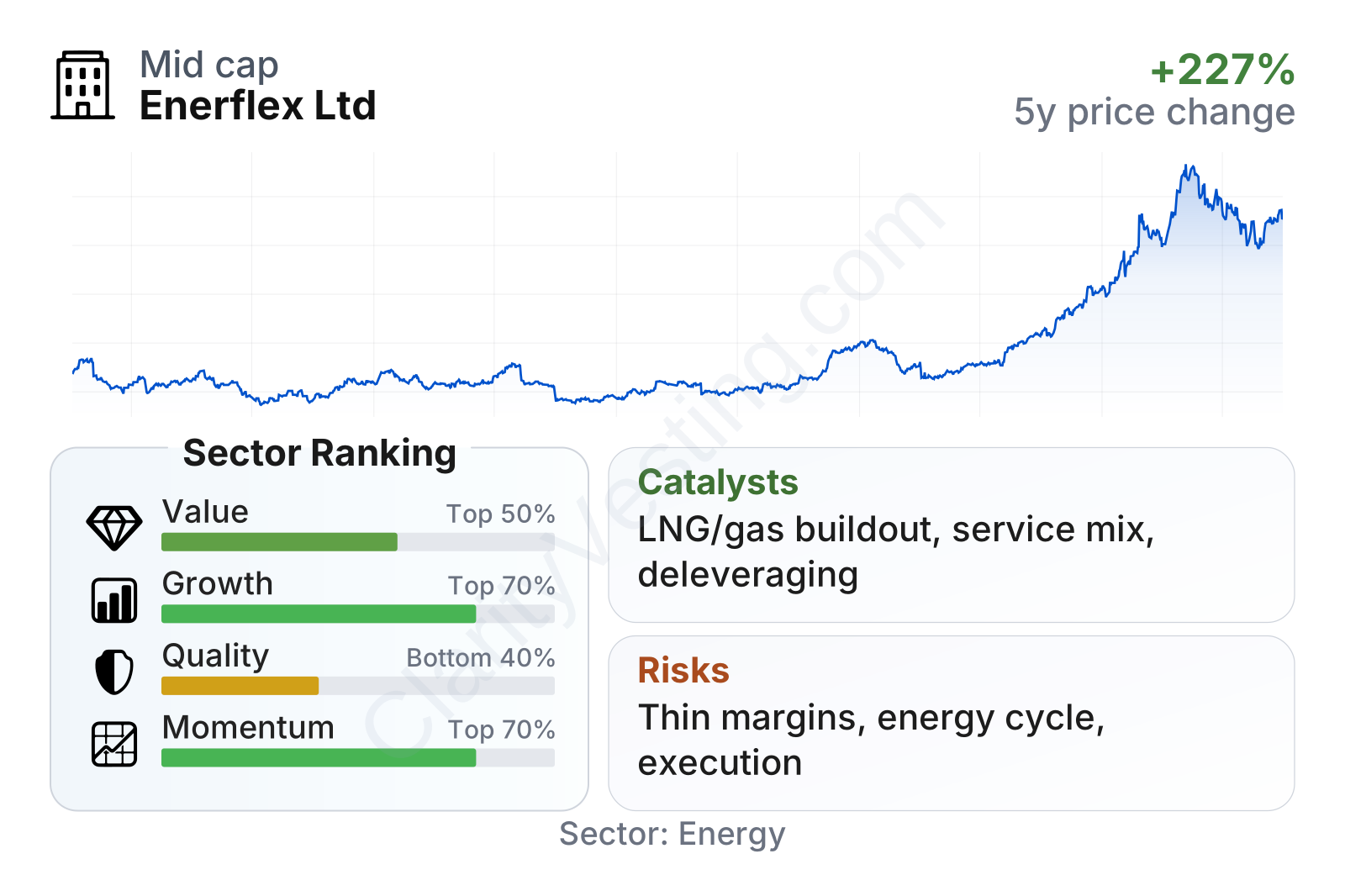
Enerflex is now a mid-sized company in its sector, and its stock has been very volatile, with a strong multi-year rise after a weak 2022–2024 period. In the factor summary, valuation looks mixed: traditional multiples such as earnings and book value sit above sector medians, but cash-flow-based measures are closer to average or slightly better. Growth indicators are uneven, with weak recent year-over-year revenue but a much better five-year expansion record. Quality remains the softer area, as profitability and returns on assets still trail much of the sector despite better leverage and stronger free cash flow. Momentum remains favorable after the major rebound in the share price, though the stock’s beta above 2 suggests larger swings than the broader market.
Growth
Enerflex operates in a part of the energy market that should remain relevant for years because natural gas continues to play an important role in power generation, industrial activity, LNG exports, and energy reliability. Even in an energy transition scenario, gas infrastructure often acts as a bridge fuel and backup source for intermittent renewable power. That does not make the sector immune to cycles, but it does support ongoing demand for compression, processing, and related services.
The company’s strategy is reasonably clear: use its global installed base to capture more recurring service work, improve margins after the Exterran integration, and keep capital discipline so that more operating profit turns into free cash flow. That strategy makes practical sense because service and infrastructure revenue tends to be less lumpy than one-time equipment sales.
Recent revenue growth has cooled after the sharp post-acquisition jump. The company moved from extremely strong growth in 2022 and 2023 to flatter and occasionally negative comparisons in 2024 through mid-2026. For long-term analysis, that is an important distinction: Enerflex is no longer in a simple expansion phase driven by a larger corporate footprint, so future progress depends more on execution, backlog conversion, utilization, and margin improvement than on headline scale alone.
Free cash flow is one of the more encouraging signals. After a weak period in 2023, Enerflex produced a clear recovery in cash generation, remaining positive at a meaningful level even with some moderation in the latest period. That matters because this type of business can look attractive on revenue while still consuming cash if projects, inventory, or integration costs are poorly managed. Here, the recent pattern suggests improving operational discipline.
A meaningful catalyst is the broader buildout of gas infrastructure tied to LNG exports, power demand, and upstream gas development in regions where compression and processing are critical. Another support factor is Enerflex’s large international footprint, which gives it exposure to several end markets rather than only one basin or one country. Recent company updates have also emphasized backlog execution, balance-sheet improvement, and operational streamlining, all of which can create a stronger earnings base if sustained.
Risks
This article is for informational purposes only and does not constitute financial advice. Some content is AI-generated. See Disclaimer