Stock Analysis · Equifax Inc (EFX)
Overview
Equifax is a data, analytics, and technology company best known for consumer and commercial credit information. In simple terms, it helps lenders, employers, insurers, and government agencies verify identities, assess risk, detect fraud, and make decisions faster. The company operates one of the major credit bureaus in the United States, but its business goes well beyond credit scores. It also sells employment and income verification, fraud prevention tools, marketing solutions, and data services for businesses and public-sector clients.
Its revenue is mainly organized by business segment. Based on the latest annual reporting, the largest sources are:
- Workforce Solutions: about 40% of revenue. This segment includes employment and income verification services, unemployment claims tools, HR-related services, and government verification products. The Work Number is a central asset here.
- U.S. Information Solutions: about 34% of revenue. This includes U.S. credit bureau services, mortgage-related data, identity and fraud solutions, marketing services, and analytics sold to financial institutions and other businesses.
- International: about 26% of revenue. This covers consumer and commercial credit, analytics, and digital identity offerings outside the U.S., with operations across Latin America, Europe, Canada, India, and Asia-Pacific markets.
That mix matters for long-term analysis because Equifax is not purely tied to one activity like mortgage lending. The company has built a broader platform around verification, fraud, and decisioning. It also generates recurring demand from businesses that need data and compliance tools as part of daily operations.
Over the last several years, revenue has moved upward overall, but the cost structure has also become heavier. Sales have increased from roughly $4.9 billion in 2021 to just above $6.0 billion in 2025, while net income has been more uneven. This points to a business that is still growing, but where execution and margin discipline remain important.
The business has expanded its top line over time, yet profit conversion has not risen in a straight line. Gross profit weakened noticeably in 2025 relative to revenue, which suggests a less favorable mix, higher delivery costs, or investment pressure even as operating income held up reasonably well.
Key Figures
| Metric | Value | Sector ⓘ |
|---|---|---|
| Date | Oct 03, 2026 | |
| Context | ||
| Sector | Industrials | |
| Industry | Consulting Services | |
| Market Cap ⓘ | $16.55B | |
| Beta ⓘ | 1.30 | |
Value (Cheapness) | ||
| P/E Ratio ⓘ | 25.65 | 22.45 |
| P/B Ratio ⓘ | 3.86 | 1.98 |
| FCF Yield ⓘ | 6.68% | 6.31% |
| Dividend Yield ⓘ | 1.45% | 1.96% |
| EBIT / EV ⓘ | 4.93% | 4.81% |
| PEG ⓘ | 1.34 | |
Growth (Business expansion) | ||
| Revenue Growth ⓘ | 10.60% | 9.10% |
| RPS Growth (5Y CAGR) ⓘ | 5.28% | 7.75% |
| EPS Growth (5Y CAGR) ⓘ | -15.01% | -13.59% |
| BVPS Growth (5Y CAGR) ⓘ | 5.69% | 6.22% |
| Margin Growth (5Y Trend) ⓘ | -4.01% | 0.72% |
| FCF Growth (5Y CAGR) ⓘ | 6.99% | 10.98% |
| DPS Growth (5Y CAGR) ⓘ | 5.10% | 9.48% |
Quality (Business durability) | ||
| ROIC (Latest) ⓘ | 8.77% | 10.92% |
| ROA (Latest) ⓘ | 5.81% | 5.41% |
| ROIC (5Y Median) ⓘ | 8.43% | 9.21% |
| ROA (5Y Median) ⓘ | 5.59% | 4.94% |
| Net Debt / EBIT (Latest) ⓘ | 4.57 | 2.07 |
| Net Debt / EBIT (5Y Median) ⓘ | 4.66 | 2.28 |
| Net Debt / EBITDA (Latest) ⓘ | 2.79 | 1.43 |
| Net Debt / Assets ⓘ | 44.21% | 19.27% |
| EBITDA / Interest ⓘ | 8.56 | 9.53 |
| Operating Margin (Latest) ⓘ | 18.00% | 10.50% |
| Operating Margin (5Y Median) ⓘ | 18.30% | 10.27% |
| Debt to Equity (Latest) ⓘ | 124.81% | 65.48% |
| Profit Margin (Latest) ⓘ | 10.73% | 6.62% |
| Free Cash Flow (Latest) ⓘ | $1.10B | |
Momentum (Price trend) | ||
| 3Y Return ⓘ | -23.19% | +58.56% |
| 12M Return (excl. last month) ⓘ | -22.16% | +15.63% |
| 6M Return ⓘ | -23.30% | +4.19% |
| Price vs. 200-Day MA ⓘ | -24.73% | +0.93% |
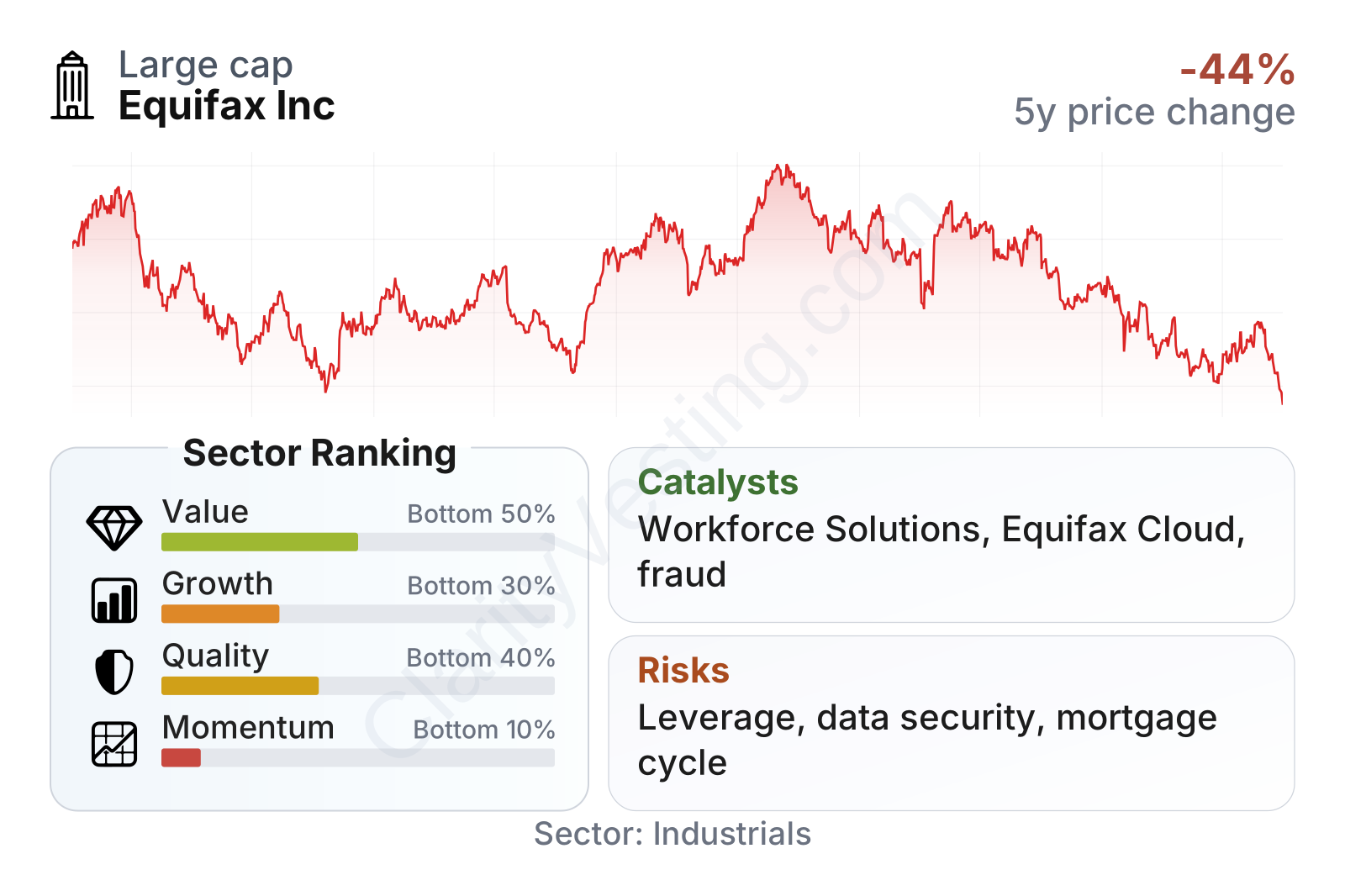
Equifax is a large, established company with a market value in the tens of billions of dollars, but the overall factor profile is mixed. Profitability remains better than many peers on operating and net margins, while growth and share-price momentum rank weaker within its sector. Valuation does not screen as cheap on earnings or book value, although free cash flow generation is relatively solid and helps balance that picture.
The stock has been volatile over the last several years. After reaching much higher levels in earlier periods, it has pulled back materially into 2026. That decline has reduced the valuation premium, but it also reflects market caution around growth quality, leverage, and the pace of earnings recovery.
Growth
Equifax operates in areas that still have long-term growth drivers: digital identity, fraud prevention, automated verification, risk analytics, and cloud-based decision tools. These are attractive markets because financial institutions, employers, and government agencies increasingly need real-time data and workflow automation. Fraud threats are also rising, which tends to support demand for identity and verification products.
A key part of Equifax’s strategy has been to modernize its technology platform through the Equifax Cloud. The logic is straightforward: if the company can move more products onto a common cloud-based infrastructure, it can launch tools faster, process more data, and improve reliability and scalability. That can support cross-selling across credit, verification, and fraud solutions rather than relying only on traditional credit bureau activity.
Another major growth engine is Workforce Solutions. Employment and income verification has become more valuable as lenders and employers want faster and more automated checks. This area is structurally different from classic credit reporting and can be less tied to the same cycle as mortgage originations. That diversification is one of the stronger elements in the company’s growth profile.
Recent revenue trends show a clear reacceleration after a softer period in 2022 and early 2023. Growth moved back into a healthy range through 2024, 2025, and the first half of 2026, including low-double-digit year-over-year expansion recently. That suggests demand has remained resilient across the platform even though some end markets have been uneven.
Cash generation has improved meaningfully over the last few years, with trailing free cash flow now above $1.1 billion. For a data and analytics business, this is important because it shows the model can still produce strong cash even while investing in technology. Rising free cash flow gives the company more room to support dividends, reduce debt, fund product development, and pursue bolt-on acquisitions.
One recent opportunity to watch is the continued expansion of verification, government-related solutions, and fraud offerings, which are benefiting from digitization and regulatory complexity. In addition, any eventual recovery in mortgage activity could provide an extra tailwind for U.S. Information Solutions, although that would be more cyclical than structural.
Risks
This article is for informational purposes only and does not constitute financial advice. Some content is AI-generated. See Disclaimer