Stock Analysis · Enterprise Financial Services (EFSC)
Overview
Enterprise Financial Services Corp is the parent company of Enterprise Bank & Trust, a regional bank that serves businesses, property owners, entrepreneurs, and households. Its footprint is centered on the Midwest and parts of the Southwest and West, with a business model built around commercial banking rather than mass-market consumer banking. In simple terms, the company gathers deposits, lends that money out at higher rates, earns fees from treasury and wealth services, and keeps the spread after funding and operating costs.
Its revenue mix is typical for a regional bank, with most income coming from net interest income, meaning the difference between what it earns on loans and securities and what it pays on deposits and borrowings. Based on the company’s recent annual reporting structure, the main sources of revenue can be summarized as follows:
- Net interest income: approximately 75% to 85% of total revenue. This includes income from commercial real estate loans, commercial and industrial lending, residential lending, and the securities portfolio, after subtracting deposit and borrowing costs.
- Wealth management and trust fees: approximately 5% to 10%. This generally includes investment management, trust administration, estate-related services, and private client relationships.
- Service charges and deposit-related fees: approximately 3% to 6%. These come from account services, treasury management, and transaction-related banking fees.
- Mortgage banking and other loan-related fees: approximately 2% to 5%. This can include gains on loan sales, mortgage servicing-related activity, and loan administration fees.
- Other noninterest income: approximately 3% to 7%. This typically includes card-related income, tax credit and investment-related items, and miscellaneous banking fees.
Over the last several years, the business has become larger in absolute revenue terms, but profitability has not expanded at the same pace because funding costs rose sharply after interest rates moved higher. That is an important point for long-term readers: this is a company whose economics are still driven mainly by balance sheet management, credit quality, and deposit discipline, not by a highly diversified fee platform.
The long-term picture shows a bigger revenue base than a few years ago, while net income has been much steadier than revenue growth alone would suggest. That usually means higher interest expense and operating costs have absorbed a meaningful part of the top-line expansion.
Key Figures
| Metric | Value | Sector ⓘ |
|---|---|---|
| Date | Oct 24, 2026 | |
| Context | ||
| Sector | Financial Services | |
| Industry | Banks - Regional | |
| Market Cap ⓘ | $2.18B | |
| Beta ⓘ | 0.83 | |
Value (Cheapness) | ||
| P/E Ratio ⓘ | 11.98 | 12.46 |
| P/B Ratio ⓘ | 1.07 | 1.25 |
| FCF Yield ⓘ | 9.70% | 9.82% |
| Dividend Yield ⓘ | N/A | 2.94% |
| EBIT / EV ⓘ | 11.75% | 8.11% |
| PEG ⓘ | 1.23 | |
Growth (Business expansion) | ||
| Revenue Growth ⓘ | 1.20% | 9.10% |
| RPS Growth (5Y CAGR) ⓘ | 18.95% | 12.31% |
| EPS Growth (5Y CAGR) ⓘ | -9.83% | -6.97% |
| BVPS Growth (5Y CAGR) ⓘ | -38.17% | 5.02% |
| Margin Growth (5Y Trend) ⓘ | -8.90% | -4.00% |
| FCF Growth (5Y CAGR) ⓘ | 3.52% | 4.71% |
| DPS Growth (5Y CAGR) ⓘ | 14.65% | 8.92% |
Quality (Business durability) | ||
| ROIC (Latest) ⓘ | N/A | 9.18% |
| ROE (Latest) ⓘ | 9.48% | 13.93% |
| ROA (Latest) ⓘ | 1.07% | 1.57% |
| ROIC (5Y Median) ⓘ | 9.82% | 7.80% |
| ROE (5Y Median) ⓘ | 10.42% | 12.15% |
| ROA (5Y Median) ⓘ | 1.23% | 1.28% |
| Net Debt / EBIT (Latest) ⓘ | 1.49 | 1.02 |
| Net Debt / EBIT (5Y Median) ⓘ | 0.08 | 0.72 |
| Net Debt / EBITDA (Latest) ⓘ | 1.42 | 0.88 |
| Operating Margin (Latest) ⓘ | 27.68% | 22.30% |
| Operating Margin (5Y Median) ⓘ | 40.00% | 24.50% |
| Debt to Equity (Latest) ⓘ | 33.42% | 59.34% |
| Profit Margin (Latest) ⓘ | 27.36% | 26.42% |
| Free Cash Flow (Latest) ⓘ | $211.43M | |
Momentum (Price trend) | ||
| 3Y Return ⓘ | +82.92% | +95.73% |
| 12M Return (excl. last month) ⓘ | +3.60% | +17.30% |
| 6M Return ⓘ | +7.14% | +6.07% |
| Price vs. 200-Day MA ⓘ | +1.88% | +5.36% |
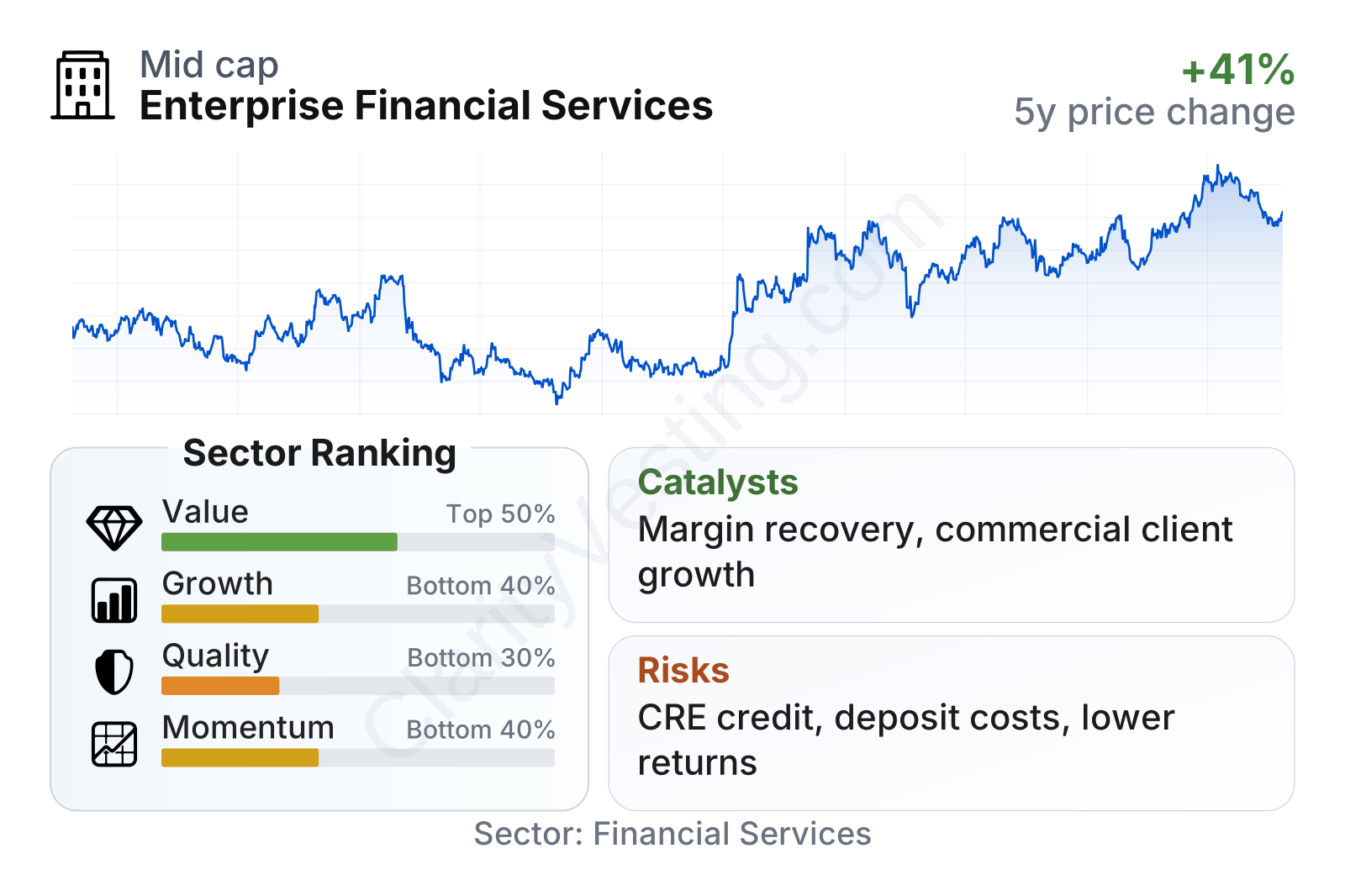
Enterprise Financial Services is a mid-sized regional bank with relatively low share-price volatility, as reflected by a beta below 1. On valuation, it screens close to or slightly below sector medians on earnings and book value multiples, suggesting the market is not assigning a premium to the franchise. Quality and growth rankings are weaker, however, which matches a business that remains profitable and well-capitalized but has recently delivered slower growth and lower returns than many peers.
The stock performance has been uneven over the last several years, with a clear drawdown during the regional bank stress period and a strong recovery afterward. More recently, the share price has moved to new highs for the period shown, which indicates improving sentiment, but momentum still looks less robust than the broader regional bank group when viewed over longer comparison windows.
Growth
Regional banking is not a fast-growth industry in the way software or semiconductors can be, but it remains a durable sector because businesses and households continue to need credit, deposits, treasury services, and fiduciary support. Enterprise Financial Services operates in commercial banking niches where relationship depth matters, especially with middle-market companies and commercial real estate clients. That gives it a practical path to growth through market share gains, new teams, loan production, and selective acquisitions rather than through disruptive product innovation.
The company’s strategy makes sense for future growth if management can keep expanding in attractive metropolitan markets while preserving credit quality. A key positive is that Enterprise has built a meaningful wealth and trust operation alongside the core bank. That does not transform the business into a fee-heavy financial platform, but it does provide some diversification beyond pure spread income. Another positive is the company’s history of absorbing acquisitions and extending its geographic reach, which can help produce scale in back-office functions and customer coverage.
Earnings per share surged in 2022, then stayed in a fairly narrow range through 2025 instead of continuing that earlier jump. That pattern suggests the company has been able to defend profitability reasonably well, but not convert revenue growth into a sustained earnings breakout. In other words, the bank looks stable rather than rapidly compounding at this stage.
Book value per share appears to have moved higher in recent years, which is important for banks because book value reflects the capital base supporting future lending and earnings. A steadily rising book value can support long-term value creation even when earnings growth is uneven. If deposit costs ease or loan yields remain favorable, that larger capital base could become more productive.
One meaningful catalyst is the interest-rate cycle. If funding pressure moderates faster than asset yields reset downward, net interest margin could improve. Another is continued commercial customer acquisition in existing markets, where relationship banking can still win business from larger national banks that are less locally focused. Public company communications in 2026 also point to ongoing balance-sheet management, loan discipline, and deposit gathering as central priorities, which are exactly the areas that matter most for a regional lender trying to strengthen earnings power.
Risks
This article is for informational purposes only and does not constitute financial advice. Some content is AI-generated. See Disclaimer


