Stock Analysis · Ellington Financial Inc (EFC)
Overview
Ellington Financial Inc. is a mortgage real estate investment trust, or mortgage REIT. Instead of owning large portfolios of office buildings or apartments, it mainly invests in financial assets tied to housing and consumer credit. Its business is built around earning income from mortgage loans, mortgage-backed securities, consumer and commercial credit investments, and specialized lending activities. The company is externally managed by an affiliate of Ellington Management Group, a firm known for structured credit and mortgage investing.
In simple terms, Ellington Financial tries to profit from the spread between the yield it earns on its investments and the cost of the borrowing it uses to finance them. It also seeks gains from trading, securitization, and loan origination across several credit niches. That gives it a broader business mix than some pure agency mortgage REITs, which can make results more flexible but also somewhat more complex.
The company’s revenue can move sharply from year to year because accounting revenue for mortgage REITs includes market value changes, gains or losses on investments, and interest income. Based on recent filings and portfolio disclosures, the economic drivers of earnings are best understood through the investment portfolio rather than a simple product sales model. Approximate revenue and earnings exposure appears to come from the following areas:
- Residential mortgage loans and mortgage-backed securities: approximately 45% to 55%. This includes agency and non-agency mortgage-backed securities, residential transition loans, reverse mortgage interests, and other housing-related assets.
- Consumer loans and asset-backed credit: approximately 20% to 30%. This includes consumer loan-backed investments and other securitized consumer credit exposure.
- Commercial mortgage and real estate credit: approximately 10% to 20%. This includes commercial mortgage loans and related structured credit positions.
- Mortgage loan origination and related businesses: approximately 10% to 15%. Through affiliated operating platforms, the company also participates in loan origination and servicing-related economics.
- Other strategic investments and trading activities: less precisely disclosed. These may include hedging results, opportunistic credit trades, and smaller specialty finance positions.
This mix matters because Ellington Financial is not just a yield vehicle. It is a credit allocation business that moves capital among mortgage and consumer finance markets depending on where management sees better risk-adjusted returns.
The long-term pattern shows a business that recovered strongly after the difficult 2022 rate shock. Revenue and gross profit expanded sharply in 2023 through 2025, while net income turned positive again. That said, interest expense also rose materially, which is a reminder that the model depends heavily on funding conditions and portfolio spreads.
Key Figures
| Metric | Value | Sector ⓘ |
|---|---|---|
| Date | Oct 03, 2026 | |
| Context | ||
| Sector | Real Estate | |
| Industry | REIT - Mortgage | |
| Market Cap ⓘ | $1.55B | |
| Beta ⓘ | 0.93 | |
Value (Cheapness) | ||
| P/E Ratio ⓘ | 7.39 | 17.35 |
| P/B Ratio ⓘ | 0.76 | 0.86 |
| FCF Yield ⓘ | -21.07% | 7.47% |
| Dividend Yield ⓘ | 12.95% | 4.75% |
| EBIT / EV ⓘ | N/A | 3.81% |
| PEG ⓘ | 0.86 | |
Growth (Business expansion) | ||
| Revenue Growth ⓘ | 33.80% | 5.30% |
| RPS Growth (5Y CAGR) ⓘ | 28.63% | 5.96% |
| EPS Growth (5Y CAGR) ⓘ | -4.96% | -11.41% |
| BVPS Growth (5Y CAGR) ⓘ | -4.39% | 0.41% |
| Margin Growth (5Y Trend) ⓘ | 3.00% | 0.53% |
| FCF Growth (5Y CAGR) ⓘ | 22.76% | 5.40% |
| DPS Growth (5Y CAGR) ⓘ | 1.48% | 5.02% |
Quality (Business durability) | ||
| ROIC (Latest) ⓘ | N/A | 5.77% |
| ROE (Latest) ⓘ | 11.34% | 7.64% |
| ROA (Latest) ⓘ | 1.14% | 2.85% |
| ROIC (5Y Median) ⓘ | 2.11% | 4.20% |
| ROE (5Y Median) ⓘ | 7.09% | 6.03% |
| ROA (5Y Median) ⓘ | 0.82% | 2.45% |
| Net Debt / EBIT (Latest) ⓘ | N/A | 7.57 |
| Net Debt / EBIT (5Y Median) ⓘ | N/A | 8.41 |
| Net Debt / EBITDA (Latest) ⓘ | 31.00 | 5.12 |
| Net Debt / Assets ⓘ | 86.72% | 37.84% |
| EBITDA / Interest ⓘ | 1.70 | 4.11 |
| Operating Margin (Latest) ⓘ | N/A | 35.40% |
| Operating Margin (5Y Median) ⓘ | 112.01% | 36.59% |
| Debt to Equity (Latest) ⓘ | 940.18% | 89.06% |
| Profit Margin (Latest) ⓘ | 51.50% | 19.99% |
| Free Cash Flow (Latest) ⓘ | -$327.28M | |
Momentum (Price trend) | ||
| 3Y Return ⓘ | +38.33% | +30.60% |
| 12M Return (excl. last month) ⓘ | +9.42% | +7.55% |
| 6M Return ⓘ | +4.22% | +0.69% |
| Price vs. 200-Day MA ⓘ | -6.13% | -2.30% |
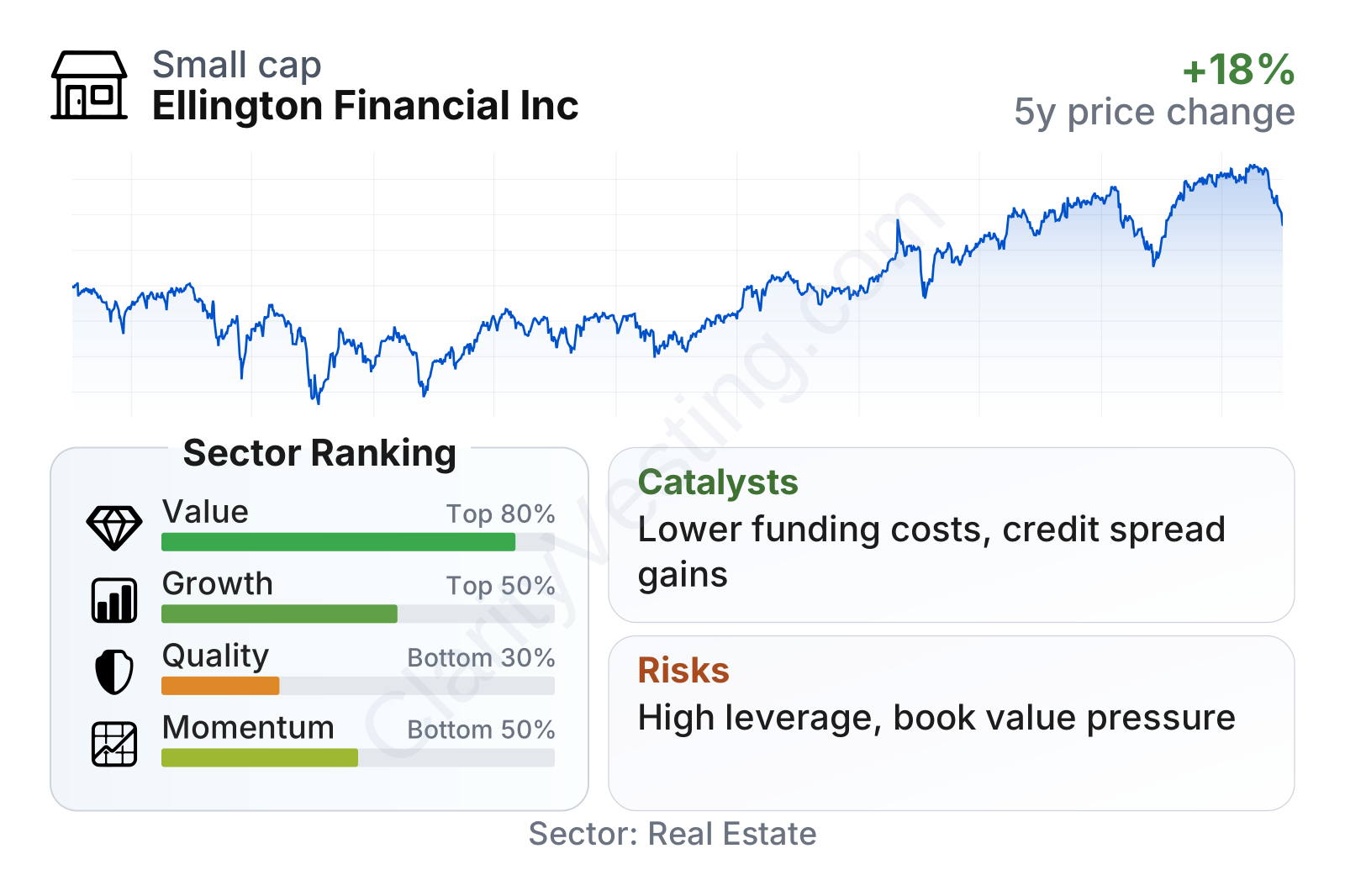
Ellington Financial is a small-cap mortgage REIT with market value around the lower end of the publicly traded real estate finance space. The stock’s recent multi-year price trend has been constructive, with a strong rebound from 2022 lows and better medium-term performance than the sector median. In the factor breakdown, valuation looks inexpensive relative to the broader real estate sector, while growth and momentum are around the better half of the group. The weaker area is balance-sheet quality, where leverage and interest coverage remain notably less favorable than many peers.
The dividend yield is far above the sector median, which is a core attraction of the stock, but the negative free cash flow reading is not unusual to interpret literally for this type of business. For mortgage REITs, cash flow metrics can be less useful than book value stability, net interest economics, leverage control, and distributable earnings.
Growth
Ellington Financial operates in a sector that should remain relevant for a long time: housing finance, mortgage credit, and asset-backed lending. This is not a classic high-growth industry like software, but it can produce attractive expansion when market dislocations create better lending spreads or distressed buying opportunities. The company’s strategy makes sense in that context because it is built to shift capital across different parts of the mortgage and consumer credit markets rather than depend on one narrow niche.
That flexibility has become more important since the interest-rate shock of 2022. Many real estate finance companies were hurt by fast rate increases, but those same conditions also created wider spreads, lower asset prices, and new opportunities for managers with trading and securitization experience. Ellington Financial’s platform is designed to operate in exactly that kind of environment.
Revenue per share has risen strongly over the past five years despite volatility along the way. The path has not been smooth, but the broader direction suggests the company has been able to rebuild earning power after the 2022 downturn. Growth metrics also compare well with the sector median, especially on a five-year revenue-per-share basis.
The dividend per share has been comparatively stable, although it has softened from its recent peak. That pattern suggests management has tried to keep distributions attractive while adjusting to changing financing costs and portfolio returns. For a mortgage REIT, the ability to sustain a meaningful payout without a severe collapse is an important signal of underlying franchise resilience.
A meaningful catalyst is the possibility of a more favorable rate environment. If funding costs stabilize or decline while mortgage and credit spreads remain healthy, Ellington Financial could benefit from stronger net interest economics, improved portfolio marks, and potentially better origination volumes in housing-related businesses. Another catalyst is continued expansion in securitized consumer credit and residential transition lending, where specialized underwriting can create better margins than plain-vanilla agency assets.
Recent company updates have also emphasized portfolio diversification, active capital allocation, and expansion in loan-focused strategies. For this type of company, that is significant: growth is less about opening new stores or launching new products and more about placing capital into better-yielding assets at the right point in the cycle.
Risks
This article is for informational purposes only and does not constitute financial advice. Some content is AI-generated. See Disclaimer