Stock Analysis · Energean plc (EERGF)
Overview
Energean plc is an upstream energy company focused on finding, developing, and producing natural gas and oil. Its core business is concentrated in the Eastern Mediterranean, with Israel as the center of current production, and additional interests in nearby regional assets. In simple terms, the company drills for hydrocarbons, brings them to market, and sells the output under a mix of gas sales agreements and oil-linked pricing structures.
The business is more gas-focused than many traditional exploration and production companies. That matters because natural gas is often seen as the lower-carbon fossil fuel within the energy mix, and in Energean’s case it is tied to domestic and regional demand in markets that value secure local supply.
Based on recent company disclosures, Energean’s revenue is mainly generated from production in Israel, especially from the Karish field and related infrastructure. The broad revenue mix can be described as follows:
- Natural gas sales in Israel: approximately 70% to 80% of revenue. This is the company’s main earnings engine and is supported by long-term gas sales contracts with power and industrial customers.
- Liquids production, including condensate and oil: approximately 20% to 30% of revenue. This includes associated liquids from gas production and output from other operated assets.
- Other sources: limited. These can include smaller contributions from remaining international interests or non-core items, but they are not a major part of the current investment case.
Energean’s operating profile is relatively concentrated: one region, a small number of key fields, and a strategy built around turning discovered reserves into contracted gas production. That creates clearer visibility than many early-stage explorers, but it also means individual assets matter a great deal to overall results.
The long-term financial pattern shows a company that scaled up quickly after bringing major assets into production. Revenue rose sharply from 2021 through 2025, while operating profitability improved materially versus the pre-ramp period. At the same time, interest expense remained heavy, showing that asset growth has been funded with meaningful debt and that financing costs still absorb a large part of operating earnings.
Key Figures
| Metric | Value | Sector ⓘ |
|---|---|---|
| Date | Oct 17, 2026 | |
| Context | ||
| Sector | Energy | |
| Industry | Oil & Gas E&P | |
| Market Cap ⓘ | $1.74B | |
| Beta ⓘ | 0.34 | |
Value (Cheapness) | ||
| P/E Ratio ⓘ | N/A | 15.44 |
| P/B Ratio ⓘ | 7.74 | 1.73 |
| FCF Yield ⓘ | 28.47% | 8.20% |
| Dividend Yield ⓘ | 10.64% | 3.59% |
| EBIT / EV ⓘ | 16.02% | 7.46% |
| PEG ⓘ | N/A | |
Growth (Business expansion) | ||
| Revenue Growth ⓘ | -7.60% | 26.90% |
| RPS Growth (5Y CAGR) ⓘ | 36.02% | 6.90% |
| EPS Growth (5Y CAGR) ⓘ | N/A | -15.73% |
| BVPS Growth (5Y CAGR) ⓘ | -33.94% | 6.07% |
| Margin Growth (5Y Trend) ⓘ | 32.79% | 0.58% |
| FCF Growth (5Y CAGR) ⓘ | N/A | 1.86% |
| DPS Growth (5Y CAGR) ⓘ | 26.99% | 16.79% |
Quality (Business durability) | ||
| ROIC (Latest) ⓘ | N/A | 11.40% |
| ROA (Latest) ⓘ | -1.32% | 6.06% |
| ROIC (5Y Median) ⓘ | 6.22% | 10.30% |
| ROA (5Y Median) ⓘ | 0.31% | 5.42% |
| Net Debt / EBIT (Latest) ⓘ | 3.94 | 1.64 |
| Net Debt / EBIT (5Y Median) ⓘ | 7.29 | 1.83 |
| Net Debt / EBITDA (Latest) ⓘ | 1.92 | 1.08 |
| Net Debt / Assets ⓘ | 58.23% | 17.29% |
| EBITDA / Interest ⓘ | 4.58 | 9.64 |
| Operating Margin (Latest) ⓘ | 31.25% | 16.27% |
| Operating Margin (5Y Median) ⓘ | 30.36% | 20.39% |
| Debt to Equity (Latest) ⓘ | 1571.48% | 54.76% |
| Profit Margin (Latest) ⓘ | -12.50% | 8.82% |
| Free Cash Flow (Latest) ⓘ | $494.26M | |
Momentum (Price trend) | ||
| 3Y Return ⓘ | +17.83% | +67.38% |
| 12M Return (excl. last month) ⓘ | -2.49% | +49.19% |
| 6M Return ⓘ | -15.21% | +7.07% |
| Price vs. 200-Day MA ⓘ | -11.71% | +9.56% |
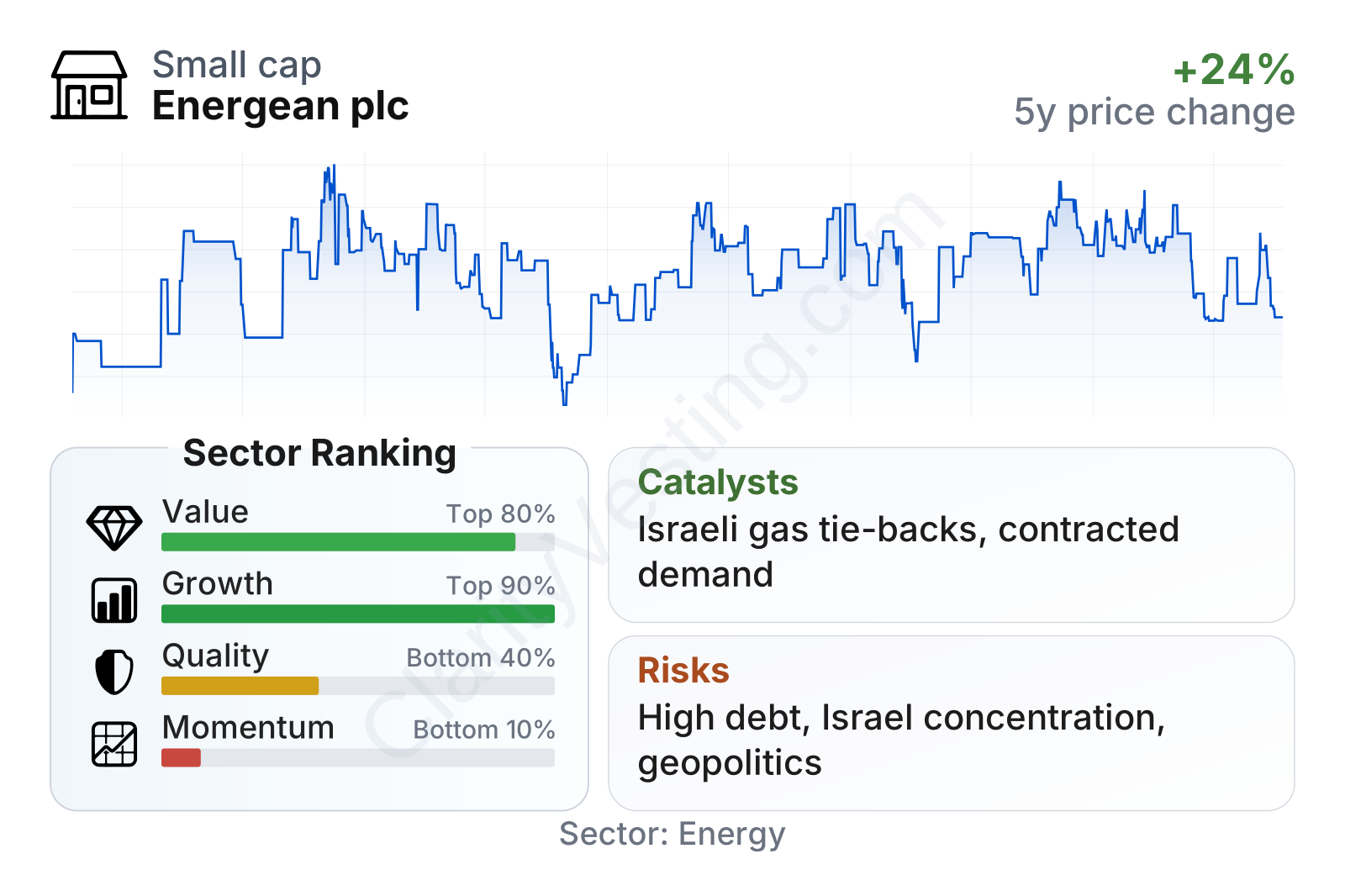
The current profile is unusual in a few ways. On valuation-oriented measures, Energean looks strong relative to much of the energy sector: free cash flow yield is very high, dividend yield is also high, and operating earnings relative to enterprise value are comfortably above the sector median. However, balance-sheet quality is weaker. Net debt remains elevated compared with peers, interest coverage is lower than average, and debt-to-equity is exceptionally high. Growth metrics over a five-year period are strong thanks to the production ramp-up, but recent year-over-year revenue was down, which shows how commodity prices and field-level factors can create volatility even when the long-term trajectory remains upward. Share-price momentum has also been weak, suggesting the market is still discounting execution and leverage concerns.
Growth
Energean operates in a sector with mixed long-term characteristics. Oil and gas production is mature and cyclical, but natural gas in the Eastern Mediterranean still has room for expansion because it serves practical needs: electricity generation, industrial demand, and regional energy security. In that sense, Energean is not simply exposed to global commodity demand; it is also exposed to a structural need for domestic and nearby gas supply in a region where reliability matters.
The company’s strategy is coherent. It has centered its capital on large offshore gas assets, developed the infrastructure needed to produce them, and signed customer contracts intended to reduce pure spot-price exposure. That is generally a stronger model than relying on constant new discoveries. It means future growth depends less on exploration luck and more on executing projects, optimizing production, and adding volumes from existing developments and nearby tie-backs.
A key catalyst is additional field development around the company’s existing hub in Israel. When an operator already has offshore infrastructure in place, nearby reserves can often be commercialized more efficiently than a standalone project. That can improve returns on capital and support production growth without requiring a completely new export system or processing chain.
Another important catalyst is contract-backed gas demand. Energean has emphasized long-term gas sales agreements in its investor communications, and that gives the business a degree of cash-flow visibility that many commodity producers lack. If regional power demand remains firm and governments continue to prioritize local supply, this contracted model could remain a meaningful advantage.
Recent company updates have also highlighted continued focus on portfolio optimization and reserve development. For long-term analysis, the most significant opportunity is straightforward: if Energean can sustain production, connect additional reserves, and keep converting operating profits into cash flow, its existing asset base still appears capable of generating substantial cash relative to its market value.
Risks
This article is for informational purposes only and does not constitute financial advice. Some content is AI-generated. See Disclaimer


