Stock Analysis · Consolidated Edison Inc (ED)
Overview
Consolidated Edison is one of the oldest regulated utility groups in the United States. Its core business is straightforward: it delivers electricity, natural gas, and steam to customers, mainly in New York City and Westchester County through Consolidated Edison Company of New York, and it also operates a regulated electric and gas utility in southeastern New York through Orange & Rockland. In practice, the company earns most of its money by building, maintaining, and operating essential energy networks, then recovering those costs through rates approved by regulators.
That business mix matters for long-term analysis because regulated utilities usually have steadier demand than most industries. Households, businesses, transit systems, hospitals, and public infrastructure still need power and gas in weak and strong economies alike. Con Edison’s service territory is especially dense and economically important, which gives it a durable role in the region’s infrastructure.
Based on the company’s latest annual reporting structure, revenue is primarily generated from utility sales and delivery services, with the largest contribution coming from electricity.
- Electric: approximately 70% to 80% of total revenue. This includes retail electric delivery and supply activities for residential, commercial, and industrial customers in New York.
- Gas: approximately 15% to 25% of total revenue. This covers natural gas delivery and related sales, mainly for heating and business use.
- Steam: approximately 3% to 6% of total revenue. This is a niche but distinctive business serving parts of Manhattan, where steam is used for heating, hot water, and some commercial applications.
- Other operating revenue: generally a small residual share, including miscellaneous regulated activities and service-related items.
The broad financial flow over recent years shows a business with fairly stable top-line progression, but also one where interest expense is becoming more important as capital needs rise. Gross profit and operating income have generally remained solid, reflecting the resilience of the regulated model even when yearly earnings fluctuate.
Key Figures
| Metric | Value | Sector ⓘ |
|---|---|---|
| Date | Oct 17, 2026 | |
| Context | ||
| Sector | Utilities | |
| Industry | Utilities - Regulated Electric | |
| Market Cap ⓘ | $39.87B | |
| Beta ⓘ | 0.25 | |
Value (Cheapness) | ||
| P/E Ratio ⓘ | 17.76 | 17.28 |
| P/B Ratio ⓘ | 1.58 | 1.51 |
| FCF Yield ⓘ | 12.72% | 0.65% |
| Dividend Yield ⓘ | 3.24% | 3.77% |
| EBIT / EV ⓘ | 7.77% | 5.01% |
| PEG ⓘ | 2.06 | |
Growth (Business expansion) | ||
| Revenue Growth ⓘ | 13.20% | 6.10% |
| RPS Growth (5Y CAGR) ⓘ | 4.78% | 3.87% |
| EPS Growth (5Y CAGR) ⓘ | -10.44% | -11.30% |
| BVPS Growth (5Y CAGR) ⓘ | 4.53% | 4.23% |
| Margin Growth (5Y Trend) ⓘ | 5.52% | 3.57% |
| FCF Growth (5Y CAGR) ⓘ | N/A | -8.84% |
| DPS Growth (5Y CAGR) ⓘ | 2.47% | 4.84% |
Quality (Business durability) | ||
| ROIC (Latest) ⓘ | 7.41% | 6.53% |
| ROA (Latest) ⓘ | 2.99% | 3.20% |
| ROIC (5Y Median) ⓘ | 5.89% | 5.95% |
| ROA (5Y Median) ⓘ | 2.66% | 2.75% |
| Net Debt / EBIT (Latest) ⓘ | 5.33 | 7.13 |
| Net Debt / EBIT (5Y Median) ⓘ | 7.44 | 7.23 |
| Net Debt / EBITDA (Latest) ⓘ | 3.64 | 4.31 |
| Net Debt / Assets ⓘ | 35.12% | 38.42% |
| EBITDA / Interest ⓘ | 5.92 | 4.58 |
| Operating Margin (Latest) ⓘ | 28.47% | 20.83% |
| Operating Margin (5Y Median) ⓘ | 21.79% | 20.08% |
| Debt to Equity (Latest) ⓘ | 110.11% | 137.69% |
| Profit Margin (Latest) ⓘ | 12.53% | 11.37% |
| Free Cash Flow (Latest) ⓘ | $5.07B | |
Momentum (Price trend) | ||
| 3Y Return ⓘ | +37.91% | +52.37% |
| 12M Return (excl. last month) ⓘ | +12.03% | +8.84% |
| 6M Return ⓘ | -0.21% | -3.95% |
| Price vs. 200-Day MA ⓘ | +2.51% | -0.79% |
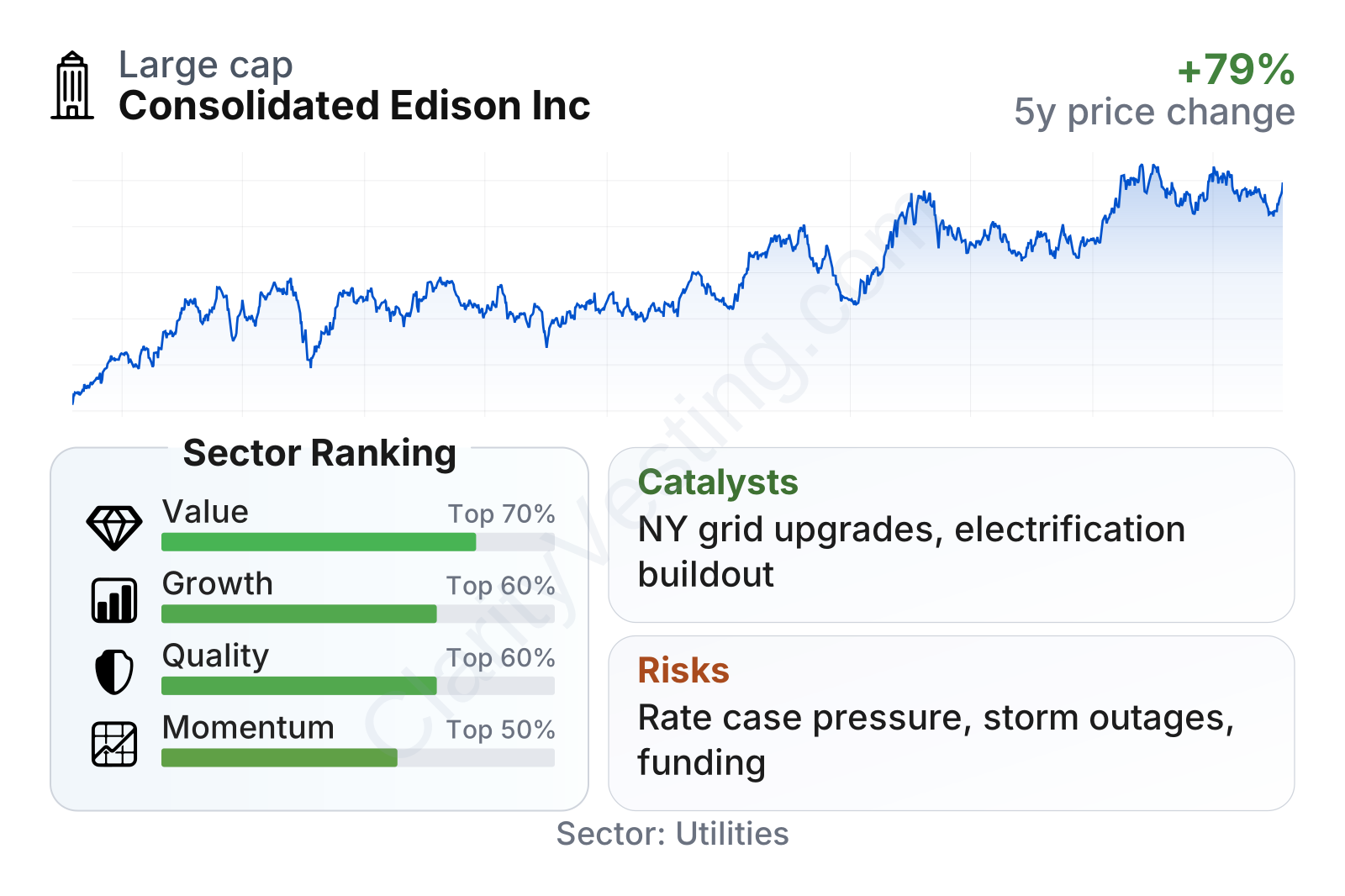
Con Edison stands out as a large utility with unusually low share-price volatility, reflected in a beta near 0.26. Relative to the utility sector, the overall profile looks balanced rather than extreme: value metrics are close to sector norms, quality is around the middle of the pack, growth ranks somewhat better than many regulated peers, and recent market momentum has been weaker. The dividend yield is around 3.4%, a little below the sector median, while free cash flow yield is notably strong at the moment. That combination suggests the market is treating Con Edison as a relatively stable, mature infrastructure company rather than a high-growth utility.
Growth
Con Edison operates in a sector that is not usually associated with rapid expansion, but it does benefit from long-duration structural demand. Electrification, grid modernization, building decarbonization, data usage growth, transit needs, and resilience spending all support ongoing investment in utility networks. In a dense region like New York, replacing aging infrastructure and adapting the grid for cleaner energy can create years of regulated capital deployment.
The company’s strategy is built around this logic. Instead of chasing volatile commodity exposure, Con Edison focuses on investing in transmission, distribution, reliability, safety, and clean-energy enabling infrastructure. For a regulated utility, that usually matters more than headline revenue growth because earnings are often tied to the approved return on invested capital and the size of the rate base.
Revenue per share has trended upward over the last five years, with some year-to-year variation. That is consistent with a utility that is expanding its regulated asset base and adjusting to rate cases rather than one dependent on cyclical demand surges. The recent revenue growth rate is ahead of the sector median, and the five-year revenue-per-share trend is also modestly better than many peers, which supports the view that Con Edison is still finding room to grow within a mature industry.
A meaningful recent improvement is cash generation. Free cash flow had been negative for several periods, which is common when utilities are in heavy investment cycles, but the latest trailing figure has turned clearly positive. That shift does not remove the capital intensity of the business, yet it does suggest better near-term financial flexibility than earlier in the cycle.
One of the clearest catalysts is the continued need for grid hardening and modernization in the New York region. Con Edison also remains exposed to policy trends favoring electrification and cleaner energy infrastructure, which can justify more regulated investment over time. In addition, because its customer base sits in one of the country’s most economically significant metropolitan areas, system upgrades tend to be essential rather than optional.
Recent company communications have also emphasized capital spending plans, reliability projects, and the regulatory framework supporting infrastructure recovery. For long-term analysis, that is important: in utilities, visible investment pipelines can be more meaningful than dramatic quarterly growth.
Risks
This article is for informational purposes only and does not constitute financial advice. Some content is AI-generated. See Disclaimer


