Stock Analysis · Encore Capital Group Inc (ECPG)
Overview
Encore Capital Group is a debt purchasing and recovery company. In simple terms, it buys portfolios of overdue consumer debt from banks, credit card issuers, telecom providers, and other lenders at a discount, then tries to collect more than it paid over time. The company operates mainly through two large platforms: Midland Credit Management in the United States and Cabot in Europe.
Its business is built around estimating how much cash a portfolio of delinquent accounts can generate over several years. If collections come in above purchase price and operating costs, Encore earns attractive returns. This model can look unusual compared with traditional lenders because revenue is tied to collections from debt already in default, not to making new loans.
The main revenue mix is not reported in a simple product-style breakdown because accounting centers on collections and portfolio returns rather than classic sales categories. Still, the operating structure is clear:
- Purchased debt portfolios in the United States: likely the largest earnings source, generated through Midland Credit Management. This includes charged-off credit card, consumer, and other receivable portfolios acquired from financial institutions.
- Purchased debt portfolios in Europe: a major second pillar, generated mainly through Cabot. This includes debt buying and collections across several European markets, with the U.K. as an important market.
- Third-party servicing and recovery activities: a much smaller contribution, where Encore collects or manages receivables for others rather than owning the debt itself.
Recent financial flow trends show a business that went through a difficult period in 2023 and 2024, when high interest expense and weaker profitability hurt results, but then rebounded sharply in 2025 as revenue and operating income recovered. That swing matters because it highlights both the earning power of the model and its sensitivity to financing costs and collection performance.
Key Figures
| Metric | Value | Sector ⓘ |
|---|---|---|
| Date | Oct 24, 2026 | |
| Context | ||
| Sector | Financial Services | |
| Industry | Credit Services | |
| Market Cap ⓘ | $2.21B | |
| Beta ⓘ | 1.31 | |
Value (Cheapness) | ||
| P/E Ratio ⓘ | 7.83 | 12.46 |
| P/B Ratio ⓘ | 2.12 | 1.25 |
| FCF Yield ⓘ | 5.88% | 9.82% |
| Dividend Yield ⓘ | N/A | 2.94% |
| EBIT / EV ⓘ | 11.38% | 8.11% |
| PEG ⓘ | 0.17 | |
Growth (Business expansion) | ||
| Revenue Growth ⓘ | 11.30% | 9.10% |
| RPS Growth (5Y CAGR) ⓘ | 9.64% | 12.31% |
| EPS Growth (5Y CAGR) ⓘ | -0.32% | -6.97% |
| BVPS Growth (5Y CAGR) ⓘ | 2.20% | 5.02% |
| Margin Growth (5Y Trend) ⓘ | -2.15% | -4.00% |
| FCF Growth (5Y CAGR) ⓘ | -17.17% | 4.71% |
| DPS Growth (5Y CAGR) ⓘ | N/A | 8.92% |
Quality (Business durability) | ||
| ROIC (Latest) ⓘ | 10.40% | 9.18% |
| ROE (Latest) ⓘ | 29.69% | 13.93% |
| ROA (Latest) ⓘ | 5.57% | 1.57% |
| ROIC (5Y Median) ⓘ | 7.04% | 7.80% |
| ROE (5Y Median) ⓘ | 16.45% | 12.15% |
| ROA (5Y Median) ⓘ | 4.27% | 1.28% |
| Net Debt / EBIT (Latest) ⓘ | 6.87 | 1.02 |
| Net Debt / EBIT (5Y Median) ⓘ | 6.37 | 0.72 |
| Net Debt / EBITDA (Latest) ⓘ | 6.60 | 0.88 |
| Operating Margin (Latest) ⓘ | 35.94% | 22.30% |
| Operating Margin (5Y Median) ⓘ | 33.20% | 24.50% |
| Debt to Equity (Latest) ⓘ | 451.57% | 59.34% |
| Profit Margin (Latest) ⓘ | 15.86% | 26.42% |
| Free Cash Flow (Latest) ⓘ | $130.00M | |
Momentum (Price trend) | ||
| 3Y Return ⓘ | +137.43% | +95.73% |
| 12M Return (excl. last month) ⓘ | +116.21% | +17.30% |
| 6M Return ⓘ | +20.32% | +6.07% |
| Price vs. 200-Day MA ⓘ | +22.60% | +5.36% |
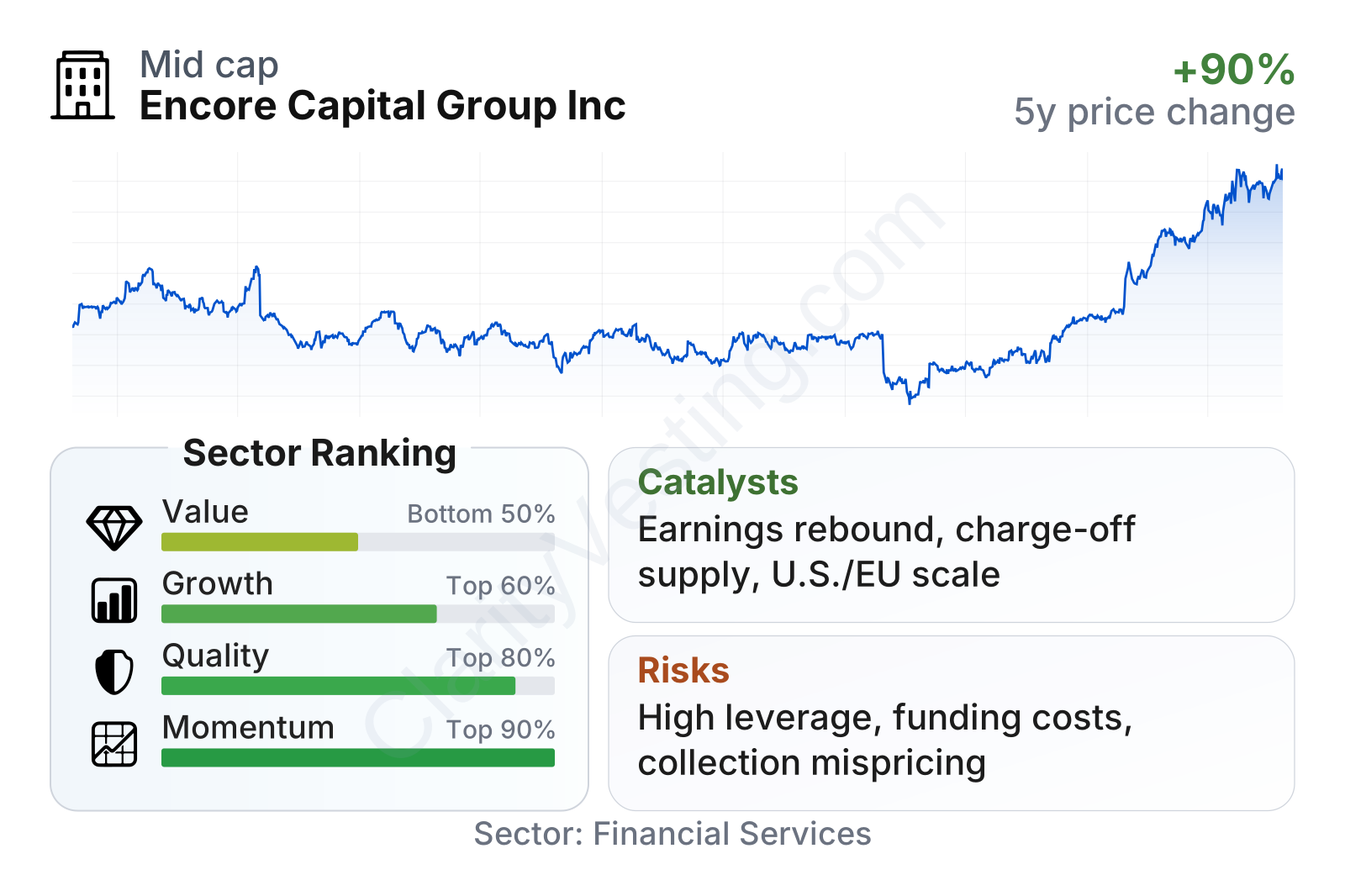
Encore is a mid-sized financial services company with a stock that has been volatile but very strong recently. Price momentum has been far ahead of the sector over the last 6 months, 12 months, and 3 years, reflecting the market’s recognition of its earnings recovery. On valuation, the earnings multiple is low at around 7x, but that needs to be read alongside a higher-than-sector price-to-book ratio and very elevated leverage. Quality metrics are strong versus peers, especially returns on equity, returns on assets, and operating margin, while growth is mixed: recent revenue growth is solid, but free cash flow and book value growth over a longer period are less impressive.
Growth
Encore operates in a niche that tends to remain relevant across economic cycles. Consumer credit is a large and recurring market, and whenever lenders charge off unpaid balances, someone needs the balance sheets, compliance systems, and analytics to price and collect those accounts. That gives Encore exposure to a structurally durable activity rather than a short-lived trend.
The company’s long-term growth case depends less on broad economic expansion and more on three practical factors: the supply of charged-off debt available for purchase, the prices paid for those portfolios, and Encore’s ability to collect efficiently. When banks tighten underwriting after a credit cycle weakens, future supply of defaulted receivables can rise. That can create more purchasing opportunities for scaled buyers such as Encore, especially if smaller competitors pull back.
Encore’s strategy also makes sense operationally. Scale matters in this industry because compliance, legal infrastructure, consumer contact operations, and data science are expensive to build but can be spread across many portfolios. Having major platforms in both the U.S. and Europe gives the company broader sourcing relationships and a more diversified opportunity set than a single-market collector.
The recent earnings pattern supports the view that the business has regained momentum after a weak patch. Profitability fell sharply in 2023 and turned negative in 2024, then rebounded strongly in 2025. That kind of recovery is important because it suggests prior pressure was not purely structural.
The earnings trend points to a business that can recover quickly when collections, pricing discipline, and cost absorption improve together. For long-term analysis, the key question is not whether results will be smooth from year to year—they likely will not—but whether Encore can continue to translate portfolio purchases into attractive multi-year cash returns.
Book value per share also helps show whether the company is rebuilding shareholder capital after the downturn.
Book value dipped in 2023 and 2024 and then recovered in 2025, which lines up with the broader earnings rebound. That recovery matters because debt buyers rely heavily on disciplined capital allocation. If management can grow book value steadily over several years while preserving returns, the business becomes easier to underwrite for a long horizon.
A meaningful recent catalyst has been the company’s return to stronger profitability and improved market confidence. The sharp share price recovery through 2026 indicates that the market is giving more credit to the rebound in earnings power. In addition, if charge-off volumes remain healthy and portfolio pricing stays rational, Encore may have room to deploy more capital at attractive returns.
Risks
This article is for informational purposes only and does not constitute financial advice. Some content is AI-generated. See Disclaimer


