Stock Analysis · Okeanis Eco Tankers Corp (ECO)
Overview
Okeanis Eco Tankers Corp is a crude oil shipping company. It owns and operates a modern fleet of large tankers that transport crude oil around the world, mainly on long-haul routes. The company focuses on “eco” vessels, meaning newer ships designed to consume less fuel than older tonnage. In a business where fuel efficiency, vessel age, and charter rates matter a lot, that positioning is central to how the company tries to compete.
The business is relatively simple to understand: Okeanis earns money by making its ships available to oil traders, producers, and charterers. Revenue depends mostly on how many ships are operating, how many days they are employed, and the freight rates available in the tanker market. Based on company disclosures, the revenue mix is overwhelmingly tied to crude tanker operations rather than a diversified set of business lines.
The main sources of revenue are approximately:
- VLCC operations: about 55% to 65% of revenue. These are Very Large Crude Carriers, used mainly for long-distance transport of crude oil in very large volumes.
- Suezmax operations: about 35% to 45% of revenue. These are smaller than VLCCs but still large crude tankers, often used on routes or at ports that cannot handle the biggest ships.
- Other operating income: usually a very small share when present, including items linked to vessel operations rather than a separate major business segment.
Geographically, the company is exposed to global seaborne crude flows rather than one domestic market. That means its results are influenced more by world oil trade patterns, fleet supply, route disruptions, and charter conditions than by consumer brands, retail demand, or product innovation.
Over the last several years, the business has shown a strong improvement in profitability compared with 2021, when interest costs absorbed much of the operating result. By 2023 through 2025, the company was converting a much larger share of revenue into operating income and net income, helped by stronger tanker markets and a still disciplined cost base. The broad picture is a shipping company with a focused niche, a premium fleet profile, and earnings that can move sharply with the freight cycle.
The flow from revenue to profit has become much more favorable than it was a few years ago. Operating costs have stayed relatively contained while revenue expanded sharply from 2021 levels, and interest expense has become less burdensome as earnings improved. That said, the business remains cyclical, so this stronger earnings conversion should be viewed as market-dependent rather than permanently fixed.
Key Figures
| Metric | Value | Sector ⓘ |
|---|---|---|
| Date | Oct 04, 2026 | |
| Context | ||
| Sector | Industrials | |
| Industry | Marine Shipping | |
| Market Cap ⓘ | $3.41B | |
| Beta ⓘ | -0.01 | |
Value (Cheapness) | ||
| P/E Ratio ⓘ | 8.09 | 22.45 |
| P/B Ratio ⓘ | 3.88 | 1.98 |
| FCF Yield ⓘ | 1.32% | 6.29% |
| Dividend Yield ⓘ | 11.14% | 1.96% |
| EBIT / EV ⓘ | 12.30% | 4.81% |
| PEG ⓘ | N/A | |
Growth (Business expansion) | ||
| Revenue Growth ⓘ | 239.40% | 9.10% |
| RPS Growth (5Y CAGR) ⓘ | 23.18% | 7.75% |
| EPS Growth (5Y CAGR) ⓘ | 35.67% | -13.59% |
| BVPS Growth (5Y CAGR) ⓘ | 12.28% | 6.22% |
| Margin Growth (5Y Trend) ⓘ | 15.91% | 0.72% |
| FCF Growth (5Y CAGR) ⓘ | 83.38% | 10.98% |
| DPS Growth (5Y CAGR) ⓘ | 116.12% | 9.48% |
Quality (Business durability) | ||
| ROIC (Latest) ⓘ | 25.84% | 10.92% |
| ROA (Latest) ⓘ | 29.61% | 5.41% |
| ROIC (5Y Median) ⓘ | 11.64% | 9.21% |
| ROA (5Y Median) ⓘ | 9.85% | 4.94% |
| Net Debt / EBIT (Latest) ⓘ | 1.15 | 2.07 |
| Net Debt / EBIT (5Y Median) ⓘ | 3.97 | 2.28 |
| Net Debt / EBITDA (Latest) ⓘ | 1.04 | 1.43 |
| Net Debt / Assets ⓘ | 30.31% | 19.27% |
| EBITDA / Interest ⓘ | 12.16 | 9.53 |
| Operating Margin (Latest) ⓘ | 61.35% | 10.50% |
| Operating Margin (5Y Median) ⓘ | 41.32% | 10.27% |
| Debt to Equity (Latest) ⓘ | 82.33% | 65.48% |
| Profit Margin (Latest) ⓘ | 56.92% | 6.62% |
| Free Cash Flow (Latest) ⓘ | $44.90M | |
Momentum (Price trend) | ||
| 3Y Return ⓘ | +383.40% | +58.56% |
| 12M Return (excl. last month) ⓘ | +206.21% | +16.33% |
| 6M Return ⓘ | +91.22% | +4.19% |
| Price vs. 200-Day MA ⓘ | +79.14% | +1.27% |
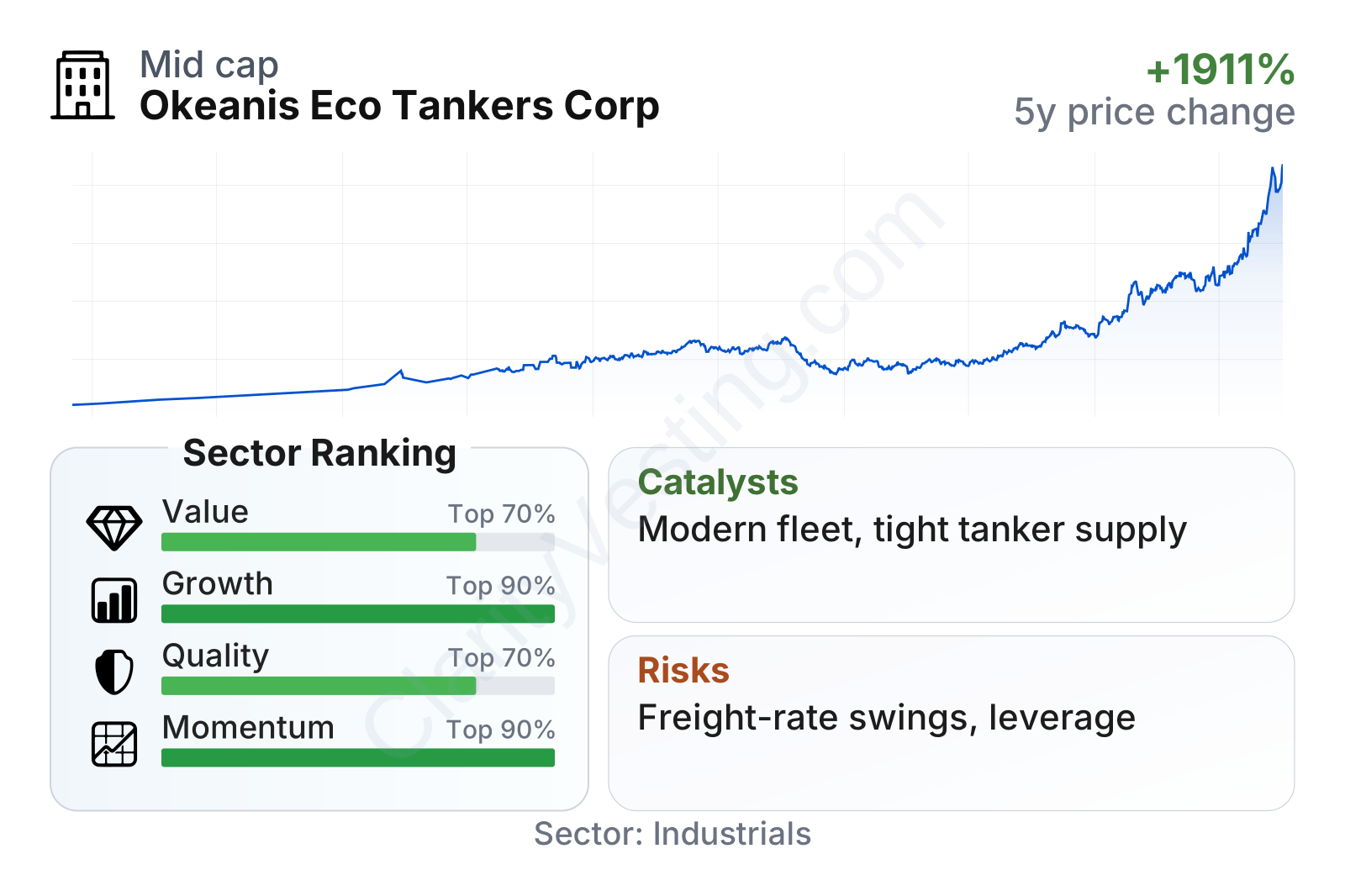
The recent market performance has been exceptionally strong, with the share price far above its level from a few years ago. In the broader sector ranking, the company stands out most on growth and momentum, while quality is also solid. Value is more mixed: the earnings multiple is low compared with the sector, but other measures such as price-to-book suggest the market is assigning a premium to the fleet quality and recent profitability.
Growth
Okeanis operates in a sector that is mature, but still capable of powerful upcycles. Crude oil shipping does not grow like software or consumer internet, yet it can expand meaningfully when vessel supply is tight, trading routes become longer, or older ships leave the market. For a company like Okeanis, growth is not mainly about launching new products. It comes from maintaining high fleet utilization, securing attractive charter rates, and benefiting from favorable supply-demand conditions in tanker shipping.
The company’s strategy makes sense within that framework. Its focus on a modern, fuel-efficient fleet is important because charterers often prefer newer ships, especially when fuel costs are high or environmental rules tighten. Newer vessels can also preserve asset values better than aging fleets. This does not eliminate cyclicality, but it can improve relative performance within the cycle.
Revenue growth has been volatile, which is normal in tanker shipping, but the most recent direction is notably strong. After a weaker stretch during 2024 and early 2025, growth reaccelerated sharply into 2026. That pattern suggests the company remains highly geared to freight market improvements: when rates recover, revenue can rise very quickly.
Cash generation has also been uneven. Free cash flow moved from strongly positive to negative again in the latest period shown, which highlights an important feature of shipping companies: accounting profits and cash flow do not always move together quarter to quarter, especially when vessel investments, debt movements, or working capital swings are involved. For long-term analysis, this means strong earnings should be checked against cash conversion over time rather than in a single quarter.
Several industry catalysts support the growth case. Global tanker supply has been constrained by limited shipyard capacity and a cautious newbuild environment across the industry. Environmental regulations can also make older vessels less competitive, which may support utilization and pricing for younger fleets. In addition, changes in trade routes linked to sanctions, geopolitics, and shifting crude sourcing can increase voyage distances, which effectively raises shipping demand even if oil volumes do not rise much.
Recent company developments have also reinforced the opportunity set. Management has continued to emphasize commercial flexibility between spot exposure and time-charter coverage, while highlighting the earning power of its modern fleet. In a strong freight environment, that flexibility can allow the company to capture more upside than operators locked into low fixed rates.
Risks
This article is for informational purposes only and does not constitute financial advice. Some content is AI-generated. See Disclaimer