Stock Analysis · Dycom Industries Inc (DY)
Overview
Dycom Industries is a specialty contracting company that builds, upgrades, and maintains communications infrastructure. In simple terms, it does the field work that helps broadband, fiber, wireless, and utility networks function and expand. Its crews handle tasks such as underground and aerial construction, engineering, installation, maintenance, and program management for large network owners across the United States.
The business is heavily tied to telecom and broadband capital spending. Dycom works mainly for major communications service providers, cable operators, telecom carriers, and some utilities that are extending fiber or supporting network upgrades. The company does not primarily sell a product; it sells labor-intensive services and project execution.
Based on company disclosures, Dycom’s revenue is concentrated in a relatively small number of large customers, with the largest communications and cable network operators accounting for most sales. Exact customer mix can change from year to year, but revenue is primarily generated from U.S. telecommunications infrastructure programs rather than from diversified end markets.
The main revenue sources can be understood as follows:
- Telecommunications and broadband construction services: likely well above 80% of revenue. This includes fiber deployment, network expansion, aerial and underground construction, and related field services for cable and telecom operators.
- Engineering, design, and program management: a smaller but important share, tied to planning, permitting, and supervising communications network projects.
- Maintenance and fulfillment work: a more recurring portion, including repair, upgrades, and support services for existing network infrastructure.
- Utility-related and other infrastructure services: a limited share, including certain electric and other network support projects.
One notable financial trend is that revenue has climbed strongly over the last several years, while operating income and net income have risen faster than sales. That suggests execution has improved and scale has started to matter more.
Key Figures
| Metric | Value | Sector ⓘ |
|---|---|---|
| Date | Oct 17, 2026 | |
| Context | ||
| Sector | Industrials | |
| Industry | Engineering & Construction | |
| Market Cap ⓘ | $8.13B | |
| Beta ⓘ | 1.50 | |
Value (Cheapness) | ||
| P/E Ratio ⓘ | 24.62 | 22.10 |
| P/B Ratio ⓘ | 3.82 | 1.97 |
| FCF Yield ⓘ | 5.76% | 6.38% |
| Dividend Yield ⓘ | N/A | 1.94% |
| EBIT / EV ⓘ | 7.06% | 4.79% |
| PEG ⓘ | 3.50 | |
Growth (Business expansion) | ||
| Revenue Growth ⓘ | 45.60% | 9.30% |
| RPS Growth (5Y CAGR) ⓘ | 16.74% | 7.81% |
| EPS Growth (5Y CAGR) ⓘ | 22.77% | -13.06% |
| BVPS Growth (5Y CAGR) ⓘ | 26.61% | 6.14% |
| Margin Growth (5Y Trend) ⓘ | 5.09% | 0.88% |
| FCF Growth (5Y CAGR) ⓘ | 27.58% | 11.01% |
| DPS Growth (5Y CAGR) ⓘ | N/A | 9.48% |
Quality (Business durability) | ||
| ROIC (Latest) ⓘ | 15.74% | 10.84% |
| ROA (Latest) ⓘ | 6.68% | 5.41% |
| ROIC (5Y Median) ⓘ | 10.59% | 9.38% |
| ROA (5Y Median) ⓘ | 6.42% | 4.95% |
| Net Debt / EBIT (Latest) ⓘ | 3.43 | 2.08 |
| Net Debt / EBIT (5Y Median) ⓘ | 3.03 | 2.27 |
| Net Debt / EBITDA (Latest) ⓘ | 2.32 | 1.39 |
| Net Debt / Assets ⓘ | 41.41% | 19.28% |
| EBITDA / Interest ⓘ | 10.57 | 9.58 |
| Operating Margin (Latest) ⓘ | 11.48% | 10.50% |
| Operating Margin (5Y Median) ⓘ | 7.83% | 10.29% |
| Debt to Equity (Latest) ⓘ | 147.70% | 65.48% |
| Profit Margin (Latest) ⓘ | 4.79% | 6.67% |
| Free Cash Flow (Latest) ⓘ | $468.67M | |
Momentum (Price trend) | ||
| 3Y Return ⓘ | +211.63% | +61.68% |
| 12M Return (excl. last month) ⓘ | +11.24% | +12.58% |
| 6M Return ⓘ | -33.73% | 0.00% |
| Price vs. 200-Day MA ⓘ | -32.58% | +0.02% |
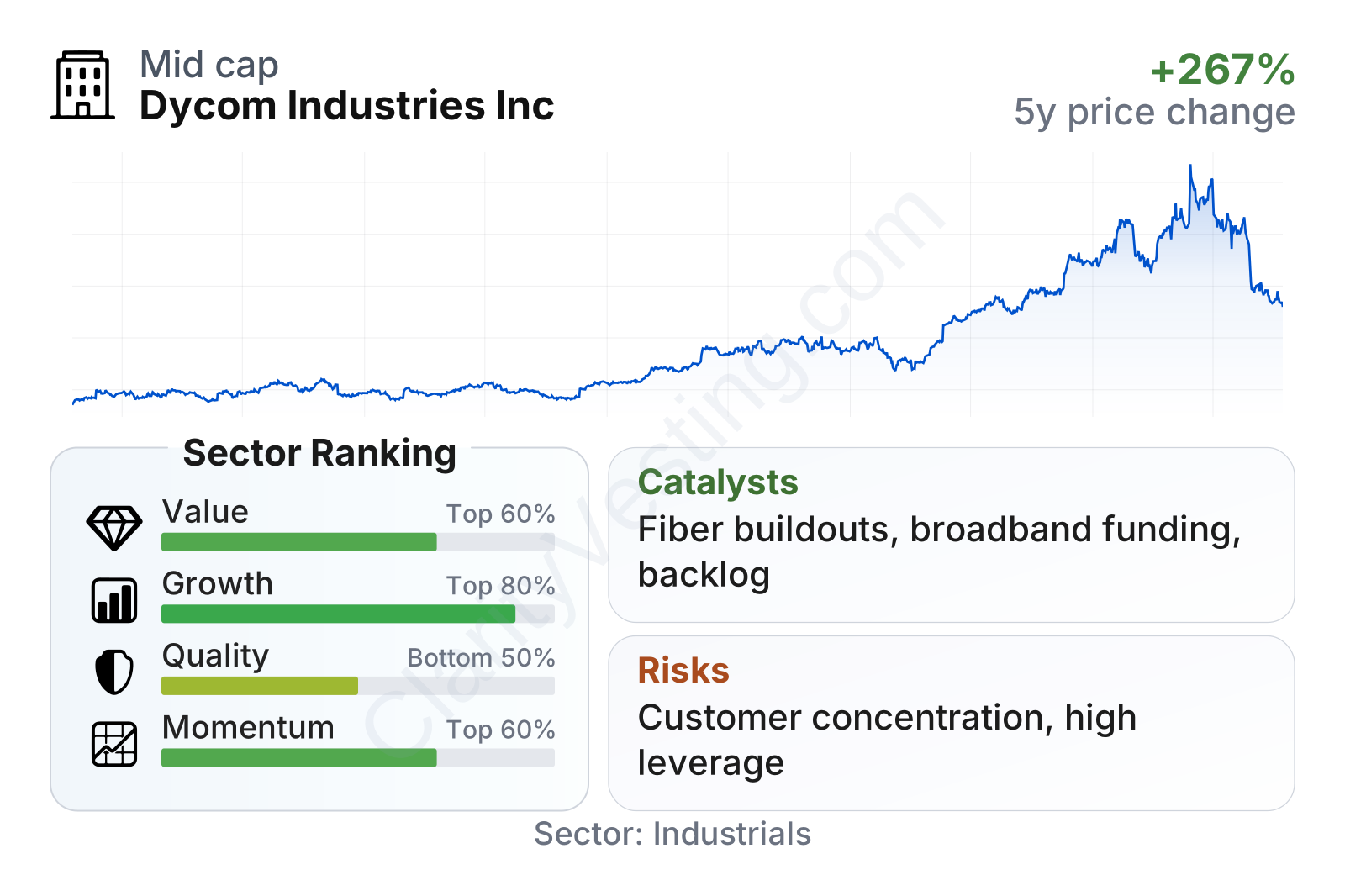
Dycom is now a large public contractor by market value, with a stock that has been much more volatile than the broader market. The factor mix is unusual: growth ranks very high versus the industrial sector, while balance-sheet-related quality measures look weaker. Profitability on capital is solid, but leverage is elevated, which pulls down the overall quality profile. Valuation is not extreme for a company growing this quickly, but it is no longer obviously cheap on traditional multiples.
Growth
Dycom operates in a part of the market that still benefits from long-duration demand. Broadband expansion, fiber-to-the-home buildouts, increasing network capacity needs, and rural connectivity funding all support continued infrastructure work. This is not a short-lived niche. The U.S. still has major investment needs in high-speed communications networks, and the workload extends beyond initial construction into upgrades, densification, and maintenance.
The company’s strategy also looks coherent for this environment. Dycom has built a national scale platform, long-standing customer relationships, and broad in-field capabilities. That matters because large network owners increasingly want contractors that can handle planning, permitting, construction, and support across multiple states. The more network spending shifts toward big multi-year programs, the more scale and execution consistency can matter.
Growth has accelerated sharply in the latest period. Recent year-over-year revenue gains moved from already healthy double-digit levels to much faster expansion, clearly ahead of the typical company in the sector. Over a five-year view, revenue per share, earnings per share, and book value per share have all compounded at rates that stand out in industrials.
Cash generation has improved even more dramatically than revenue. Free cash flow was uneven a few years ago, including a negative period, but the latest trailing figure shows a major step-up. That suggests stronger project economics, better working-capital conversion, or both. When a contractor can turn growth into significantly larger cash flow, it strengthens the case that expansion is translating into real business value rather than only accounting profits.
A meaningful catalyst is the continued rollout of fiber networks by major communications customers and the broader push to bring high-speed internet to underserved areas. Public broadband funding programs and private network upgrades can both feed Dycom’s backlog. Recent company updates have also pointed to robust customer demand and a larger volume of awarded work, which supports the view that current momentum is tied to underlying market demand rather than a one-off quarter.
Risks
This article is for informational purposes only and does not constitute financial advice. Some content is AI-generated. See Disclaimer


