Stock Analysis · DexCom Inc (DXCM)
Overview
DexCom is a medical device company focused on continuous glucose monitoring, usually called CGM. Its systems measure glucose levels throughout the day and night through a small wearable sensor, then send readings to a receiver or smartphone app. The main users are people living with diabetes, but the company is also expanding into broader metabolic health use cases. DexCom’s products are designed to help users track glucose trends in real time, reduce fingersticks, and improve daily disease management.
The business model is relatively straightforward: DexCom places a monitoring platform with a user, and then generates recurring sales as sensors need to be replaced regularly. That creates a revenue base that is more repeat-driven than one-time equipment sales. Based on company filings, most revenue comes from the United States, with international markets representing a growing but smaller share.
Its revenue sources are concentrated in a few categories:
- Sensors and other disposable CGM supplies: approximately 70% to 80% of revenue. This is the largest source because sensors are replaced frequently and drive recurring demand.
- Transmitters, receivers, and starter kits: approximately 15% to 25% of revenue. These are the hardware components needed to begin or maintain use of the CGM system.
- Collaboration, licensing, and other revenue: generally a small contribution, typically below 10%. This can include partnerships, technology-related arrangements, and other smaller items.
Over the last several years, the company has scaled revenue materially while also improving profitability. Gross profit has expanded faster than total operating expenses, and net income has risen strongly from the low hundreds of millions of dollars to well above that level. Research and development spending has also remained meaningful, which is important in a device category where product upgrades, sensor accuracy, and ease of use directly affect adoption.
The business mix shows an attractive pattern for a long-term medical technology company: rising sales, improving operating income, and a large gross profit pool that can fund product development and global expansion.
Key Figures
| Metric | Value | Sector ⓘ |
|---|---|---|
| Date | Oct 17, 2026 | |
| Context | ||
| Sector | Healthcare | |
| Industry | Medical Devices | |
| Market Cap ⓘ | $31.50B | |
| Beta ⓘ | 1.48 | |
Value (Cheapness) | ||
| P/E Ratio ⓘ | 33.79 | 24.79 |
| P/B Ratio ⓘ | 13.11 | 3.08 |
| FCF Yield ⓘ | 4.46% | 3.15% |
| Dividend Yield ⓘ | N/A | 1.94% |
| EBIT / EV ⓘ | 3.98% | 0.57% |
| PEG ⓘ | 1.35 | |
Growth (Business expansion) | ||
| Revenue Growth ⓘ | 13.10% | 7.45% |
| RPS Growth (5Y CAGR) ⓘ | 19.12% | 8.61% |
| EPS Growth (5Y CAGR) ⓘ | 10.39% | -17.81% |
| BVPS Growth (5Y CAGR) ⓘ | 9.20% | 3.72% |
| Margin Growth (5Y Trend) ⓘ | 12.48% | -0.62% |
| FCF Growth (5Y CAGR) ⓘ | 112.03% | 1.04% |
| DPS Growth (5Y CAGR) ⓘ | N/A | 6.77% |
Quality (Business durability) | ||
| ROIC (Latest) ⓘ | 23.49% | 3.24% |
| ROA (Latest) ⓘ | 14.33% | 3.01% |
| ROIC (5Y Median) ⓘ | 12.95% | 4.60% |
| ROA (5Y Median) ⓘ | 9.04% | 1.89% |
| Net Debt / EBIT (Latest) ⓘ | 0.23 | 1.34 |
| Net Debt / EBIT (5Y Median) ⓘ | 2.78 | 1.84 |
| Net Debt / EBITDA (Latest) ⓘ | 0.19 | 1.00 |
| Net Debt / Assets ⓘ | 4.55% | 5.45% |
| EBITDA / Interest ⓘ | 103.94 | 9.64 |
| Operating Margin (Latest) ⓘ | 26.06% | 9.27% |
| Operating Margin (5Y Median) ⓘ | 18.05% | 7.38% |
| Debt to Equity (Latest) ⓘ | 53.35% | 28.58% |
| Profit Margin (Latest) ⓘ | 20.12% | 3.59% |
| Free Cash Flow (Latest) ⓘ | $1.41B | |
Momentum (Price trend) | ||
| 3Y Return ⓘ | +11.10% | +42.80% |
| 12M Return (excl. last month) ⓘ | +14.38% | +18.50% |
| 6M Return ⓘ | +42.53% | +7.57% |
| Price vs. 200-Day MA ⓘ | +18.73% | +5.12% |
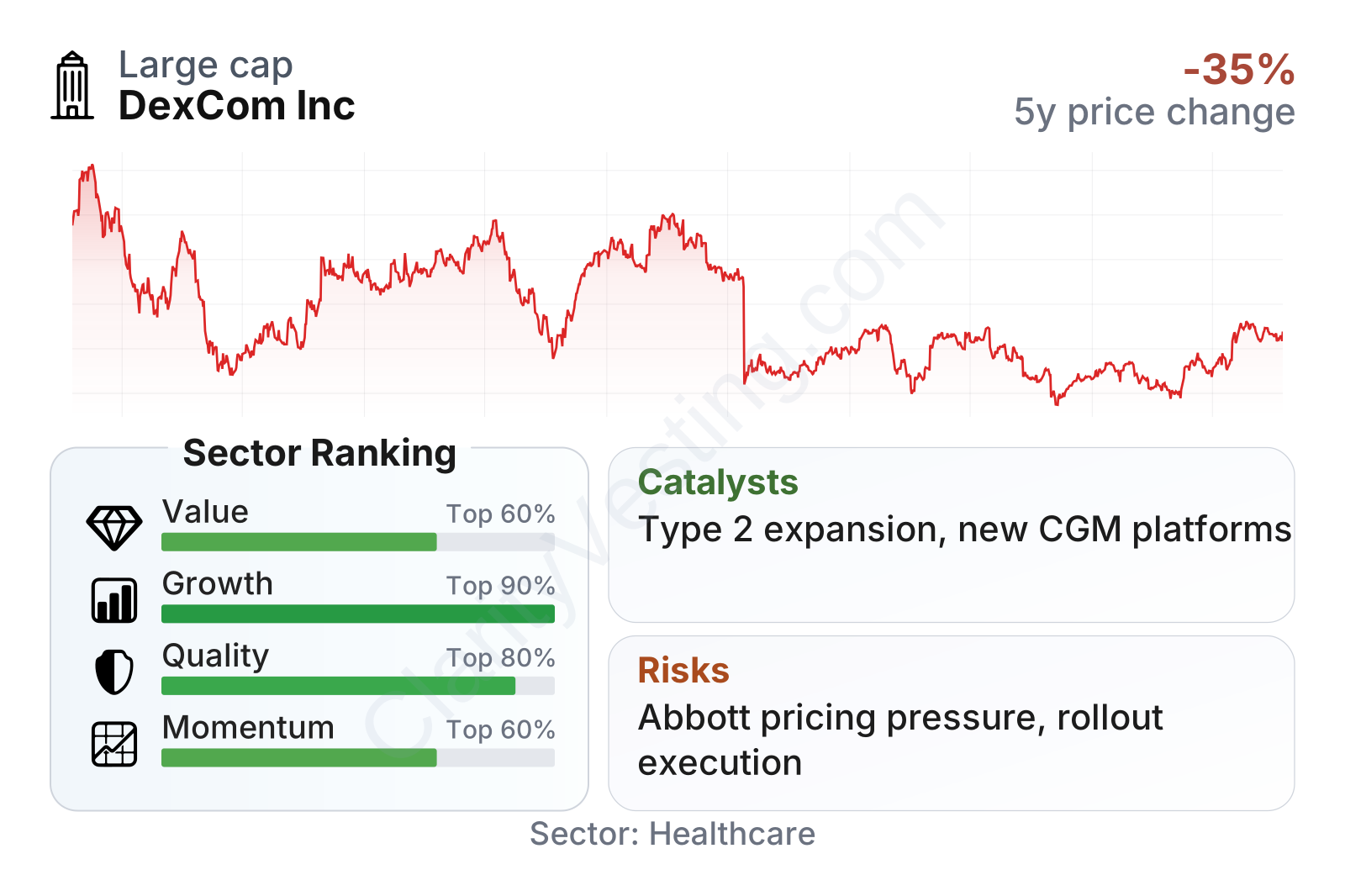
DexCom stands out more for growth and business quality than for cheap valuation. Revenue growth remains ahead of the sector median, margins are notably stronger than many healthcare peers, and returns on capital are high. Free cash flow generation has also become a much bigger part of the picture. On the other hand, the stock still trades at above-median earnings and book multiples, which means the market continues to assign a premium to its business profile.
Share price history also shows that this is not a low-volatility stock. The stock has experienced several deep swings over the last few years, even while the underlying company continued to grow. That gap between business progress and stock performance is important for anyone evaluating the name over a multi-year period.
Growth
DexCom operates in a sector with favorable long-term demand. Diabetes remains a large and growing global health issue, and glucose monitoring is moving toward more continuous, connected, and user-friendly systems. CGM penetration still has room to expand across intensive insulin users, Type 2 diabetes patients, and international markets. That gives the company exposure to both medical need and technology adoption.
The company’s strategy also fits that opportunity. DexCom has focused on making its systems smaller, easier to use, and more broadly compatible with phones, digital health tools, and insulin delivery platforms. It has also been investing in pharmacy channel access and international distribution, which can widen adoption beyond the traditional specialist-prescriber base. For a recurring-revenue device business, easier onboarding and broader reimbursement are major drivers of future scale.
Growth has clearly normalized from the exceptionally strong periods seen earlier, but it remains solid. Recent year-over-year revenue growth has generally stayed in the low-to-mid teens after previously running much higher. That slowdown matters, yet it still places DexCom above the sector median and suggests the business is growing faster than many healthcare companies of similar size.
Cash generation is one of the more encouraging developments. Free cash flow has moved from relatively modest levels a few years ago to roughly $1.4 billion on a trailing basis. That kind of increase gives the company more flexibility to fund manufacturing, product launches, international expansion, and software ecosystem development without relying heavily on outside financing.
Recent company developments continue to support the long-term case. DexCom has been pushing newer-generation platforms, including simpler sensor insertion and longer usability improvements, while also working with connected insulin delivery and digital health partners. Another important opportunity is the expansion of CGM use among people with Type 2 diabetes who are not intensive insulin users, a much larger population than the company’s traditional core market. If reimbursement and physician adoption continue broadening, that addressable market could become a meaningful catalyst.
There is also a strategic opening in non-intensive care and consumer-oriented metabolic tracking. This area is earlier-stage and less predictable than the core diabetes business, but it offers optionality beyond the company’s established patient base. For a business already strong in sensor design, app connectivity, and glucose analytics, that extension is logical.
Risks
This article is for informational purposes only and does not constitute financial advice. Some content is AI-generated. See Disclaimer


