Stock Analysis · DaVita HealthCare Partners Inc (DVA)
Overview
DaVita HealthCare Partners Inc is a U.S.-focused kidney care company best known for operating dialysis centers. Its core business is treating patients with chronic kidney failure, especially people with end stage kidney disease who need dialysis several times per week. The company also provides related clinical support such as laboratory services, pharmacy activities tied to kidney care, care coordination, and some home dialysis support.
The business is relatively easy to understand: DaVita earns money primarily when it delivers dialysis treatments and associated care services, with reimbursement coming largely from government programs and commercial insurers. Because kidney failure patients need ongoing treatment, demand is recurring rather than one-time, which gives the company a fairly stable operating base.
Based on recent annual reporting, DaVita’s revenue mix is highly concentrated in kidney care services.
- U.S. dialysis and related patient services: approximately 85% to 90% of revenue. This includes in-center hemodialysis treatments, home dialysis support, physician-related kidney care arrangements, lab services, and other ancillary services tied to dialysis patients.
- Capitated and integrated kidney care arrangements: approximately 10% to 15% of revenue. This includes value-based care contracts, care coordination, and population health programs for patients with chronic kidney disease and end stage kidney disease.
- Other activities: low single-digit percentage or less when separated, depending on classification in company reporting. These can include international or non-core items, but the company today is overwhelmingly driven by U.S. kidney care.
Over the last several years, the business has remained centered on a narrow but essential service line. That focus is a strength because it creates specialization, but it also means performance depends heavily on dialysis economics, reimbursement rates, labor efficiency, and patient volumes.
The long-term financial pattern shows a business with gradually rising revenue and a meaningful recovery in operating profit after a tougher 2022 period. A notable change more recently is that interest expense has climbed, which means more of the operating profit is being absorbed by financing costs.
Key Figures
| Metric | Value | Sector ⓘ |
|---|---|---|
| Date | Oct 24, 2026 | |
| Context | ||
| Sector | Healthcare | |
| Industry | Medical Care Facilities | |
| Market Cap ⓘ | $11.28B | |
| Beta ⓘ | 0.80 | |
Value (Cheapness) | ||
| P/E Ratio ⓘ | 14.93 | 25.42 |
| P/B Ratio ⓘ | N/A | 3.08 |
| FCF Yield ⓘ | 14.27% | 3.12% |
| Dividend Yield ⓘ | N/A | 1.85% |
| EBIT / EV ⓘ | 8.41% | 0.56% |
| PEG ⓘ | 0.45 | |
Growth (Business expansion) | ||
| Revenue Growth ⓘ | 5.20% | 7.50% |
| RPS Growth (5Y CAGR) ⓘ | 10.02% | 8.60% |
| EPS Growth (5Y CAGR) ⓘ | 3.99% | -17.73% |
| BVPS Growth (5Y CAGR) ⓘ | -9.87% | 3.72% |
| Margin Growth (5Y Trend) ⓘ | -1.40% | -0.57% |
| FCF Growth (5Y CAGR) ⓘ | 0.41% | 0.96% |
| DPS Growth (5Y CAGR) ⓘ | 25.15% | 6.69% |
Quality (Business durability) | ||
| ROIC (Latest) ⓘ | 16.62% | 3.17% |
| ROA (Latest) ⓘ | 4.78% | 2.98% |
| ROIC (5Y Median) ⓘ | 15.05% | 4.56% |
| ROA (5Y Median) ⓘ | 4.30% | 1.87% |
| Net Debt / EBIT (Latest) ⓘ | 4.93 | 1.34 |
| Net Debt / EBIT (5Y Median) ⓘ | 6.81 | 1.86 |
| Net Debt / EBITDA (Latest) ⓘ | 3.66 | 1.00 |
| Net Debt / Assets ⓘ | 57.10% | 5.06% |
| EBITDA / Interest ⓘ | 4.93 | 9.55 |
| Operating Margin (Latest) ⓘ | 14.65% | 9.25% |
| Operating Margin (5Y Median) ⓘ | 14.12% | 7.33% |
| Debt to Equity (Latest) ⓘ | -1409.11% | 26.68% |
| Profit Margin (Latest) ⓘ | 6.05% | 3.34% |
| Free Cash Flow (Latest) ⓘ | $1.61B | |
Momentum (Price trend) | ||
| 3Y Return ⓘ | +135.96% | +51.61% |
| 12M Return (excl. last month) ⓘ | +40.08% | +19.90% |
| 6M Return ⓘ | +22.10% | +10.10% |
| Price vs. 200-Day MA ⓘ | +6.52% | +6.44% |
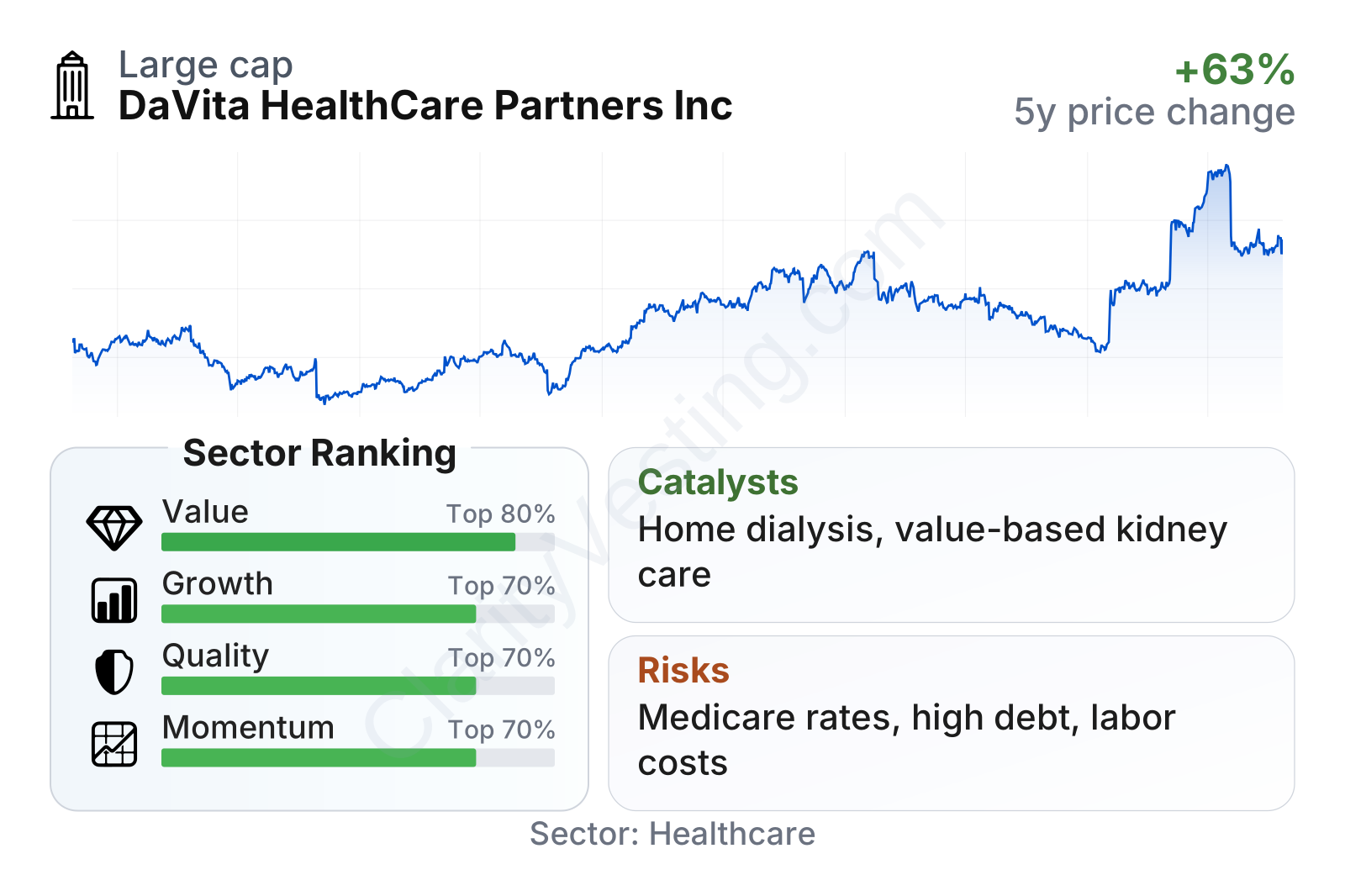
DaVita is a mid-to-large healthcare company with a defensive share-price profile relative to the broader market, as reflected by a beta below 1. The overall metric profile is stronger than it may first appear: profitability and returns on capital are solid versus the healthcare sector median, while cash generation is especially strong. The weaker area is balance-sheet structure, where leverage stands out as materially higher than most healthcare peers. Growth is positive, but not exceptionally fast, which fits the nature of a mature healthcare services business.
The stock has also had a strong multi-year run, even though the path was not smooth. After a sharp decline in 2022, the share price recovered strongly through 2024 and then accelerated again in 2026. That suggests the market has become more confident in earnings durability and cash flow, but it also means expectations are no longer as low as they were during the downturn.
Growth
DaVita operates in a sector with durable underlying demand. Chronic kidney disease and end stage kidney disease are supported by long-term demographic forces such as aging populations, diabetes, hypertension, and obesity. These are not fast-moving trends, but they create a steady need for dialysis and related kidney care over many years. That makes the sector attractive from a visibility standpoint, even if growth tends to be moderate rather than explosive.
The company’s strategy also makes practical sense for future growth. DaVita is not trying to become a broad hospital or insurance platform. Instead, it is deepening its role within kidney care by combining clinic-based dialysis, home treatment options, and value-based care programs. That can help in two ways: it may improve patient retention within DaVita’s network, and it may allow the company to capture a larger share of spending around the same patient population.
Recent revenue growth has been steady rather than spectacular, generally running in the mid-single-digit range after the low-growth period seen in 2022. That is slower than some parts of healthcare, but it is respectable for a mature care-delivery company. Over a five-year period, revenue per share growth has been better than the healthcare sector median, which suggests DaVita has created shareholder value even without rapid top-line expansion.
Cash flow is one of the more encouraging parts of the picture. Free cash flow has remained substantial, even with some year-to-year volatility. For a business that operates a large clinic network and carries debt, consistent cash generation matters because it supports debt service, share repurchases, and operational investment. DaVita’s free cash flow yield is well above the sector median, which points to a business that is converting a meaningful share of earnings into cash.
A further catalyst is the continuing shift toward home dialysis and integrated kidney care models. Home-based treatment can be more convenient for some patients and may be attractive to payers if it helps manage costs and outcomes. Value-based care contracts are another potential growth lever because they reward care coordination rather than just treatment volume. If DaVita executes well, these models could gradually strengthen margins and deepen relationships with insurers and health systems.
Recent company updates have also highlighted ongoing operating discipline, including productivity actions and cost management efforts. In a labor-intensive healthcare business, even moderate improvements in staffing efficiency can have a meaningful effect on earnings.
Risks
This article is for informational purposes only and does not constitute financial advice. Some content is AI-generated. See Disclaimer


