Stock Analysis · Duke Energy Corporation (DUK)
Overview
Duke Energy is one of the largest regulated electric and gas utilities in the United States. It generates, transmits, distributes, and sells electricity, and it also distributes natural gas. Its service territories are concentrated in the Carolinas, Florida, Indiana, Ohio, and Kentucky, giving the company a large customer base in fast-growing parts of the Southeast and Midwest. For long-term analysis, the key point is that Duke’s business is built around essential infrastructure: power grids, power plants, substations, and gas distribution networks. That usually makes demand steadier than in most industries, although returns are heavily shaped by regulation.
The company’s revenue is mainly driven by regulated utility operations. Based on recent annual reporting, the business mix is broadly concentrated as follows:
- Electric Utilities and Infrastructure: about 85% to 90% of revenue. This includes electricity generation, transmission, distribution, and retail sales to residential, commercial, and industrial customers across Duke’s regulated service areas.
- Gas Utilities and Infrastructure: about 10% to 15% of revenue. This includes natural gas distribution, transportation, storage, and related services, primarily through Piedmont Natural Gas and Duke’s Midwest gas operations.
- Other and eliminations: low single-digit share when present. This can include miscellaneous energy-related activities and intersegment adjustments, but these are not the main earnings engine.
What matters most is that Duke has become increasingly focused on regulated operations after exiting many merchant and international businesses in prior years. That simplifies the company: it now depends more on approved capital spending plans, customer growth, and rate cases than on commodity trading or volatile wholesale power markets.
The multi-year income trend shows a business with gradually rising revenue and operating income, while interest expense has also climbed as debt has increased to fund major infrastructure investment. Net income has generally moved higher despite that financing burden, which is typical for a utility expanding its regulated asset base.
Key Figures
| Metric | Value | Sector ⓘ |
|---|---|---|
| Date | Oct 17, 2026 | |
| Context | ||
| Sector | Utilities | |
| Industry | Utilities - Regulated Electric | |
| Market Cap ⓘ | $92.15B | |
| Beta ⓘ | 0.34 | |
Value (Cheapness) | ||
| P/E Ratio ⓘ | 17.72 | 17.28 |
| P/B Ratio ⓘ | 1.77 | 1.51 |
| FCF Yield ⓘ | -4.64% | 0.65% |
| Dividend Yield ⓘ | 3.62% | 3.77% |
| EBIT / EV ⓘ | 5.37% | 5.01% |
| PEG ⓘ | 2.13 | |
Growth (Business expansion) | ||
| Revenue Growth ⓘ | 1.10% | 6.10% |
| RPS Growth (5Y CAGR) ⓘ | 6.18% | 3.87% |
| EPS Growth (5Y CAGR) ⓘ | -11.58% | -11.30% |
| BVPS Growth (5Y CAGR) ⓘ | 2.46% | 4.23% |
| Margin Growth (5Y Trend) ⓘ | 3.57% | 3.57% |
| FCF Growth (5Y CAGR) ⓘ | N/A | -8.84% |
| DPS Growth (5Y CAGR) ⓘ | 1.20% | 4.84% |
Quality (Business durability) | ||
| ROIC (Latest) ⓘ | 5.95% | 6.53% |
| ROA (Latest) ⓘ | 2.67% | 3.20% |
| ROIC (5Y Median) ⓘ | 5.67% | 5.95% |
| ROA (5Y Median) ⓘ | 2.16% | 2.75% |
| Net Debt / EBIT (Latest) ⓘ | 9.29 | 7.13 |
| Net Debt / EBIT (5Y Median) ⓘ | 10.31 | 7.23 |
| Net Debt / EBITDA (Latest) ⓘ | 5.18 | 4.31 |
| Net Debt / Assets ⓘ | 45.04% | 38.42% |
| EBITDA / Interest ⓘ | 4.64 | 4.58 |
| Operating Margin (Latest) ⓘ | 29.21% | 20.83% |
| Operating Margin (5Y Median) ⓘ | 26.78% | 20.08% |
| Debt to Equity (Latest) ⓘ | 166.64% | 137.69% |
| Profit Margin (Latest) ⓘ | 16.00% | 11.37% |
| Free Cash Flow (Latest) ⓘ | -$4.27B | |
Momentum (Price trend) | ||
| 3Y Return ⓘ | +51.04% | +52.37% |
| 12M Return (excl. last month) ⓘ | +1.02% | +8.84% |
| 6M Return ⓘ | -6.20% | -3.95% |
| Price vs. 200-Day MA ⓘ | -2.32% | -0.79% |
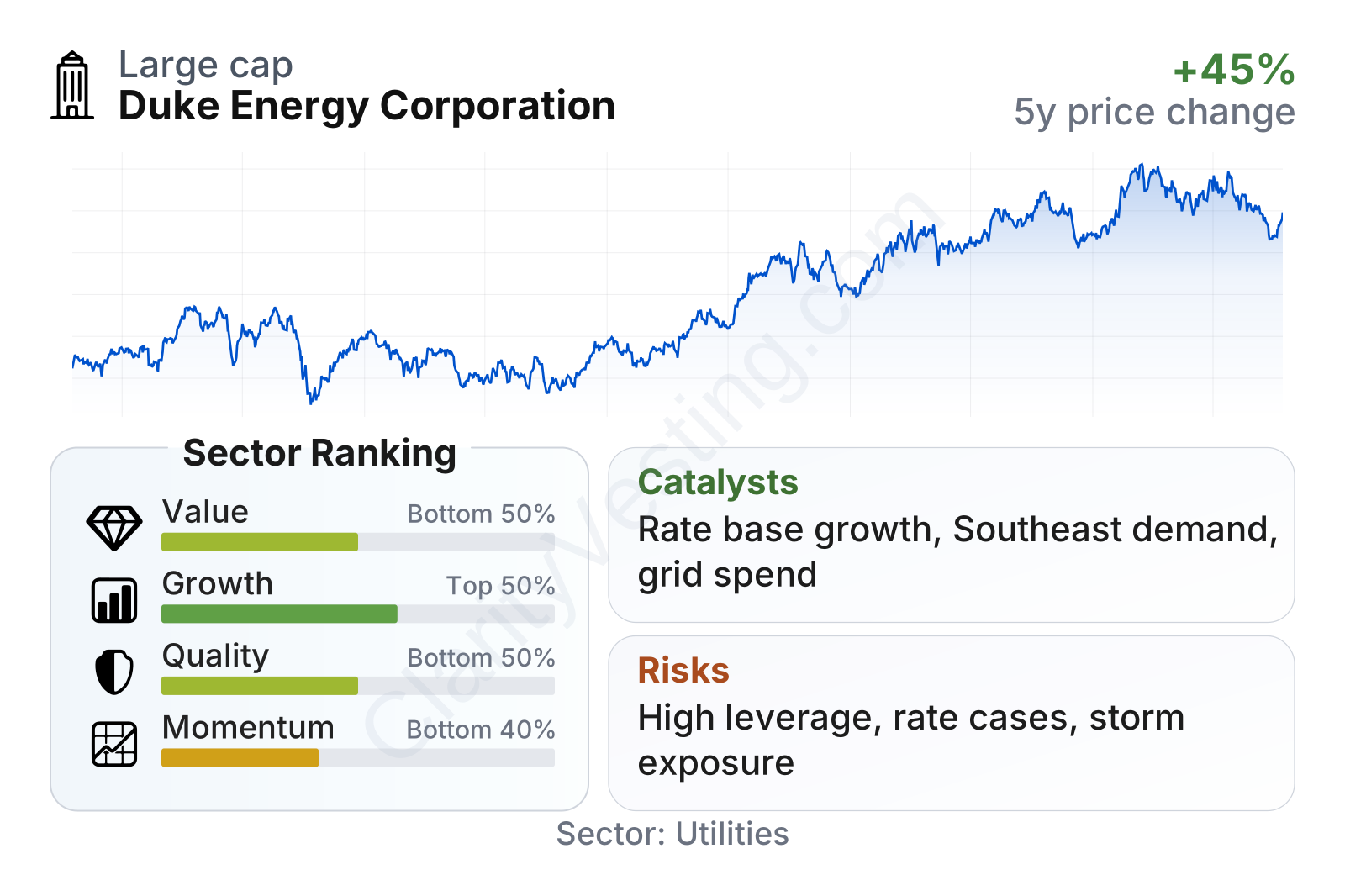
Duke Energy is a very large utility with low share-price volatility, reflected in a beta well below 1. In relative terms, its valuation metrics sit around the middle of the utility sector, while growth characteristics are also around the middle. Profitability is better than many peers on margins, but balance-sheet quality is weaker because leverage is above sector norms. Market momentum has been softer recently, with the stock trailing many utility peers over shorter periods even after a strong longer-term rise.
Growth
Duke operates in a sector with steady long-term relevance rather than rapid disruption. Electricity demand is receiving renewed support from population growth, industrial reshoring, data centers, grid modernization, and broader electrification of transportation and buildings. For a regulated utility, growth usually does not come from launching new products; it comes from expanding the asset base on which regulators allow a return. In that sense, Duke is in a favorable part of the market because several of its territories, especially in the Southeast, continue to attract people and businesses.
The company’s strategy is built around very large capital investment programs in grid upgrades, generation replacement, transmission expansion, and cleaner energy resources. That approach is coherent with the industry’s direction. Utilities with room to invest in regulated infrastructure can often produce visible earnings growth over long periods, provided regulators remain constructive. Duke has repeatedly emphasized reliability, cleaner generation, and system modernization, which align with what state commissions typically want utilities to deliver.
Revenue per share has trended upward over the last five years, showing that Duke has been able to expand its business base over time. Recent annual growth has been modest, but the longer trend is more encouraging than the latest year alone suggests.
Free cash flow is more uneven, which is common for utilities undertaking heavy capital spending. Duke moved from deeply negative levels to positive trailing free cash flow more recently, indicating that cash generation has improved after a period of intense investment pressure. That is a useful sign, even if it should not be expected to move in a straight line from one period to the next.
Another important catalyst is the possibility of rising electricity demand from large-load customers. Duke’s service territories have been discussing and planning for higher needs tied to manufacturing, infrastructure expansion, and digital infrastructure. In a regulated model, sustained demand growth can support larger capital plans, which then support earnings growth if approved by regulators.
Recent company communications have also highlighted multi-year grid and generation investments, including cleaner energy and reliability spending. For a utility of Duke’s size, these projects can become meaningful long-duration growth drivers because they enlarge the regulated rate base over time rather than creating only one-time revenue boosts.
Risks
This article is for informational purposes only and does not constitute financial advice. Some content is AI-generated. See Disclaimer


