Stock Analysis · Dassault Aviation SA (DUAVF)
Overview
Dassault Aviation is a French aerospace and defense company best known for two activities: military combat aircraft and high-end business jets. It designs, produces, and supports the Rafale fighter aircraft for France and export customers, while also manufacturing Falcon business jets for corporate and private aviation. The group also provides maintenance, training, spare parts, upgrades, and other support services over the life of its aircraft.
This mix matters for long-term analysis because the two businesses behave differently. Defense programs are usually backed by governments, long production cycles, and multiyear support contracts. Business aviation is more exposed to the economic cycle, corporate confidence, and customer spending, but it can deliver attractive margins when demand is healthy.
Based on recent annual reporting, Dassault Aviation’s revenue is mainly split across the following sources:
- Military activities: about 65% to 75% of revenue in recent years. This includes Rafale aircraft, military modernization work, support services, and related equipment.
- Falcon business jets: about 25% to 35% of revenue. This includes new aircraft deliveries and associated support for the Falcon family.
- Services and support are embedded across both segments rather than always disclosed as a fully separate line. They include maintenance, spare parts, training, and upgrades, and they help smooth revenue between major aircraft deliveries.
Dassault Aviation also has strategic exposure beyond its own aircraft programs through its industrial role in European aerospace, including work connected to future combat-air systems. That gives the company relevance not only as a manufacturer of current aircraft, but also as a participant in long-cycle defense technology programs.
The business profile is therefore relatively unusual: it combines a premium civil aerospace franchise with one of the most successful non-U.S. fighter aircraft programs in production today.
The profit flow over the last few years shows how uneven aerospace can be from one year to the next. Revenue and operating profit have improved strongly since 2023, while research and development spending has remained meaningful, which is normal for a company that must keep upgrading aircraft and preparing future platforms.
Key Figures
| Metric | Value | Sector ⓘ |
|---|---|---|
| Date | Oct 03, 2026 | |
| Context | ||
| Sector | Industrials | |
| Industry | Aerospace & Defense | |
| Market Cap ⓘ | $25.43B | |
| Beta ⓘ | 0.42 | |
Value (Cheapness) | ||
| P/E Ratio ⓘ | 22.48 | 22.45 |
| P/B Ratio ⓘ | 3.72 | 1.98 |
| FCF Yield ⓘ | 6.97% | 6.31% |
| Dividend Yield ⓘ | 1.43% | 1.96% |
| EBIT / EV ⓘ | N/A | 4.81% |
| PEG ⓘ | 1.03 | |
Growth (Business expansion) | ||
| Revenue Growth ⓘ | 45.10% | 9.10% |
| RPS Growth (5Y CAGR) ⓘ | 2.23% | 7.75% |
| EPS Growth (5Y CAGR) ⓘ | -19.57% | -13.59% |
| BVPS Growth (5Y CAGR) ⓘ | 7.55% | 6.22% |
| Margin Growth (5Y Trend) ⓘ | 0.55% | 0.72% |
| FCF Growth (5Y CAGR) ⓘ | 3.09% | 10.98% |
| DPS Growth (5Y CAGR) ⓘ | 40.03% | 9.48% |
Quality (Business durability) | ||
| ROIC (Latest) ⓘ | 21.78% | 10.92% |
| ROA (Latest) ⓘ | 5.11% | 5.41% |
| ROIC (5Y Median) ⓘ | 8.65% | 9.21% |
| ROA (5Y Median) ⓘ | 3.51% | 4.94% |
| Net Debt / EBIT (Latest) ⓘ | -0.62 | 2.07 |
| Net Debt / EBIT (5Y Median) ⓘ | -4.61 | 2.28 |
| Net Debt / EBITDA (Latest) ⓘ | -0.51 | 1.43 |
| Net Debt / Assets ⓘ | -3.30% | 19.27% |
| EBITDA / Interest ⓘ | 23.17 | 9.53 |
| Operating Margin (Latest) ⓘ | 13.10% | 10.50% |
| Operating Margin (5Y Median) ⓘ | 8.62% | 10.27% |
| Debt to Equity (Latest) ⓘ | 3.06% | 65.48% |
| Profit Margin (Latest) ⓘ | 11.29% | 6.62% |
| Free Cash Flow (Latest) ⓘ | $1.77B | |
Momentum (Price trend) | ||
| 3Y Return ⓘ | +71.51% | +58.56% |
| 12M Return (excl. last month) ⓘ | +4.88% | +15.63% |
| 6M Return ⓘ | -11.92% | +4.19% |
| Price vs. 200-Day MA ⓘ | -10.10% | +0.93% |
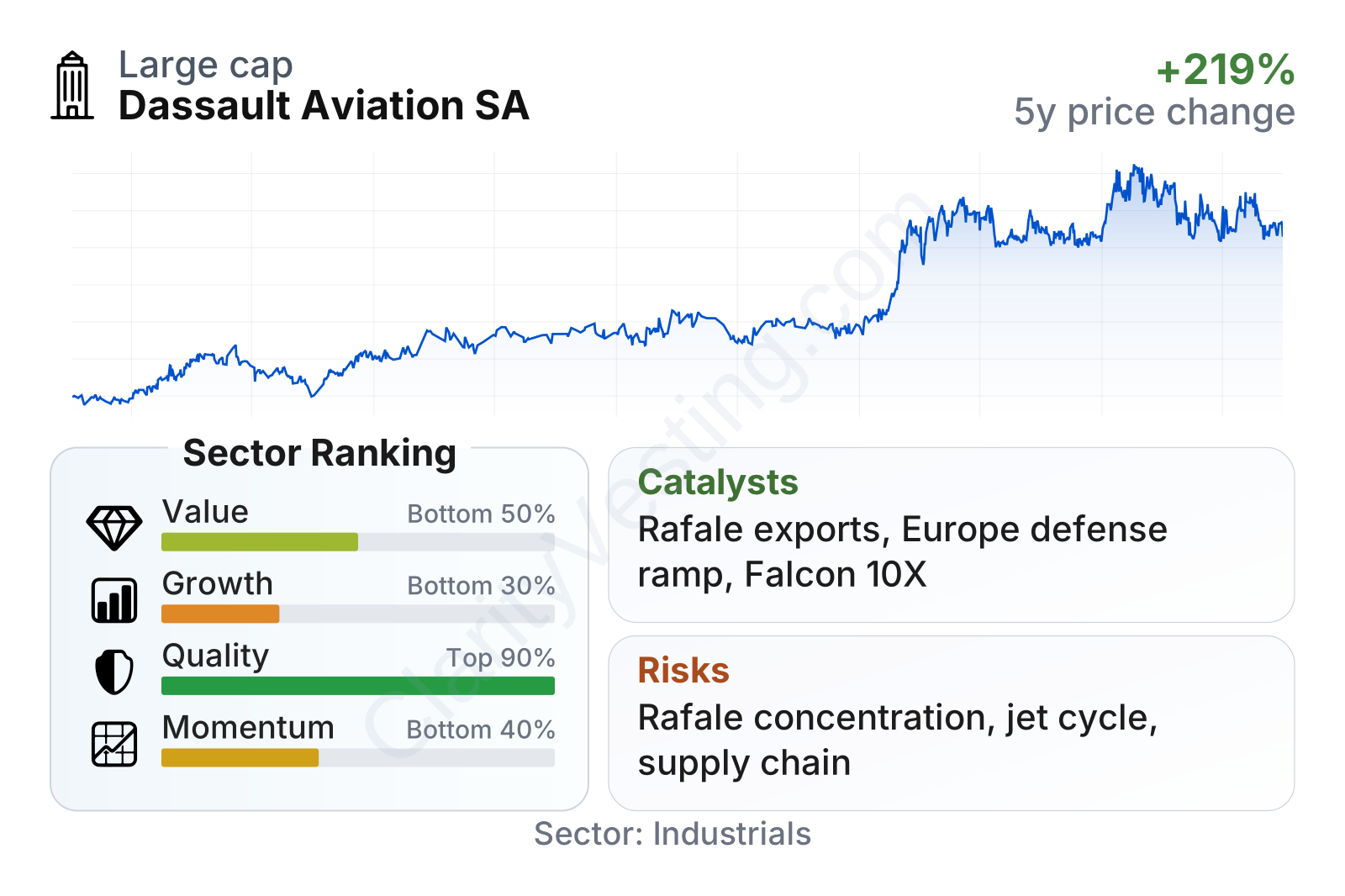
Dassault Aviation stands out more for financial strength and profitability than for traditional value screens. It ranks very high on quality, supported by strong returns on invested capital, a profit margin above the sector median, and an unusually conservative balance sheet. Debt is very low, and net debt metrics are negative, which means cash exceeds borrowings. Growth metrics are more mixed: the latest year shows a sharp acceleration in revenue, but the longer five-year record is much less impressive, reflecting the lumpy nature of aircraft deliveries and defense contract timing.
The stock’s longer-term performance has been strong, but the shorter-term pattern has been more volatile after a sharp run-up. That fits a company whose valuation expanded as defense demand improved and execution strengthened.
Growth
Dassault Aviation operates in two sectors with credible long-term demand, but for different reasons. Defense aerospace is benefiting from a structural rise in military spending across Europe, the Middle East, and parts of Asia. Governments are rethinking readiness, munitions stocks, air power, and strategic autonomy. Business aviation has a different engine: demand for premium long-range aircraft, fleet renewal, and private or corporate travel flexibility. That market is cyclical, but the top end tends to be more resilient than entry-level private aviation.
The company’s strategy is coherent for this environment. On the defense side, Rafale remains the key growth driver. It already has an installed base, export visibility, and a support tail that can last for decades. On the civil side, the Falcon franchise was refreshed with newer aircraft such as the Falcon 6X and the ultra-long-range Falcon 10X under development, which helps Dassault compete in the most profitable business jet categories instead of chasing volume.
A major near-term catalyst is the broad European defense upcycle. France and other countries are increasing military budgets, and export demand for advanced combat aircraft remains active. Additional Rafale orders, whether from repeat customers or new operators, can matter a great deal because fighter programs create not just initial delivery revenue but also long-duration maintenance, training, upgrades, and parts income.
Another important growth lever is production normalization in business jets. Supply-chain disruptions affected the whole aerospace industry in recent years. If engine, cabin, and systems suppliers continue to stabilize, Dassault can convert backlog into deliveries more efficiently. For a company like this, delivery timing has an outsized effect on reported sales and profits.
Recent company communication has also highlighted strong order intake and backlog support. That is especially important in aerospace because backlog gives visibility that many industrial companies do not have. It does not remove execution risk, but it does make future activity easier to forecast than in most cyclical sectors.
Risks
This article is for informational purposes only and does not constitute financial advice. Some content is AI-generated. See Disclaimer


