Stock Analysis · DNO ASA (DTNOY)
Overview
DNO ASA is an independent oil and gas exploration and production company headquartered in Norway. Its business is centered on finding, developing, and producing hydrocarbons, then selling that output into export and local markets. The company has historically been best known for its position in the Kurdistan region of Iraq, and in recent years it has also expanded its North Sea portfolio through acquisitions and field interests in Norway and the U.K.
For a simple way to think about DNO, it is a mid-sized upstream energy company. That means its economics depend mainly on how much oil and gas it can produce, what prices it receives, and how efficiently it can operate its fields.
Based on recent company reporting, DNO’s revenue mix is still heavily concentrated in crude oil, with geography also playing a major role.
- Oil sales from Kurdistan: likely the largest revenue source over the last several reporting periods, historically representing a very large share of group production and cash generation. This includes output from key operated fields such as Tawke and Peshkabir.
- North Sea oil and gas production: a growing second source of revenue, coming from producing assets and development interests offshore Norway and the U.K. This segment has become more important as DNO broadened beyond Kurdistan.
- Gas-related revenue and other petroleum income: a smaller contribution, depending on field mix, pricing, transportation arrangements, and lifting schedules.
- Other income: a limited contribution that can include tariff, service, hedging, or transaction-related items depending on the period.
The recent financial flow shows a business with sharp swings: revenue fell materially in 2023 and stayed weak in 2024 before rebounding strongly in 2025. Operating profitability remained meaningful even during weaker periods, but bottom-line earnings were hit by taxes, financing costs, and non-operating items. That pattern is common in upstream energy, but it also highlights how exposed DNO remains to production interruptions and regional factors.
Key Figures
| Metric | Value | Sector ⓘ |
|---|---|---|
| Date | Oct 03, 2026 | |
| Context | ||
| Sector | Energy | |
| Industry | Oil & Gas E&P | |
| Market Cap ⓘ | $2.04B | |
| Beta ⓘ | -0.15 | |
Value (Cheapness) | ||
| P/E Ratio ⓘ | 26.12 | 14.47 |
| P/B Ratio ⓘ | 2.10 | 1.70 |
| FCF Yield ⓘ | 33.75% | 8.66% |
| Dividend Yield ⓘ | 7.46% | 3.77% |
| EBIT / EV ⓘ | 41.70% | 7.46% |
| PEG ⓘ | N/A | |
Growth (Business expansion) | ||
| Revenue Growth ⓘ | 194.80% | 27.35% |
| RPS Growth (5Y CAGR) ⓘ | 10.08% | 6.75% |
| EPS Growth (5Y CAGR) ⓘ | -29.46% | -15.45% |
| BVPS Growth (5Y CAGR) ⓘ | 6.87% | 5.85% |
| Margin Growth (5Y Trend) ⓘ | 6.21% | 0.75% |
| FCF Growth (5Y CAGR) ⓘ | -29.92% | 3.62% |
| DPS Growth (5Y CAGR) ⓘ | 55.61% | 16.85% |
Quality (Business durability) | ||
| ROIC (Latest) ⓘ | N/A | 11.33% |
| ROA (Latest) ⓘ | 1.77% | 6.03% |
| ROIC (5Y Median) ⓘ | 2.27% | 10.16% |
| ROA (5Y Median) ⓘ | 0.68% | 5.34% |
| Net Debt / EBIT (Latest) ⓘ | 0.91 | 1.62 |
| Net Debt / EBIT (5Y Median) ⓘ | -0.54 | 1.91 |
| Net Debt / EBITDA (Latest) ⓘ | 0.60 | 1.06 |
| Net Debt / Assets ⓘ | 15.67% | 17.29% |
| EBITDA / Interest ⓘ | 18.55 | 9.64 |
| Operating Margin (Latest) ⓘ | 44.35% | 16.32% |
| Operating Margin (5Y Median) ⓘ | 30.46% | 19.53% |
| Debt to Equity (Latest) ⓘ | 157.51% | 54.41% |
| Profit Margin (Latest) ⓘ | 4.96% | 8.79% |
| Free Cash Flow (Latest) ⓘ | $687.80M | |
Momentum (Price trend) | ||
| 3Y Return ⓘ | +176.25% | +62.93% |
| 12M Return (excl. last month) ⓘ | +33.43% | +44.83% |
| 6M Return ⓘ | +15.19% | -1.62% |
| Price vs. 200-Day MA ⓘ | +89.44% | +5.18% |
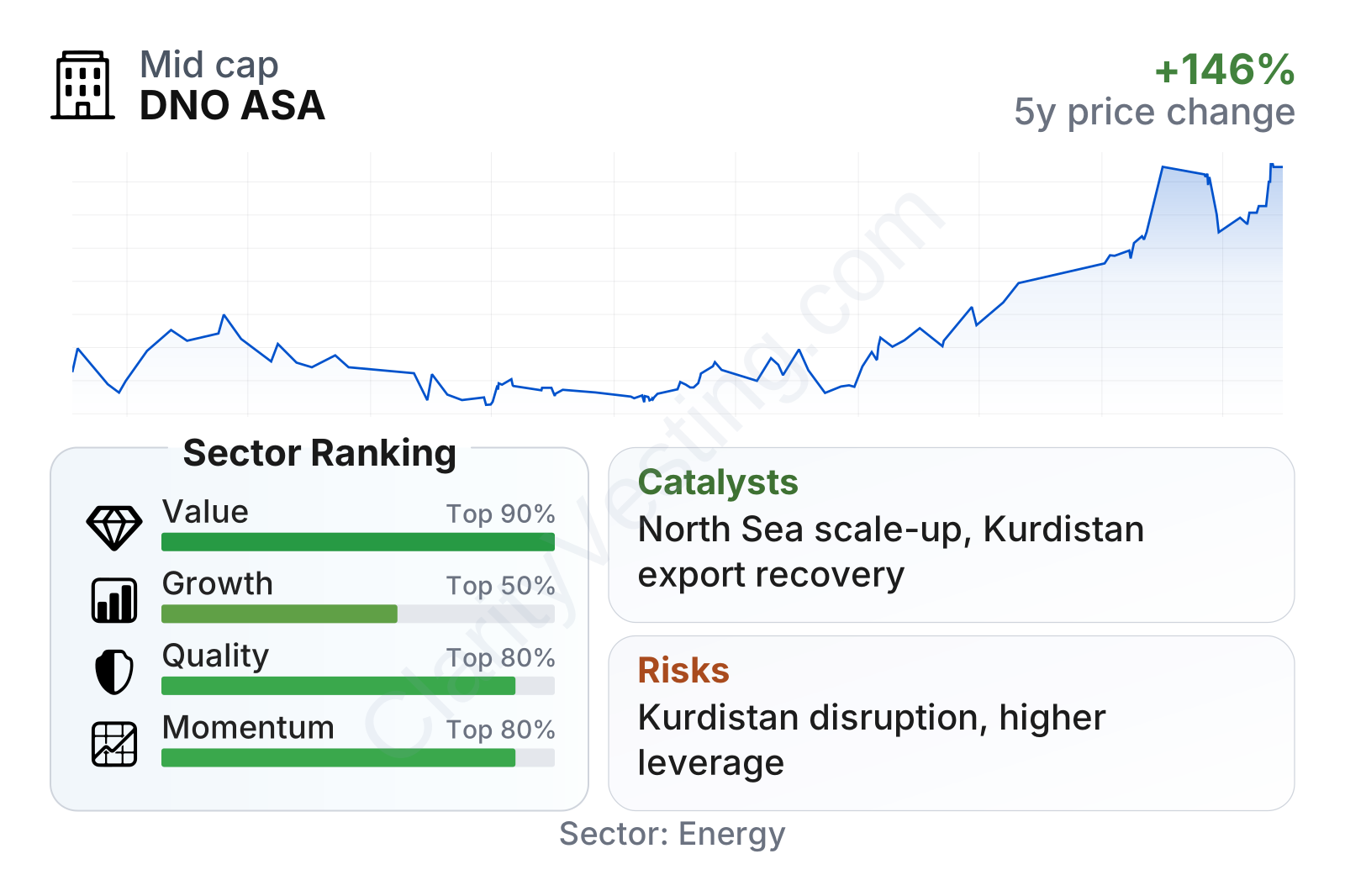
DNO sits in the smaller end of the public energy universe by market value, but its operating profile is more robust than that size might suggest. The table points to a company that screens strongly on valuation measures and cash generation, with free cash flow yield, dividend yield, and EBIT relative to enterprise value all standing well above sector norms. Growth is more mixed: recent revenue momentum has been very strong, but longer-term earnings and free cash flow have been uneven. Quality indicators also show two sides at once: operating margins and interest coverage are strong, while returns on assets and equity-funded balance sheet strength are less convincing.
Growth
DNO operates in a sector that should remain relevant for years, even as the global energy system gradually changes. Oil and gas demand growth may slow over time, but the industry still benefits from underinvestment in supply in many regions, the need for energy security, and the importance of low-cost barrels. For a company like DNO, future growth is less about broad sector expansion than about replacing reserves, raising production, and improving asset mix.
The company’s strategy broadly makes sense for that goal. DNO has used cash flow from established assets to build a more diversified production base, especially in the North Sea. That matters because it reduces dependence on a single political and export route. The North Sea portfolio also gives DNO exposure to more predictable legal and regulatory systems, even if those barrels can come with higher operating and development costs than its best Kurdistan assets.
Recent revenue growth has been extremely strong on a year-over-year basis, far above the sector median. That rebound looks more like a recovery from a depressed base than a smooth growth trend, so it should be read carefully. The longer picture is volatile rather than linear, with big downswings followed by sharp improvements. Still, the latest direction is clearly better than what the company experienced in 2023 and 2024.
Cash generation tells a similar story. Free cash flow moved from very strong levels to a negative phase and then back into positive territory. That kind of swing is normal in exploration and production when acquisitions, field spending, timing of liftings, and regional disruptions all hit at once. The key positive point is that DNO has recently rebuilt free cash flow, and the trailing figure remains substantial relative to its size.
A major catalyst is the company’s increased scale after expanding in the North Sea. More producing assets can mean better resilience, more optionality in capital allocation, and a larger inventory of development opportunities. Another potential growth driver is any durable normalization of exports and payments tied to Kurdistan production. If that operating backdrop improves, DNO could benefit from both higher volumes and better monetization of existing fields.
Recent company updates have also kept attention on portfolio optimization, reserve additions, and development activity across the broader asset base. For a company in DNO’s position, the most meaningful opportunities usually come from a combination of steadier exports, successful drilling, and disciplined reinvestment rather than one transformational product launch or technology shift.
Risks
This article is for informational purposes only and does not constitute financial advice. Some content is AI-generated. See Disclaimer