Stock Analysis · Dno ASA (DTNOF)
Overview
DNO ASA is an independent oil and gas exploration and production company. In simple terms, it finds hydrocarbon resources, develops fields, produces oil and gas, and sells that production into local and international markets. The company has historically been best known for its position in the Kurdistan region of Iraq, but in recent years it has expanded its footprint through North Sea acquisitions, which has made the business broader and less dependent on a single area.
Its revenue mainly comes from selling crude oil, natural gas, and liquids produced from its operated and non-operated fields. Based on the company’s recent business mix, revenue appears to be concentrated in upstream production, with the largest contribution coming from Kurdistan and the rest increasingly tied to the North Sea portfolio.
The main revenue sources can be summarized as follows:
- Kurdistan oil production: approximately 45% to 60% of group revenue in recent periods. This includes production from the Tawke license area, notably the Tawke and Peshkabir fields, where DNO has long been a key operator.
- North Sea production: approximately 40% to 55% of group revenue in recent periods. This includes producing assets in Norway and the U.K., strengthened by acquisitions that added both output and reserves.
- Other petroleum-related income: a small share when present, generally linked to tariff, trading, or other field-related items rather than a separate major business line.
DNO is therefore not a diversified energy utility or refiner. It is primarily an upstream producer, and that matters for long-term analysis because earnings, cash flow, and valuation are heavily influenced by oil and gas prices, field performance, taxes, and political conditions in the regions where it operates.
The broader financial flow also shows how cyclical the business can be. Revenue recovered sharply in 2025 after a weak 2023-2024 period, operating income rebounded strongly, but net income remained pressured by heavy tax and financing effects. That combination helps explain why cash generation can look strong even when accounting profit is thin or negative.
Key Figures
| Metric | Value | Sector ⓘ |
|---|---|---|
| Date | Oct 03, 2026 | |
| Context | ||
| Sector | Energy | |
| Industry | Oil & Gas E&P | |
| Market Cap ⓘ | $1.96B | |
| Beta ⓘ | -0.15 | |
Value (Cheapness) | ||
| P/E Ratio ⓘ | 25.12 | 14.47 |
| P/B Ratio ⓘ | 1.44 | 1.70 |
| FCF Yield ⓘ | 35.59% | 8.66% |
| Dividend Yield ⓘ | 7.46% | 3.77% |
| EBIT / EV ⓘ | 41.10% | 7.46% |
| PEG ⓘ | N/A | |
Growth (Business expansion) | ||
| Revenue Growth ⓘ | 194.80% | 27.35% |
| RPS Growth (5Y CAGR) ⓘ | 10.08% | 6.75% |
| EPS Growth (5Y CAGR) ⓘ | -40.78% | -15.45% |
| BVPS Growth (5Y CAGR) ⓘ | 6.87% | 5.85% |
| Margin Growth (5Y Trend) ⓘ | 6.21% | 0.75% |
| FCF Growth (5Y CAGR) ⓘ | -29.46% | 3.62% |
| DPS Growth (5Y CAGR) ⓘ | 56.62% | 16.85% |
Quality (Business durability) | ||
| ROIC (Latest) ⓘ | N/A | 11.33% |
| ROA (Latest) ⓘ | 1.77% | 6.03% |
| ROIC (5Y Median) ⓘ | 2.27% | 10.16% |
| ROA (5Y Median) ⓘ | 0.68% | 5.34% |
| Net Debt / EBIT (Latest) ⓘ | 0.55 | 1.62 |
| Net Debt / EBIT (5Y Median) ⓘ | -0.60 | 1.91 |
| Net Debt / EBITDA (Latest) ⓘ | 0.36 | 1.06 |
| Net Debt / Assets ⓘ | 9.37% | 17.29% |
| EBITDA / Interest ⓘ | 18.34 | 9.64 |
| Operating Margin (Latest) ⓘ | 43.55% | 16.32% |
| Operating Margin (5Y Median) ⓘ | 30.83% | 19.53% |
| Debt to Equity (Latest) ⓘ | 83.19% | 54.41% |
| Profit Margin (Latest) ⓘ | 4.96% | 8.79% |
| Free Cash Flow (Latest) ⓘ | $697.47M | |
Momentum (Price trend) | ||
| 3Y Return ⓘ | +242.59% | +62.93% |
| 12M Return (excl. last month) ⓘ | +29.95% | +44.83% |
| 6M Return ⓘ | -7.84% | -1.62% |
| Price vs. 200-Day MA ⓘ | +49.77% | +5.18% |
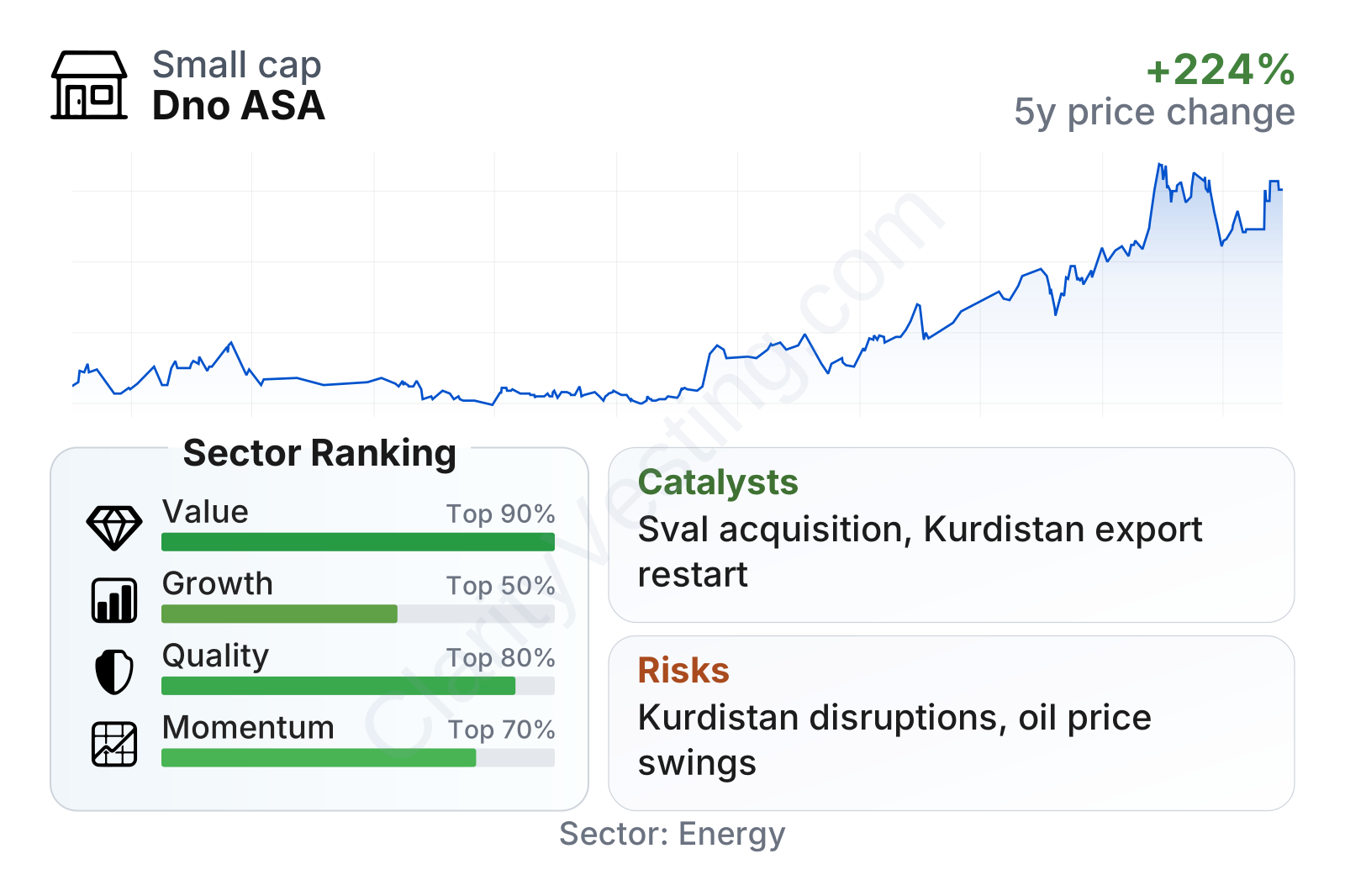
DNO is a mid-sized energy producer by market value. The stock has risen sharply over the last several years, which signals that the market has already recognized a meaningful recovery in the business. On the factor breakdown, value metrics stand out: free cash flow yield, dividend yield, and EBIT relative to enterprise value are all well above sector medians, while price-to-book remains around the sector norm. The main weak point in the table is earnings consistency: long-term EPS growth has been negative, showing how uneven reported profits have been through the cycle. Quality is mixed rather than weak overall, with very strong operating margins and conservative net debt relative to EBIT or EBITDA, but lower returns on assets and returns on invested capital than many peers.
Growth
DNO operates in a sector that still has long-term demand, even if it is not a classic high-growth industry. Oil and gas demand remains tied to transportation, industry, petrochemicals, and power systems that cannot be replaced quickly. For a company like DNO, long-term growth does not depend on creating a new market; it depends on adding reserves, maintaining production, improving realized prices, and allocating capital well across assets.
The company’s current strategy makes sense in that context. DNO has been reducing its historical reliance on Kurdistan by building a larger North Sea presence. That shift matters because the North Sea offers lower geopolitical risk, clearer legal frameworks, and access to infrastructure, while Kurdistan offers potentially higher-margin barrels when exports and payments are functioning normally. Together, that mix gives DNO a more balanced platform than it had a few years ago.
Revenue growth has been highly volatile, which is normal for a producer exposed to both commodity prices and regional disruptions. After a period of contraction, the most recent year-over-year figures show a very strong rebound, well above the sector median. That suggests the business is in a recovery phase rather than a steady linear expansion phase.
Cash generation shows a similar pattern. Free cash flow turned negative during the weaker period, then recovered materially and is now solidly positive again. Trailing free cash flow is substantial for a company of this size, which gives DNO more room to support dividends, service debt, pursue exploration, and potentially make additional bolt-on acquisitions.
A major catalyst is the company’s expanded North Sea portfolio following recent transactions, including the Sval Energi acquisition announced in 2025. That deal significantly increased reserves and production capacity and also deepened DNO’s presence in a region where assets generally have more predictable operating conditions. Another important growth lever is any durable normalization of exports from Kurdistan through the Iraq-Turkey pipeline system. If export conditions improve and payment regularity strengthens, DNO could benefit from higher volumes and better cash conversion from one of its core legacy assets.
Risks
This article is for informational purposes only and does not constitute financial advice. Some content is AI-generated. See Disclaimer