Stock Analysis · DT Midstream Inc (DTM)
Overview
DT Midstream Inc. is a U.S. energy infrastructure company focused on moving, storing, and gathering natural gas. It does not mainly make money by drilling for oil or gas. Instead, it operates pipelines, gathering systems, processing assets, and storage facilities that connect production areas to utilities, industrial users, power plants, and export-related demand centers. That makes it part of the “midstream” segment of the energy industry, which often has steadier economics than commodity producers because a large share of revenue comes from contracts and regulated or fee-based arrangements.
The company’s asset base is centered on two main business segments: Pipeline and Gathering. Pipeline includes interstate and intrastate natural gas transportation and underground storage. Gathering includes systems that collect natural gas near production fields and move it into larger pipelines, with some related treating and processing services.
Based on the company’s recent reporting structure, revenue is primarily generated from the following sources:
- Pipeline segment: approximately 55% to 65% of total revenue. This includes transportation and storage services, largely backed by firm contracts with utilities, marketers, producers, and other shippers.
- Gathering segment: approximately 35% to 45% of total revenue. This includes gathering, transportation, and related field services tied more directly to natural gas production volumes in areas such as Appalachia, Louisiana, and the Haynesville region.
That mix matters because pipeline revenue tends to be more stable, while gathering can offer more volume growth when drilling activity is healthy. In practice, DT Midstream sits between a utility-like cash flow profile and an upstream-linked growth profile.
The business has also shown an improving earnings conversion profile over time. Revenue has risen from under $1 billion a few years ago to above $1.2 billion more recently, while gross profit and operating income expanded meaningfully. Interest expense has also increased, which is common for capital-intensive pipeline businesses, so balance-sheet discipline remains an important part of the investment case.
The operating picture has generally become stronger as revenue scaled up, especially with gross profit growing faster than direct costs. That suggests recent expansion projects and contract mix have supported better economics, even though financing costs remain a noticeable drag.
Key Figures
| Metric | Value | Sector ⓘ |
|---|---|---|
| Date | Oct 17, 2026 | |
| Context | ||
| Sector | Energy | |
| Industry | Oil & Gas Midstream | |
| Market Cap ⓘ | $12.91B | |
| Beta ⓘ | 0.74 | |
Value (Cheapness) | ||
| P/E Ratio ⓘ | 27.69 | 15.44 |
| P/B Ratio ⓘ | 2.73 | 1.73 |
| FCF Yield ⓘ | 3.72% | 8.20% |
| Dividend Yield ⓘ | 2.71% | 3.59% |
| EBIT / EV ⓘ | 5.04% | 7.46% |
| PEG ⓘ | N/A | |
Growth (Business expansion) | ||
| Revenue Growth ⓘ | 11.00% | 26.90% |
| RPS Growth (5Y CAGR) ⓘ | 8.71% | 6.90% |
| EPS Growth (5Y CAGR) ⓘ | -9.77% | -15.73% |
| BVPS Growth (5Y CAGR) ⓘ | 3.88% | 6.07% |
| Margin Growth (5Y Trend) ⓘ | -2.51% | 0.58% |
| FCF Growth (5Y CAGR) ⓘ | 0.52% | 1.86% |
| DPS Growth (5Y CAGR) ⓘ | -14.00% | 16.79% |
Quality (Business durability) | ||
| ROIC (Latest) ⓘ | 7.48% | 11.40% |
| ROA (Latest) ⓘ | 4.62% | 6.06% |
| ROIC (5Y Median) ⓘ | 6.85% | 10.30% |
| ROA (5Y Median) ⓘ | 4.31% | 5.42% |
| Net Debt / EBIT (Latest) ⓘ | 3.96 | 1.64 |
| Net Debt / EBIT (5Y Median) ⓘ | 5.26 | 1.83 |
| Net Debt / EBITDA (Latest) ⓘ | 2.93 | 1.08 |
| Net Debt / Assets ⓘ | 31.36% | 17.29% |
| EBITDA / Interest ⓘ | 6.71 | 9.64 |
| Operating Margin (Latest) ⓘ | 61.76% | 16.27% |
| Operating Margin (5Y Median) ⓘ | 66.97% | 20.39% |
| Debt to Equity (Latest) ⓘ | 70.58% | 54.76% |
| Profit Margin (Latest) ⓘ | 35.72% | 8.82% |
| Free Cash Flow (Latest) ⓘ | $480.00M | |
Momentum (Price trend) | ||
| 3Y Return ⓘ | +147.30% | +67.38% |
| 12M Return (excl. last month) ⓘ | +21.79% | +49.19% |
| 6M Return ⓘ | -5.77% | +7.07% |
| Price vs. 200-Day MA ⓘ | -7.28% | +9.56% |
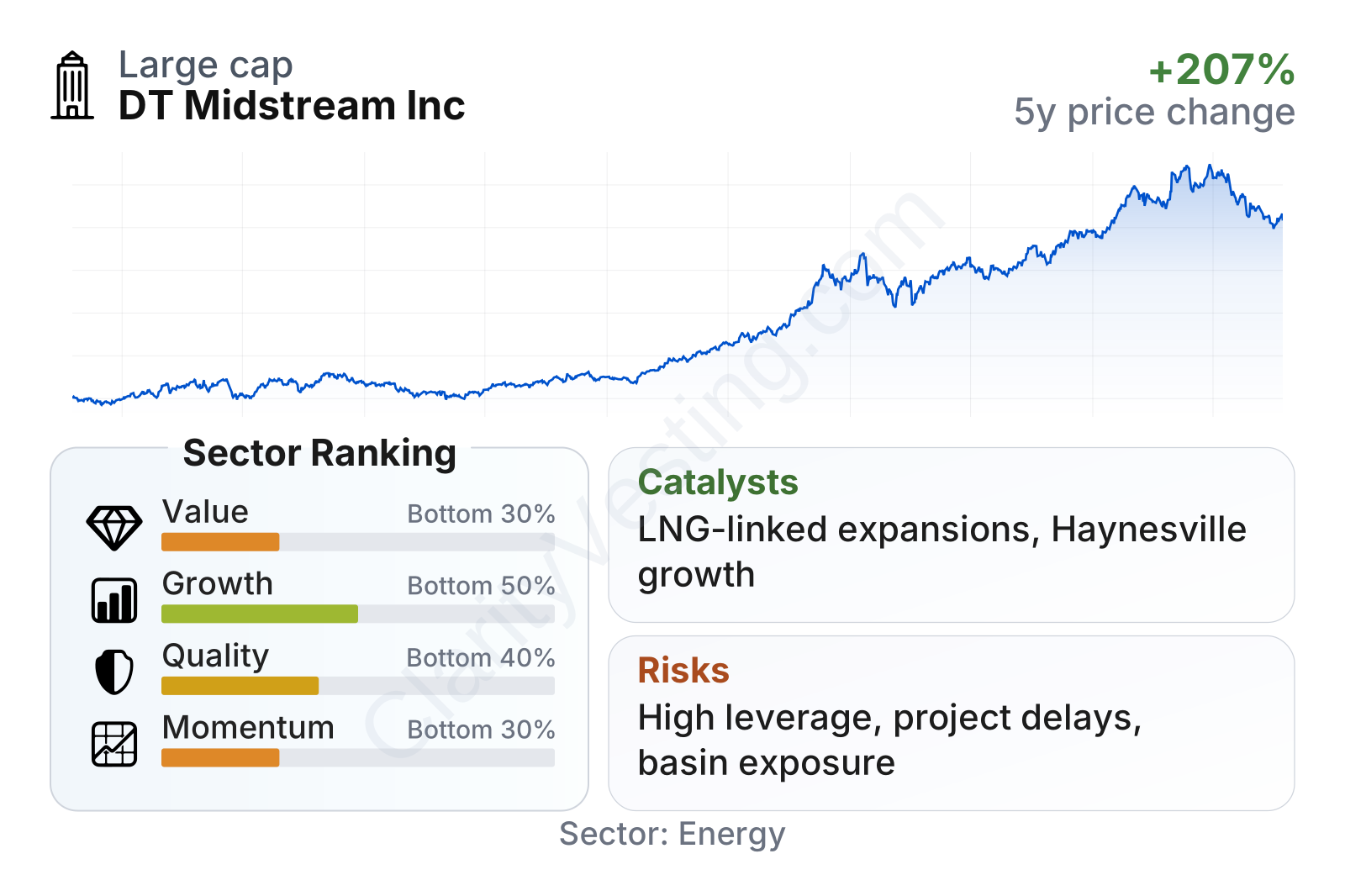
DT Midstream is a mid-sized energy infrastructure company with a relatively low beta, which means its share price has historically moved less violently than the broader market. The stock’s long-term price performance has been strong, but the current factor profile is less flattering: value ranks in the lower part of the sector, growth is below the sector median, and quality is also below many peers mainly because leverage is elevated. On the positive side, profitability itself is strong, with margins well above sector norms, showing that the underlying assets are productive even if the valuation now reflects a higher market expectation.
Growth
DT Midstream operates in a part of the energy market that still has a credible long-term role. Natural gas remains important for U.S. power generation, industrial demand, winter heating, and liquefied natural gas exports. Even in a slower energy-transition world, gas infrastructure can remain relevant for decades because it supports reliability and flexible power supply. That does not make the sector risk-free, but it does provide a clearer long runway than many people assume when they hear “fossil fuel infrastructure.”
The company’s strategy is built around expanding pipeline and gathering capacity in regions where natural gas production and demand are expected to stay resilient. A major part of the thesis is that LNG export growth on the Gulf Coast and continued demand from utilities can pull more volumes through connected systems. DT Midstream has been investing in projects tied to Haynesville and other producing areas that can benefit from this trend.
Recent growth has been uneven quarter to quarter, which is normal in this industry, but the broader direction has improved. After a softer period in 2023 and early 2024, revenue growth accelerated sharply in 2025 before moderating back toward low-double-digit rates in 2026. That pattern suggests the company has already captured a step-up from expansion activity, though the next stage may look steadier rather than explosive.
Free cash flow has also recovered after a weaker stretch. That is important because pipeline companies spend heavily on new assets before they begin producing returns. A rebound toward the mid-hundreds of millions of dollars indicates that recent investments are increasingly turning into cash generation rather than remaining only a construction story.
One of the strongest catalysts is project execution. DT Midstream has continued to advance new pipeline and compression-related developments through its existing footprint, and these projects usually come with customer commitments before construction is complete. In a business where long-lived assets and contract visibility matter more than rapid disruption, that is a meaningful advantage. Another supportive factor is the broader U.S. push to expand gas takeaway and export capacity, which can keep utilization high across connected systems.
Risks
This article is for informational purposes only and does not constitute financial advice. Some content is AI-generated. See Disclaimer


