Stock Analysis · DTE Energy Company (DTE)
Overview
DTE Energy Company is a large regulated utility based in Michigan. Its core business is delivering electricity and natural gas to homes and businesses through long-lived infrastructure such as power plants, transmission lines, distribution networks, gas pipelines, and storage systems. Because much of the business is regulated, a large share of earnings is tied to approved rates and capital spending plans rather than to rapid swings in consumer demand.
The company operates through two main utility franchises: DTE Electric and DTE Gas. It also has smaller non-utility operations, including energy-related services and trading activities. For long-term analysis, the most important point is that DTE is primarily an infrastructure-and-rate-base company: it invests heavily, seeks regulatory approval to recover those investments, and then earns a return over time.
Based on recent annual reporting, DTE’s revenue mix is led by its regulated utility operations, while non-utility and corporate activities make up a smaller share and can be more variable from year to year.
- Electric utility: approximately 50% to 55% of revenue. This includes generation, transmission, and distribution of electricity to customers in southeastern Michigan.
- Gas utility: approximately 25% to 30% of revenue. This includes natural gas distribution, storage, and transportation for residential, commercial, and industrial customers.
- Energy trading and non-utility energy operations: approximately 15% to 20% of revenue. This area can include power and gas marketing, customized energy services, and other energy-related activities, but it is typically less central to long-term valuation than the regulated businesses.
The broad financial flow over recent years shows an important pattern: revenue can move around meaningfully because energy prices and non-utility activity can distort the top line, while operating income and net income have been more stable than revenue alone suggests. Interest expense has also risen over time, which matters for a capital-intensive utility.
Key Figures
| Metric | Value | Sector ⓘ |
|---|---|---|
| Date | Oct 17, 2026 | |
| Context | ||
| Sector | Utilities | |
| Industry | Utilities - Regulated Electric | |
| Market Cap ⓘ | $26.70B | |
| Beta ⓘ | 0.38 | |
Value (Cheapness) | ||
| P/E Ratio ⓘ | 20.34 | 17.28 |
| P/B Ratio ⓘ | 2.20 | 1.51 |
| FCF Yield ⓘ | -7.23% | 0.65% |
| Dividend Yield ⓘ | 3.58% | 3.77% |
| EBIT / EV ⓘ | 4.35% | 5.01% |
| PEG ⓘ | 1.68 | |
Growth (Business expansion) | ||
| Revenue Growth ⓘ | -1.50% | 6.10% |
| RPS Growth (5Y CAGR) ⓘ | -0.24% | 3.87% |
| EPS Growth (5Y CAGR) ⓘ | -15.33% | -11.30% |
| BVPS Growth (5Y CAGR) ⓘ | 7.29% | 4.23% |
| Margin Growth (5Y Trend) ⓘ | 4.37% | 3.57% |
| FCF Growth (5Y CAGR) ⓘ | N/A | -8.84% |
| DPS Growth (5Y CAGR) ⓘ | 0.79% | 4.84% |
Quality (Business durability) | ||
| ROIC (Latest) ⓘ | N/A | 6.53% |
| ROA (Latest) ⓘ | 2.44% | 3.20% |
| ROIC (5Y Median) ⓘ | 6.17% | 5.95% |
| ROA (5Y Median) ⓘ | 2.84% | 2.75% |
| Net Debt / EBIT (Latest) ⓘ | 11.96 | 7.13 |
| Net Debt / EBIT (5Y Median) ⓘ | 10.75 | 7.23 |
| Net Debt / EBITDA (Latest) ⓘ | 6.49 | 4.31 |
| Net Debt / Assets ⓘ | 49.36% | 38.42% |
| EBITDA / Interest ⓘ | 3.74 | 4.58 |
| Operating Margin (Latest) ⓘ | 14.29% | 20.83% |
| Operating Margin (5Y Median) ⓘ | 12.96% | 20.08% |
| Debt to Equity (Latest) ⓘ | 229.15% | 137.69% |
| Profit Margin (Latest) ⓘ | 8.00% | 11.37% |
| Free Cash Flow (Latest) ⓘ | -$1.93B | |
Momentum (Price trend) | ||
| 3Y Return ⓘ | +45.31% | +52.37% |
| 12M Return (excl. last month) ⓘ | -0.98% | +8.84% |
| 6M Return ⓘ | -11.66% | -3.95% |
| Price vs. 200-Day MA ⓘ | -7.54% | -0.79% |
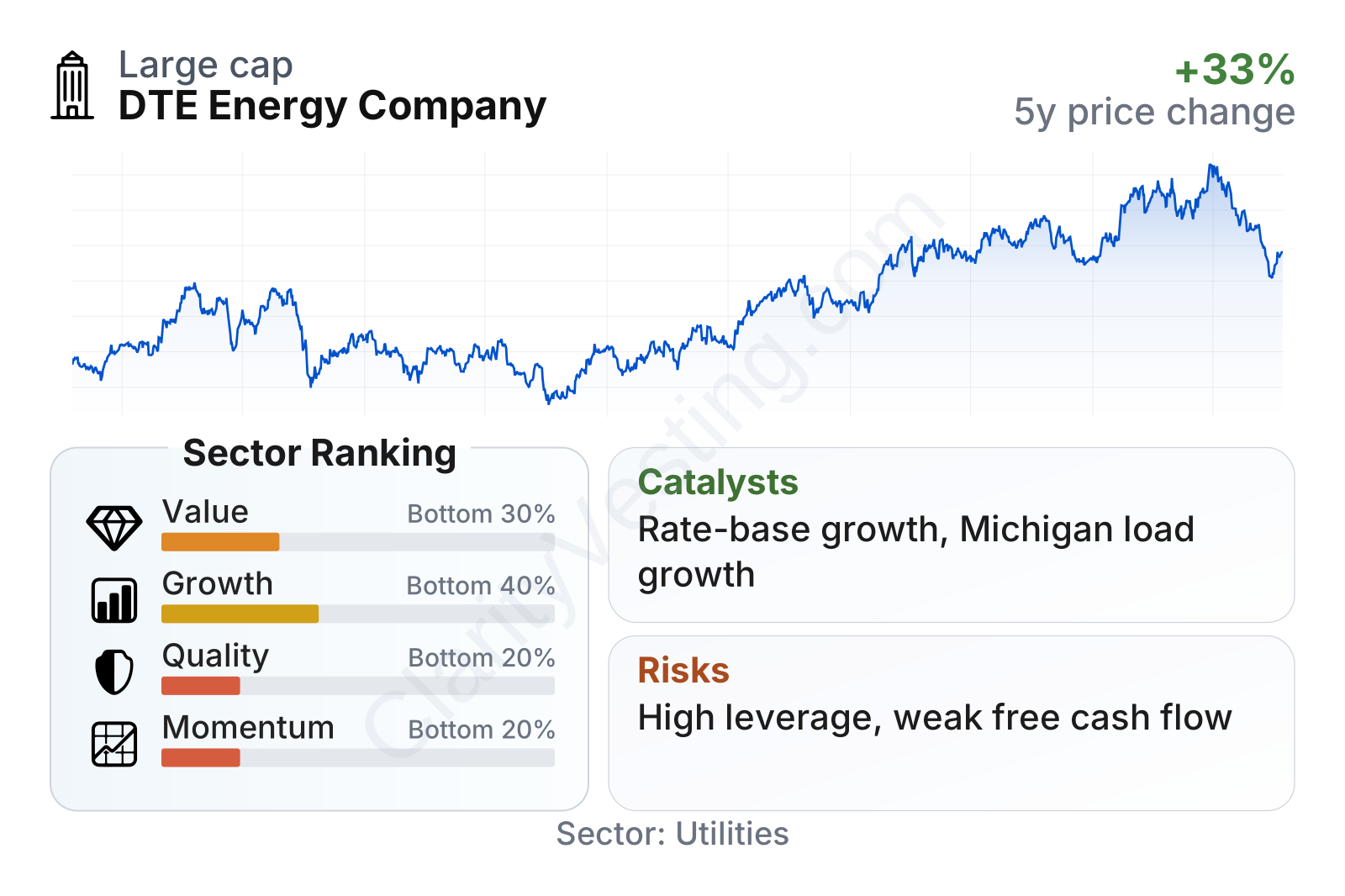
DTE is a large-cap utility with a low beta, which is typical of defensive regulated businesses. Relative to its sector, the current profile looks mixed: valuation is weaker than average, quality measures rank in the lower part of the group, growth is modest, and recent share-price momentum has been softer than most peers. The income component remains relevant, with a dividend yield close to the sector median, but that is offset by negative free cash flow and heavier leverage than many regulated utility competitors.
Growth
DTE operates in a sector that is still growing, even if it is not a high-growth industry in the usual sense. Electric grids need ongoing upgrades, utilities are replacing older generation fleets, and power demand is getting support from data centers, manufacturing investment, and broader electrification trends. Natural gas distribution remains a mature business, but system modernization and reliability spending can still expand the regulated asset base that drives earnings.
DTE’s strategy is consistent with how successful regulated utilities typically grow. The company continues to invest in grid reliability, cleaner generation, renewable energy, and gas-system modernization. For a utility, the key growth engine is not explosive revenue expansion but steady increases in approved capital investment that can be added to the rate base. If regulators allow recovery on acceptable terms, that can support multi-year earnings growth.
Revenue per share has been uneven over the past few years, which reflects the limits of using revenue alone to judge a utility. DTE’s top line has moved up and down rather than following a smooth growth path. That is not ideal, but it is less alarming here than it would be in many other industries because regulated earnings depend more on allowed returns, customer base stability, and capital recovery than on simple sales growth.
A more important issue is cash generation. DTE has been in a heavy investment phase, and free cash flow has stayed negative. That is common in utilities building and upgrading major infrastructure, but it still means growth currently relies on access to debt and equity capital rather than internally generated surplus cash.
The main catalysts for future growth are practical rather than dramatic: continued capital spending plans, electricity demand tied to economic development in Michigan, transmission and distribution upgrades, and the long transition toward cleaner energy sources. Recent company communications have also emphasized large long-term investment plans and load growth opportunities, which can be meaningful for a regulated utility if project execution and regulatory support remain solid.
Risks
This article is for informational purposes only and does not constitute financial advice. Some content is AI-generated. See Disclaimer


