Stock Analysis · Dah Sing Financial Holdings Ltd (DSFGY)
Overview
Dah Sing Financial Holdings Ltd is a Hong Kong-based financial group centered on banking, insurance, and related financial services. Its main operating asset is Dah Sing Bank, a long-established regional bank serving retail customers, small and medium-sized businesses, and corporate clients. The group also has insurance operations and holds stakes in financial services businesses. For long-term analysis, this is primarily a Hong Kong and Greater China banking franchise rather than a globally diversified financial conglomerate.
The company’s revenue base is dominated by banking income, especially net interest income generated from loans and investments after funding costs. Non-interest income adds diversification through fees, commissions, insurance, and treasury-related activities. Based on the group’s reporting structure in recent annual disclosures, the business mix can be summarized as follows:
- Net interest income from banking: approximately 65% to 75% of operating income in a normal year. This mainly comes from residential mortgages, commercial lending, trade finance, corporate loans, treasury assets, and other interest-earning banking activities.
- Fee and commission income: approximately 10% to 20%. This includes wealth management distribution, credit cards, trade services, account services, and other banking-related fees.
- Insurance and other financial services: approximately 5% to 15%. This incorporates general insurance underwriting and related services within the group.
- Trading gains, investment income, and other operating income: approximately 5% to 15%. This can include treasury operations, foreign exchange, securities income, and valuation-related movements depending on market conditions.
The business remains fairly straightforward: gather deposits, lend money conservatively, earn a spread on those activities, and supplement that core with fees and insurance. The group’s scale is much smaller than Hong Kong’s largest banking names, but it has an established local franchise and a business model that is easy to understand.
The multi-year profit flow shows a meaningful rise in total revenue and net income from 2023 through 2025, even though funding costs and operating expenses have also moved around materially. That pattern fits a bank benefiting from stronger net interest dynamics while still dealing with the normal volatility of credit and funding conditions.
Key Figures
| Metric | Value | Sector ⓘ |
|---|---|---|
| Date | Oct 24, 2026 | |
| Context | ||
| Sector | Financial Services | |
| Industry | Banks - Regional | |
| Market Cap ⓘ | $1.71B | |
| Beta ⓘ | 0.46 | |
Value (Cheapness) | ||
| P/E Ratio ⓘ | 7.82 | 12.46 |
| P/B Ratio ⓘ | 0.04 | 1.25 |
| FCF Yield ⓘ | 470.80% | 9.82% |
| Dividend Yield ⓘ | 6.21% | 2.94% |
| EBIT / EV ⓘ | N/A | 8.11% |
| PEG ⓘ | N/A | |
Growth (Business expansion) | ||
| Revenue Growth ⓘ | 3.00% | 9.10% |
| RPS Growth (5Y CAGR) ⓘ | 29.92% | 12.31% |
| EPS Growth (5Y CAGR) ⓘ | 34.89% | -6.97% |
| BVPS Growth (5Y CAGR) ⓘ | -1.51% | 5.02% |
| Margin Growth (5Y Trend) ⓘ | -27.51% | -4.00% |
| FCF Growth (5Y CAGR) ⓘ | N/A | 4.71% |
| DPS Growth (5Y CAGR) ⓘ | 23.54% | 8.92% |
Quality (Business durability) | ||
| ROIC (Latest) ⓘ | N/A | 9.18% |
| ROE (Latest) ⓘ | 11.13% | 13.93% |
| ROA (Latest) ⓘ | 1.53% | 1.57% |
| ROIC (5Y Median) ⓘ | 4.81% | 7.80% |
| ROE (5Y Median) ⓘ | 6.63% | 12.15% |
| ROA (5Y Median) ⓘ | 0.60% | 1.28% |
| Net Debt / EBIT (Latest) ⓘ | N/A | 1.02 |
| Net Debt / EBIT (5Y Median) ⓘ | -5.74 | 0.72 |
| Net Debt / EBITDA (Latest) ⓘ | N/A | 0.88 |
| Operating Margin (Latest) ⓘ | N/A | 22.30% |
| Operating Margin (5Y Median) ⓘ | 35.63% | 24.50% |
| Debt to Equity (Latest) ⓘ | 4.98% | 59.34% |
| Profit Margin (Latest) ⓘ | 32.03% | 26.42% |
| Free Cash Flow (Latest) ⓘ | $8.07B | |
Momentum (Price trend) | ||
| 3Y Return ⓘ | +200.52% | +95.73% |
| 12M Return (excl. last month) ⓘ | +57.43% | +17.30% |
| 6M Return ⓘ | +14.32% | +6.07% |
| Price vs. 200-Day MA ⓘ | +38.91% | +5.36% |
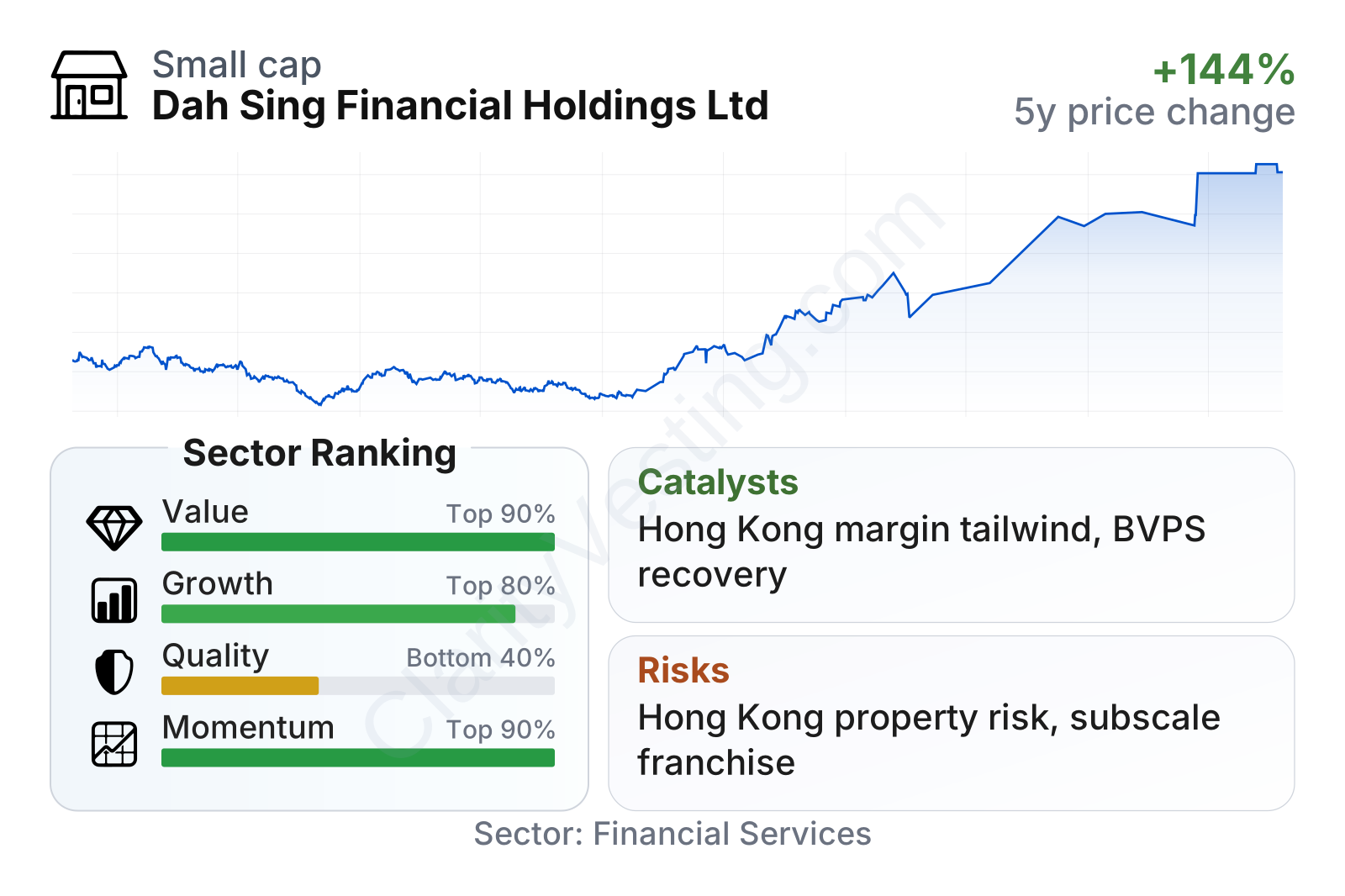
The stock has shown very strong momentum over the last three years, with gains far ahead of the sector median. At the same time, the valuation metrics remain unusually low relative to regional banking peers, with a single-digit earnings multiple, a dividend yield around 6%, and a price-to-book ratio that screens at an extreme discount. Growth and momentum rank well versus the sector, while quality measures are more mixed, reflecting acceptable current profitability but a weaker longer-term return profile than stronger regional banks.
Dah Sing is a mid-sized financial company by market value, and its shares have historically traded with relatively low beta. That lower volatility can make the price path less dramatic than many financial stocks, although regional banking names can still re-rate sharply when sentiment around Hong Kong property, credit quality, or interest rates changes.
Growth
Dah Sing operates in a mature sector rather than a high-growth one, so the long-term case depends less on rapid expansion and more on steady compounding through credit discipline, margin management, fee income, and capital strength. Banking in Hong Kong is not structurally a fast-growing market, but it remains important, profitable, and closely tied to wealth flows, trade activity, and financing demand across Hong Kong and the Greater Bay Area. That gives the company exposure to a relevant financial hub, even if growth is cyclical and sensitive to the economy.
The group’s strategy appears sensible for this setting. It is not trying to outspend the largest banks or build a global investment bank. Instead, it focuses on core banking, customer relationships, commercial lending, and selective fee-based businesses. For a smaller regional bank, that kind of specialization usually makes more sense than aggressive expansion.
The recent earnings path is encouraging. Five-year earnings per share growth has been strong, and the latest earnings trend suggests that profit recovery has continued after a weaker period earlier in the cycle. That said, banks can show sharp year-to-year moves because credit provisions, margin changes, and treasury results can all swing results quickly. For this company, the important point is that earnings have improved materially rather than merely bouncing from a very low base.
Book value per share fell after 2021, then recovered steadily through 2025. That matters because book value is a key anchor for banks: it reflects the equity base that supports lending and absorbs losses. The recovery suggests that retained earnings and balance-sheet normalization have started to rebuild capital value, even though the five-year compounded trend still trails the sector median.
A practical catalyst for future growth is any normalization in Hong Kong credit conditions. If funding costs stabilize, loan demand improves, and property-related stress eases, a bank like Dah Sing can benefit through better lending spreads, lower impairment charges, and improved customer activity. Another favorable element is the company’s strong dividend growth over five years, which indicates that management has had enough confidence in earnings and capital to raise shareholder distributions while the business recovered.
Recent company reporting has also pointed to stronger profitability and continued balance-sheet resilience. That does not transform the business into a high-growth franchise, but it does support the view that the group is moving through the cycle in better shape than it was a few years ago.
Risks
This article is for informational purposes only and does not constitute financial advice. Some content is AI-generated. See Disclaimer


