Stock Analysis · Jet2 plc (DRTGF)
Overview
Jet2 plc is a U.K.-based leisure travel company centered on two connected businesses: Jet2holidays, which sells package vacations, and Jet2.com, which operates flights. The group focuses mainly on leisure travelers rather than business travel, with a strong presence in the U.K. market and routes to Mediterranean, European, and other sun-and-city destinations. Its model is built around combining airline seats, hotels, transfers, and related travel services into one offering, which helps it capture more value from each customer than a stand-alone airline would.
The business is heavily driven by package holidays, which management has increasingly positioned as the core growth engine because they generally offer better customer retention, stronger control over the full trip, and more resilient profitability than seat-only flying. Revenue also benefits from onboard sales, baggage, seat selection, transfers, and other travel extras.
Based on recent company reporting, Jet2’s revenue mix can be summarized approximately as follows:
- Package holidays: about 75% to 80% of group revenue. This includes flights, hotel accommodation, transfers, and other bundled vacation services sold mainly through Jet2holidays.
- Scheduled passenger flights: about 20% to 25% of group revenue. This is primarily seat-only air travel sold through Jet2.com.
- Ancillary and other revenue: a small remaining share. This includes items such as baggage, seat assignment, in-flight sales, and other travel-related extras.
One of the clearest business shifts in recent years is scale. Group revenue climbed from roughly £5.0 billion in fiscal 2023 to about £7.5 billion in fiscal 2026, while profitability remained positive after the post-pandemic recovery. The flow from sales to operating profit is still sensitive to fuel, staffing, and capacity decisions, but the company has shown that its vertically integrated holiday model can generate substantial earnings when travel demand is healthy.
The longer-term picture shows a powerful rebound after the pandemic shock in 2022, followed by continued expansion through 2026. More recently, revenue kept growing, but profit conversion eased versus the prior year, suggesting that Jet2 is now in a phase where execution and cost discipline matter as much as pure demand growth.
Key Figures
| Metric | Value | Sector ⓘ |
|---|---|---|
| Date | Nov 21, 2026 | |
| Context | ||
| Sector | Consumer Cyclical | |
| Industry | Travel Services | |
| Market Cap ⓘ | $3.55B | |
| Beta ⓘ | 1.18 | |
Value (Cheapness) | ||
| P/E Ratio ⓘ | 7.22 | 17.13 |
| P/B Ratio ⓘ | N/A | 2.72 |
| FCF Yield ⓘ | 43.15% | 7.52% |
| Dividend Yield ⓘ | 0.85% | 2.43% |
| EBIT / EV ⓘ | 160.89% | 7.11% |
| PEG ⓘ | N/A | |
Growth (Business expansion) | ||
| Revenue Growth ⓘ | 2.50% | 5.30% |
| RPS Growth (5Y CAGR) ⓘ | 60.45% | 8.77% |
| EPS Growth (5Y CAGR) ⓘ | N/A | -11.05% |
| BVPS Growth (5Y CAGR) ⓘ | 25.84% | 5.47% |
| Margin Growth (5Y Trend) ⓘ | 32.69% | -0.16% |
| FCF Growth (5Y CAGR) ⓘ | -6.24% | 5.66% |
| DPS Growth (5Y CAGR) ⓘ | 52.95% | 9.76% |
Quality (Business durability) | ||
| ROIC (Latest) ⓘ | 32.51% | 11.36% |
| ROA (Latest) ⓘ | 13.46% | 5.53% |
| ROIC (5Y Median) ⓘ | 15.53% | 10.58% |
| ROA (5Y Median) ⓘ | 6.83% | 5.35% |
| Net Debt / EBIT (Latest) ⓘ | -0.22 | 2.11 |
| Net Debt / EBIT (5Y Median) ⓘ | -0.07 | 2.24 |
| Net Debt / EBITDA (Latest) ⓘ | -0.14 | 1.51 |
| Net Debt / Assets ⓘ | -3.46% | 21.74% |
| EBITDA / Interest ⓘ | 14.10 | 9.63 |
| Operating Margin (Latest) ⓘ | 7.35% | 9.20% |
| Operating Margin (5Y Median) ⓘ | 6.85% | 9.64% |
| Debt to Equity (Latest) ⓘ | 62.09% | 74.26% |
| Profit Margin (Latest) ⓘ | 5.49% | 5.47% |
| Free Cash Flow (Latest) ⓘ | $1.53B | |
Momentum (Price trend) | ||
| 3Y Return ⓘ | +35.45% | +15.79% |
| 12M Return (excl. last month) ⓘ | +2.63% | -0.63% |
| 6M Return ⓘ | +40.11% | +1.17% |
| Price vs. 200-Day MA ⓘ | +12.67% | +0.36% |
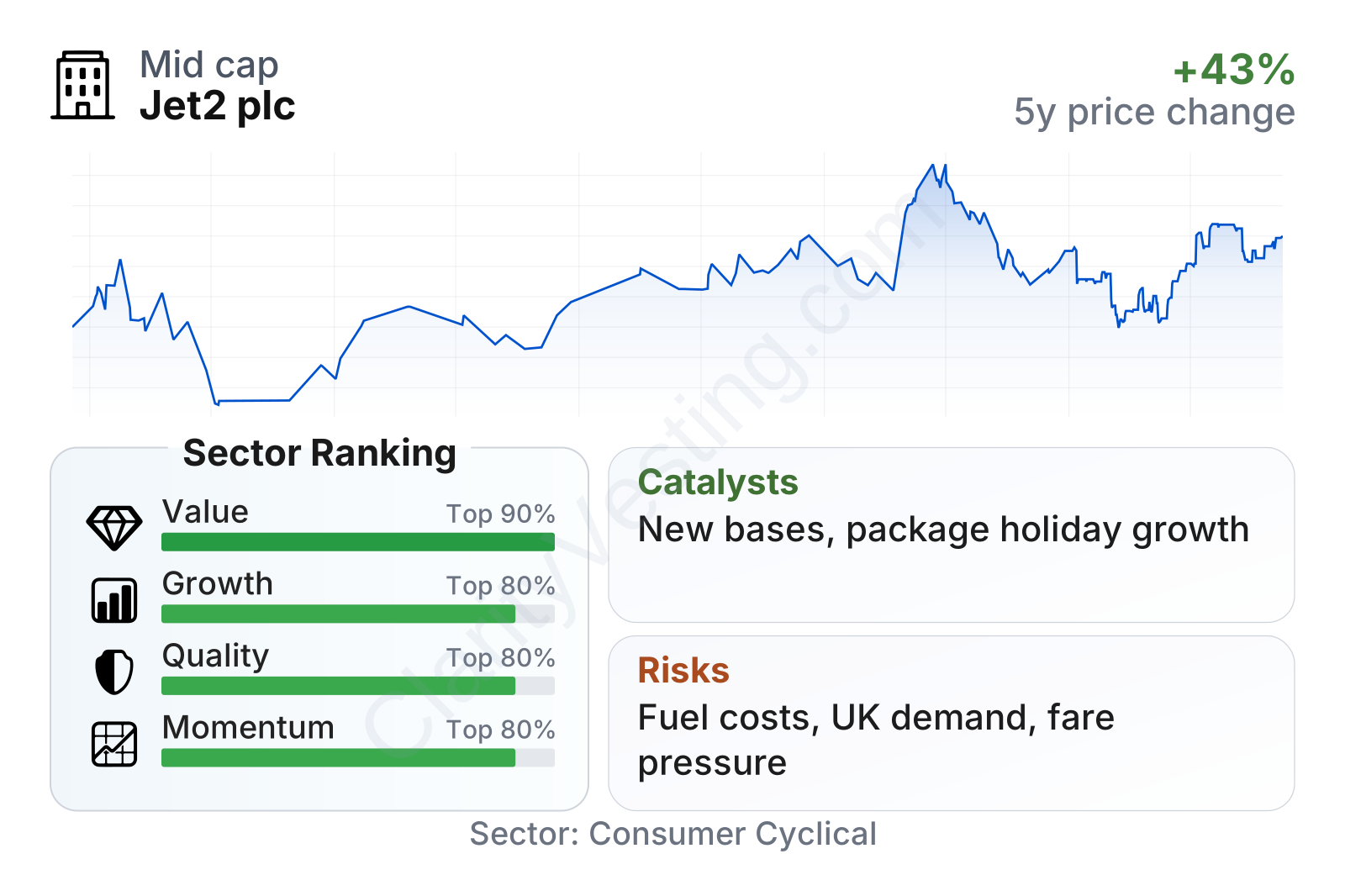
Jet2 stands out as a mid-sized listed travel operator with a share price that has moved upward over the last three years, although not in a straight line. The latest metrics show a mixed but generally solid profile: valuation multiples are low relative to the broader consumer cyclical sector, profitability is acceptable rather than exceptional, and balance-sheet strength is a notable positive. Growth metrics are particularly strong over a five-year view because the company expanded rapidly after the travel market reopened, though the most recent annual revenue growth rate is much more modest than that longer-term picture.
Quality indicators are among the more appealing aspects of the business. Returns on capital and assets are comfortably above sector medians, while net debt measures remain better than many peers because Jet2 has maintained a net cash position on several leverage metrics. Free cash flow has also been very strong in the latest period, which gives the company flexibility for aircraft, dividends, and working capital swings that are common in travel.
Growth
The company operates in a sector with durable long-term demand, even if year-to-year conditions can be volatile. Leisure travel continues to benefit from consumer preference for experiences, the appeal of package vacations for budgeting and convenience, and the ongoing shift toward organized holiday products that reduce friction for travelers. In Jet2’s core U.K. market, package holidays remain relevant because they combine price visibility with financial protection and a simpler booking process.
Jet2’s strategy is coherent for future growth because it is not trying to compete only as a low-cost airline. Instead, it uses its airline as part of a broader holiday platform. That matters because package customers can be more valuable than seat-only passengers, and the company has more control over inventory, pricing, destination mix, and customer service across the full trip. This structure also gives Jet2 more ways to differentiate itself than a pure airline focused mainly on fare competition.
Over a multi-year period, the expansion has been impressive. Revenue per share has grown far faster than the sector median over five years, and operating margin trends have improved materially over that same horizon. The latest year was less dynamic, with annual revenue growth in the low single digits, but that came after a very strong recovery period and against a much larger revenue base. In other words, the business now looks more mature than it did during the immediate reopening phase, yet still appears to have room to expand through capacity additions and share gains.
A major catalyst is fleet and network development. Jet2 has continued investing in newer aircraft and in additional U.K. bases, which supports both capacity growth and efficiency over time. The package holiday business can especially benefit when new bases are opened because it allows the company to scale hotel contracting and local destination relationships alongside flight supply. Recent trading updates have also pointed to continued customer demand for holidays, with booked capacity and passenger volumes remaining supportive even as the market becomes more normalized.
Another positive factor is competitive disruption elsewhere in the travel market. When weaker operators reduce routes, struggle operationally, or retrench, Jet2 can often step into underserved leisure routes or win customers through service reliability and brand familiarity. That does not guarantee rapid profit growth every year, but it can create recurring opportunities for gradual market share expansion.
Risks
This article is for informational purposes only and does not constitute financial advice. Some content is AI-generated. See Disclaimer


