Stock Analysis · dormakaba Holding AG (DRMKY)
Overview
dormakaba Holding AG is a global access solutions company focused on how people enter, move through, and secure buildings. Its products and services are used in offices, hospitals, schools, hotels, airports, industrial sites, public buildings, and residential properties. The group sells door hardware, automatic doors, mechanical and electronic locks, key systems, access control software, safes, lodging systems, and related installation and maintenance services.
The business is tied to both new construction and recurring activity in existing buildings. That mix matters for long-term analysis because demand does not depend only on large new projects. A meaningful share also comes from renovations, code-compliance upgrades, replacements, and service contracts, which can soften the impact of weaker construction cycles.
Based on the company’s recent annual reporting, revenue is broadly spread across product categories rather than concentrated in one line. The approximate revenue mix is as follows:
- Access Solutions and Services: about 46%. This includes electronic and mechanical access products, software, service, and support.
- Key & Wall Solutions: about 24%. This includes key systems, movable walls, and related offerings.
- Entrance Systems: about 18%. This includes automatic sliding, swing, and revolving doors as well as secure entrance systems.
- Mechanical & Other: about 12%. This includes door closers, panic devices, glass fittings, and other architectural hardware.
Geographically, dormakaba is also diversified, with Europe and the Americas representing the largest portions of sales, while Asia-Pacific and other regions provide additional exposure. That broad footprint lowers dependence on any single construction market, although Europe remains especially important to the group.
Recent profit flow shows a useful pattern for long-term readers: revenue has stayed close to the high-$2.7 billion to high-$2.8 billion range in recent years, while operating profit and net income improved sharply in fiscal 2025 and remained solid in fiscal 2026. Cost discipline appears to have played a larger role than headline sales growth.
Key Figures
| Metric | Value | Sector ⓘ |
|---|---|---|
| Date | Oct 10, 2026 | |
| Context | ||
| Sector | Industrials | |
| Industry | Building Products & Equipment | |
| Market Cap ⓘ | $3.47B | |
| Beta ⓘ | 0.73 | |
Value (Cheapness) | ||
| P/E Ratio ⓘ | 28.78 | 22.32 |
| P/B Ratio ⓘ | 4.44 | 1.98 |
| FCF Yield ⓘ | N/A | 6.34% |
| Dividend Yield ⓘ | 1.40% | 1.95% |
| EBIT / EV ⓘ | 7.24% | 4.71% |
| PEG ⓘ | N/A | |
Growth (Business expansion) | ||
| Revenue Growth ⓘ | -1.30% | 9.25% |
| RPS Growth (5Y CAGR) ⓘ | -43.52% | 7.75% |
| EPS Growth (5Y CAGR) ⓘ | -10.29% | -13.37% |
| BVPS Growth (5Y CAGR) ⓘ | -54.32% | 6.12% |
| Margin Growth (5Y Trend) ⓘ | 0.66% | 0.81% |
| FCF Growth (5Y CAGR) ⓘ | 34.69% | 11.01% |
| DPS Growth (5Y CAGR) ⓘ | -47.86% | 9.48% |
Quality (Business durability) | ||
| ROIC (Latest) ⓘ | N/A | 10.70% |
| ROA (Latest) ⓘ | N/A | 5.38% |
| ROIC (5Y Median) ⓘ | N/A | 9.26% |
| ROA (5Y Median) ⓘ | 2.27% | 4.94% |
| Net Debt / EBIT (Latest) ⓘ | N/A | 2.08 |
| Net Debt / EBIT (5Y Median) ⓘ | 1.95 | 2.29 |
| Net Debt / EBITDA (Latest) ⓘ | N/A | 1.43 |
| Net Debt / Assets ⓘ | 17.71% | 19.34% |
| EBITDA / Interest ⓘ | N/A | 9.54 |
| Operating Margin (Latest) ⓘ | N/A | 10.34% |
| Operating Margin (5Y Median) ⓘ | 9.43% | 10.29% |
| Debt to Equity (Latest) ⓘ | N/A | 65.52% |
| Profit Margin (Latest) ⓘ | 3.47% | 6.63% |
| Free Cash Flow (Latest) ⓘ | N/A | |
Momentum (Price trend) | ||
| 3Y Return ⓘ | +80.12% | +61.33% |
| 12M Return (excl. last month) ⓘ | -1.60% | +14.82% |
| 6M Return ⓘ | +33.52% | +3.53% |
| Price vs. 200-Day MA ⓘ | +15.99% | +0.88% |
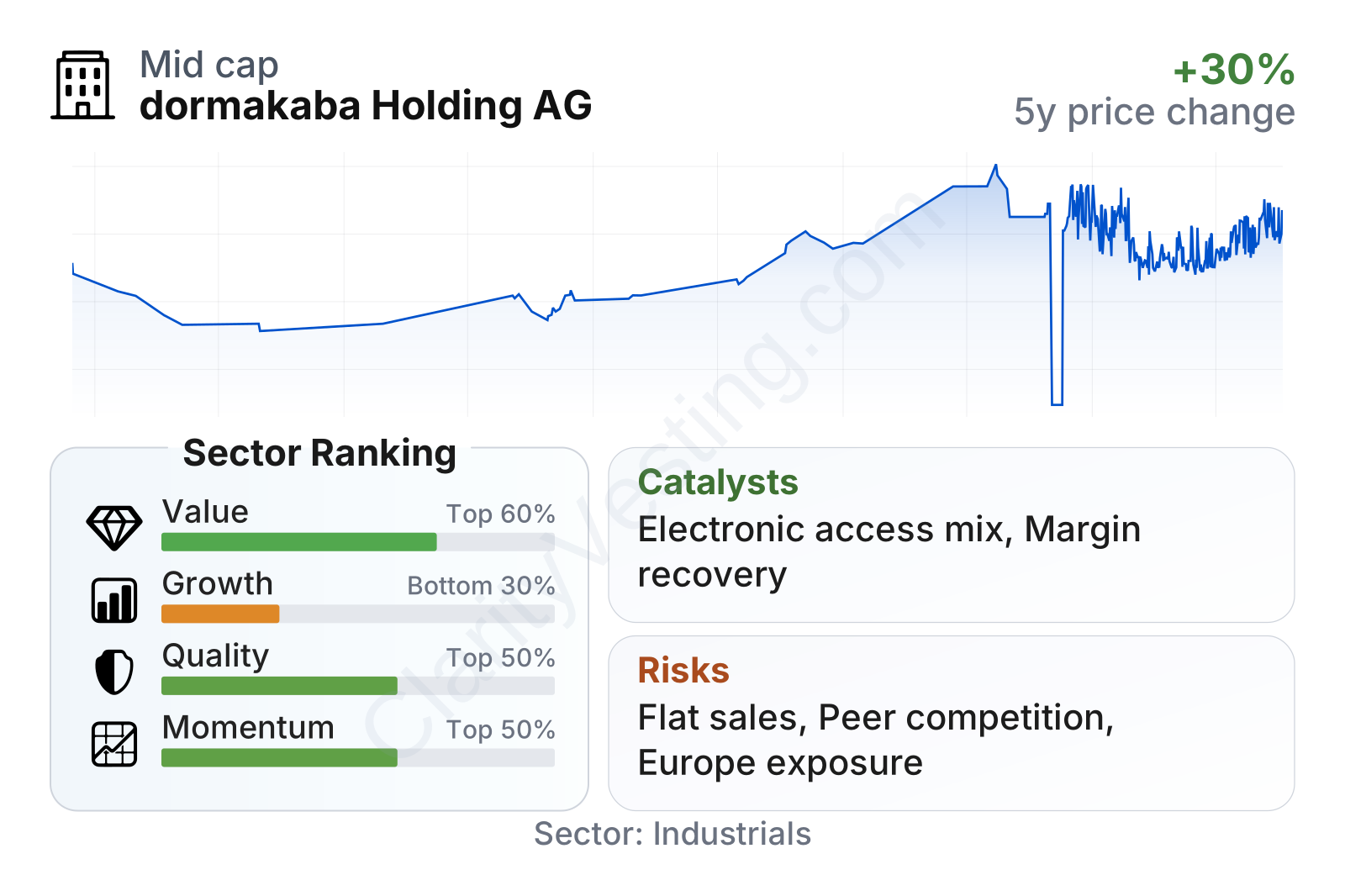
dormakaba is a mid-sized industrial company with a relatively low beta, which suggests its share price has been somewhat less volatile than the broader market. The quality profile looks acceptable rather than exceptional: leverage appears manageable, but profitability remains below many sector peers, especially on net margin and returns on assets.
The biggest weak point in the metrics is growth. Recent revenue was slightly down year over year, and several five-year growth measures remain weak. On the more positive side, free cash flow has improved strongly over a longer period, and the stock’s three-year performance has been better than the sector median even though the shorter-term path has been uneven. That combination usually points to a company where margin recovery and efficiency have mattered more than expansion.
Growth
dormakaba operates in a sector with durable long-term demand drivers. Buildings increasingly need stronger security, better access management, more automation, and tighter integration between physical hardware and digital credentials. These trends are supported by urbanization, aging building stock, stricter safety requirements, and the steady shift from purely mechanical locks toward electronic and software-linked systems.
The company’s strategy broadly fits those trends. It has been emphasizing integrated access solutions rather than only standalone hardware, and that is important because software, service, and installed-base relationships can be more recurring and harder to replace than commodity hardware. Electronic access also creates more opportunities for upgrades over time, especially in commercial and institutional buildings.
A second growth support is the after-sales and modernization opportunity. Even when new construction slows, many buildings still need door replacements, code-compliance upgrades, security retrofits, and maintenance. That gives dormakaba a more balanced profile than a company tied only to new building starts.
The most visible recent catalyst is margin improvement. Fiscal 2025 showed a sharp rebound in operating income and net income, and fiscal 2026 maintained much of that progress despite slightly lower revenue. This suggests internal execution, pricing, cost control, and portfolio streamlining are having a real effect. If that improvement proves sustainable, earnings can grow faster than revenue for a period.
Another positive point is the company’s continued focus on innovation. dormakaba spends a meaningful amount on research and development for its size, supporting digital access, automation, and integrated building entry solutions. In a market where customers increasingly want systems that connect locks, doors, credentials, and building management tools, that investment supports relevance over the long run.
Risks
This article is for informational purposes only and does not constitute financial advice. Some content is AI-generated. See Disclaimer


