Stock Analysis · Diamondrock Hospitality Company (DRH)
Overview
DiamondRock Hospitality Company is a hotel-focused real estate investment trust, or REIT. In simple terms, it owns a portfolio of hotels and resorts and earns money from the operating performance of those properties. The company concentrates on upscale and upper-upscale assets, with a mix of urban hotels, resorts, and destination properties. Because it is structured as a REIT, the business is built around real estate ownership, cash generation from lodging demand, and capital allocation through acquisitions, renovations, asset sales, and dividends.
Its revenue comes mainly from hotel operations at properties it owns. In hotel reporting, that is usually split into several streams tied to guest stays and on-property spending. Based on the company’s business model and hotel industry reporting, the main sources are approximately:
- Room revenue: about 65% to 75% of total hotel revenue. This is the nightly rate paid by guests and is the core earnings driver.
- Food and beverage: about 15% to 25%. This includes restaurants, bars, banquets, catering, and event-related dining.
- Other hotel revenue: about 5% to 15%. This typically includes resort fees, parking, meeting space rentals, golf, spa, and other guest services.
That mix matters because room revenue tends to be the most profitable piece, while food, beverage, and event business can improve total property performance but often carry higher operating costs. DiamondRock’s portfolio focus on premium hotels and resorts gives it exposure to leisure travel, group business, and business travel rather than to economy lodging.
Over the last several years, the business has largely been a recovery and optimization case: revenue rebounded strongly after the pandemic shock, operations turned profitable again, and cash flow improved. More recently, total revenue has been relatively stable around the $1.1 billion level, while profitability has fluctuated with operating costs, financing costs, and property-level demand.
The broad pattern is clear: revenue recovered sharply after 2021 and has since held near record levels, while operating income and net income have remained positive but less steady. That suggests a business that has regained scale, but still depends heavily on efficient property operations and healthy travel demand to convert revenue into stronger bottom-line results.
Key Figures
| Metric | Value | Sector ⓘ |
|---|---|---|
| Date | Oct 17, 2026 | |
| Context | ||
| Sector | Real Estate | |
| Industry | REIT - Hotel & Motel | |
| Market Cap ⓘ | $2.65B | |
| Beta ⓘ | 1.03 | |
Value (Cheapness) | ||
| P/E Ratio ⓘ | 17.89 | 17.38 |
| P/B Ratio ⓘ | 1.80 | 0.85 |
| FCF Yield ⓘ | 6.18% | 7.38% |
| Dividend Yield ⓘ | 3.68% | 4.85% |
| EBIT / EV ⓘ | 6.00% | 3.78% |
| PEG ⓘ | 2.52 | |
Growth (Business expansion) | ||
| Revenue Growth ⓘ | 4.10% | 5.30% |
| RPS Growth (5Y CAGR) ⓘ | 19.09% | 6.02% |
| EPS Growth (5Y CAGR) ⓘ | 2.20% | -11.37% |
| BVPS Growth (5Y CAGR) ⓘ | -0.75% | 0.45% |
| Margin Growth (5Y Trend) ⓘ | 41.76% | -0.22% |
| FCF Growth (5Y CAGR) ⓘ | N/A | 5.40% |
| DPS Growth (5Y CAGR) ⓘ | 82.45% | 5.02% |
Quality (Business durability) | ||
| ROIC (Latest) ⓘ | 8.32% | 5.69% |
| ROE (Latest) ⓘ | 9.99% | 7.56% |
| ROA (Latest) ⓘ | 4.95% | 2.85% |
| ROIC (5Y Median) ⓘ | 5.41% | 4.22% |
| ROE (5Y Median) ⓘ | 4.74% | 6.03% |
| ROA (5Y Median) ⓘ | 2.68% | 2.44% |
| Net Debt / EBIT (Latest) ⓘ | 5.06 | 7.59 |
| Net Debt / EBIT (5Y Median) ⓘ | 7.50 | 8.40 |
| Net Debt / EBITDA (Latest) ⓘ | 3.30 | 5.27 |
| Net Debt / Assets ⓘ | 35.56% | 37.76% |
| EBITDA / Interest ⓘ | 5.41 | 4.10 |
| Operating Margin (Latest) ⓘ | 18.98% | 35.29% |
| Operating Margin (5Y Median) ⓘ | 14.14% | 37.31% |
| Debt to Equity (Latest) ⓘ | 78.53% | 88.87% |
| Profit Margin (Latest) ⓘ | 13.52% | 19.61% |
| Free Cash Flow (Latest) ⓘ | $163.44M | |
Momentum (Price trend) | ||
| 3Y Return ⓘ | +82.26% | +30.75% |
| 12M Return (excl. last month) ⓘ | +57.47% | +4.36% |
| 6M Return ⓘ | +31.04% | -2.52% |
| Price vs. 200-Day MA ⓘ | +21.98% | -2.34% |
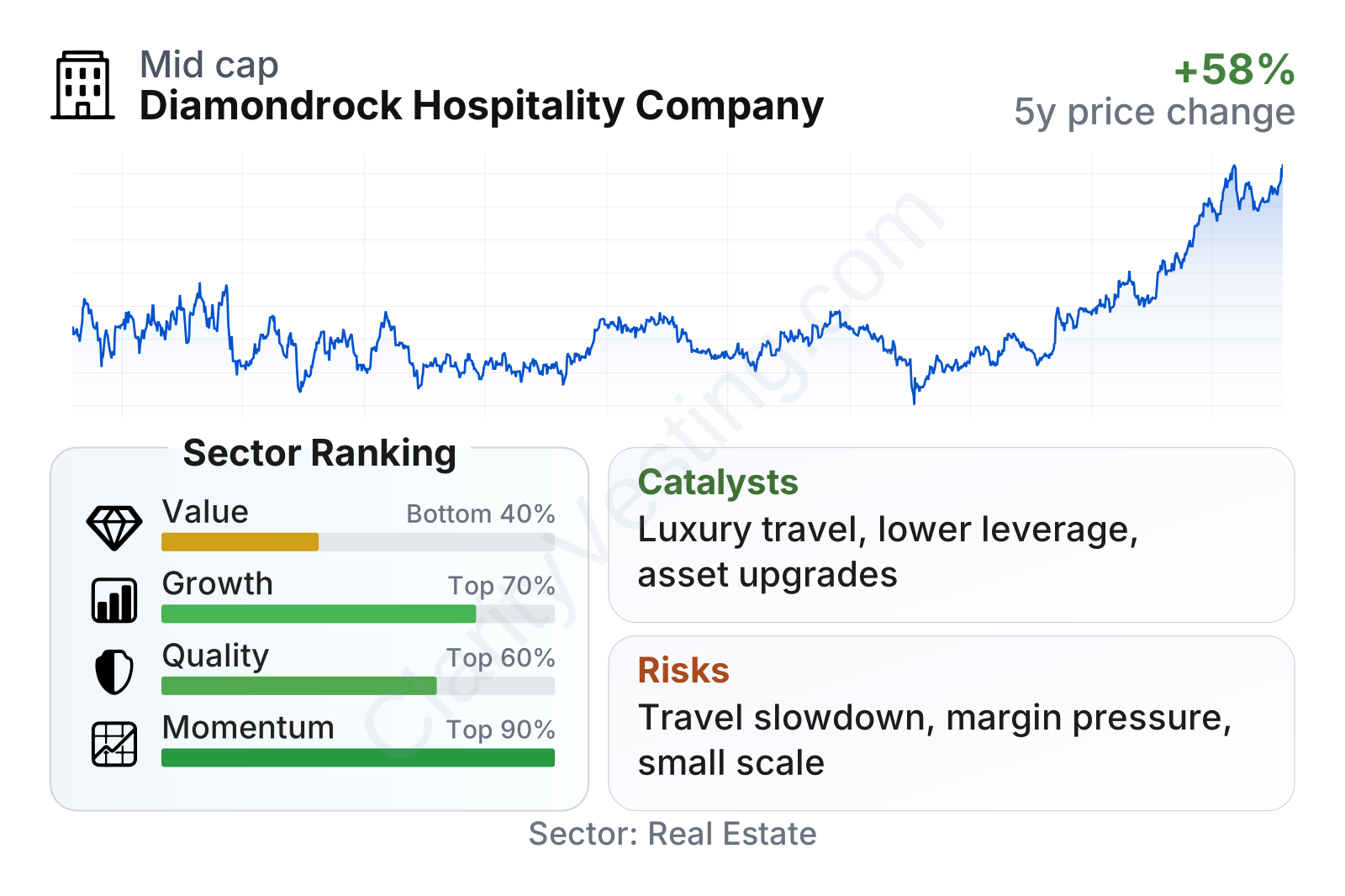
DiamondRock sits in the middle of the pack on traditional value measures, but the details are mixed. Its earnings multiple is close to the sector median, while price-to-book is above the sector median, which points to a market that is assigning some premium to asset quality or recent momentum. Growth and quality metrics are better than they may first appear: five-year revenue per share growth has been strong, returns on assets and invested capital are ahead of many peers, and balance-sheet leverage is below the sector median. Momentum is especially strong, with the stock outperforming much of the real estate universe over the last 6 months, 12 months, and 3 years.
The company is mid-sized rather than dominant, with a market value in the low single-digit billions and a beta close to 1.0, meaning the stock has recently moved broadly in line with the market rather than acting like an extreme outlier.
Growth
DiamondRock operates in the lodging REIT segment, which is a cyclical but still relevant part of real estate. Long-term growth in this area depends less on building vast scale and more on owning attractive properties, improving revenue per available room, controlling costs, and recycling capital into better-performing assets. The sector still has support from several structural drivers: steady leisure travel, recovery in group and event activity, and the continuing importance of premium destination properties that can command higher rates.
DiamondRock’s strategy is sensible for this environment. The company focuses on high-quality hotels and resorts in markets where guest demand can be supported by business travel, conventions, tourism, and affluent leisure spending. That approach can work well when management allocates capital carefully, renovates assets at the right time, and keeps debt under control.
Revenue per share has climbed strongly since 2021 and is now much higher than it was during the recovery period. The pace has moderated recently, which suggests the easy rebound phase is over, but the company has still managed to retain most of the gains. For a lodging REIT, that is a useful sign that portfolio quality and pricing power have held up reasonably well.
The dividend has also been rebuilt sharply from post-pandemic levels, although the path has not been perfectly smooth. That points to better underlying cash generation, but it also reflects how sensitive hotel REIT payouts can be to operating conditions and management’s capital priorities.
A potential catalyst is continued improvement in higher-end travel demand, especially if urban hotels and group bookings strengthen further. Another is internal portfolio optimization: hotel REITs can create value by upgrading properties, repositioning assets, or selling hotels with lower return potential and reallocating capital elsewhere. DiamondRock’s better-than-sector returns on capital suggest there is at least some evidence that management has been reasonably disciplined in that process.
Recent operating trends also support the idea of a more durable recovery than in the early post-pandemic years. The company has restored profitability, maintained revenue near peak levels, and improved leverage. In a sector where financing conditions matter a great deal, that combination can create flexibility for future renovations, acquisitions, or shareholder distributions if travel demand stays firm.
Risks
This article is for informational purposes only and does not constitute financial advice. Some content is AI-generated. See Disclaimer


