Stock Analysis · Drdgold (DRDGF)
Overview
DRDGOLD is a South African gold producer with a business model that is different from most traditional miners. Instead of focusing mainly on digging new ore underground, it reprocesses old mine waste, especially surface tailings. These are the fine residues left over from decades of earlier mining. The company treats this material to recover gold that older methods did not fully extract, then sells the recovered metal.
This approach matters because it can reduce some of the risks and costs that come with deep underground mining. DRDGOLD’s operations are centered in South Africa and are built around large-scale retreatment plants, pipelines, deposition sites, and related water and land management systems. The group’s core operating assets are generally associated with Ergo and Far West Gold Recoveries, which together form the main engine of production.
Revenue is heavily concentrated. Based on the company’s recent reporting structure, the main sources are approximately:
- Gold revenue: about 98% to 100% of total revenue. This comes from gold recovered from tailings and other surface materials and sold into the market.
- By-products and other operating revenue: about 0% to 2%. This can include smaller ancillary items tied to operations, but they are not a major driver of the business.
- Financial and other non-operating income: present at times, but not a core revenue source and typically much smaller than gold sales.
That concentration makes DRDGOLD easy to understand: its economics depend mainly on three things, the gold price, the volume and grade of material processed, and how efficiently it can run its surface recovery network. Recent results also show a strong expansion in revenue and profit, with operating income and net income rising faster than overhead costs, suggesting that higher gold prices and operating leverage have had a meaningful impact.
The business mix has remained simple, but the earnings profile has changed sharply. Over the last several years, revenue has climbed while gross profit and net income have expanded even faster, indicating that the company has recently been converting sales into profit more efficiently than before.
Key Figures
| Metric | Value | Sector ⓘ |
|---|---|---|
| Date | Oct 17, 2026 | |
| Context | ||
| Sector | Basic Materials | |
| Industry | Gold | |
| Market Cap ⓘ | $2.32B | |
| Beta ⓘ | 0.47 | |
Value (Cheapness) | ||
| P/E Ratio ⓘ | 9.22 | 16.90 |
| P/B Ratio ⓘ | 0.19 | 1.65 |
| FCF Yield ⓘ | 193.74% | 5.76% |
| Dividend Yield ⓘ | 5.54% | 2.13% |
| EBIT / EV ⓘ | N/A | 6.30% |
| PEG ⓘ | N/A | |
Growth (Business expansion) | ||
| Revenue Growth ⓘ | 49.80% | 11.10% |
| RPS Growth (5Y CAGR) ⓘ | -32.10% | 4.49% |
| EPS Growth (5Y CAGR) ⓘ | N/A | -13.47% |
| BVPS Growth (5Y CAGR) ⓘ | -30.86% | 5.51% |
| Margin Growth (5Y Trend) ⓘ | 22.26% | -1.54% |
| FCF Growth (5Y CAGR) ⓘ | 23.31% | 0.37% |
| DPS Growth (5Y CAGR) ⓘ | -37.97% | 6.08% |
Quality (Business durability) | ||
| ROIC (Latest) ⓘ | N/A | 9.26% |
| ROA (Latest) ⓘ | 52.83% | 4.91% |
| ROIC (5Y Median) ⓘ | 30.96% | 7.70% |
| ROA (5Y Median) ⓘ | 16.82% | 3.86% |
| Net Debt / EBIT (Latest) ⓘ | N/A | 1.40 |
| Net Debt / EBIT (5Y Median) ⓘ | -0.49 | 1.70 |
| Net Debt / EBITDA (Latest) ⓘ | -0.24 | 0.95 |
| Net Debt / Assets ⓘ | -15.82% | 13.69% |
| EBITDA / Interest ⓘ | N/A | 12.34 |
| Operating Margin (Latest) ⓘ | N/A | 13.20% |
| Operating Margin (5Y Median) ⓘ | 30.78% | 11.80% |
| Debt to Equity (Latest) ⓘ | 0.09% | 40.56% |
| Profit Margin (Latest) ⓘ | 38.13% | 6.43% |
| Free Cash Flow (Latest) ⓘ | $4.50B | |
Momentum (Price trend) | ||
| 3Y Return ⓘ | +261.24% | +68.89% |
| 12M Return (excl. last month) ⓘ | +34.50% | +30.21% |
| 6M Return ⓘ | -10.53% | -4.16% |
| Price vs. 200-Day MA ⓘ | +76.57% | -1.27% |
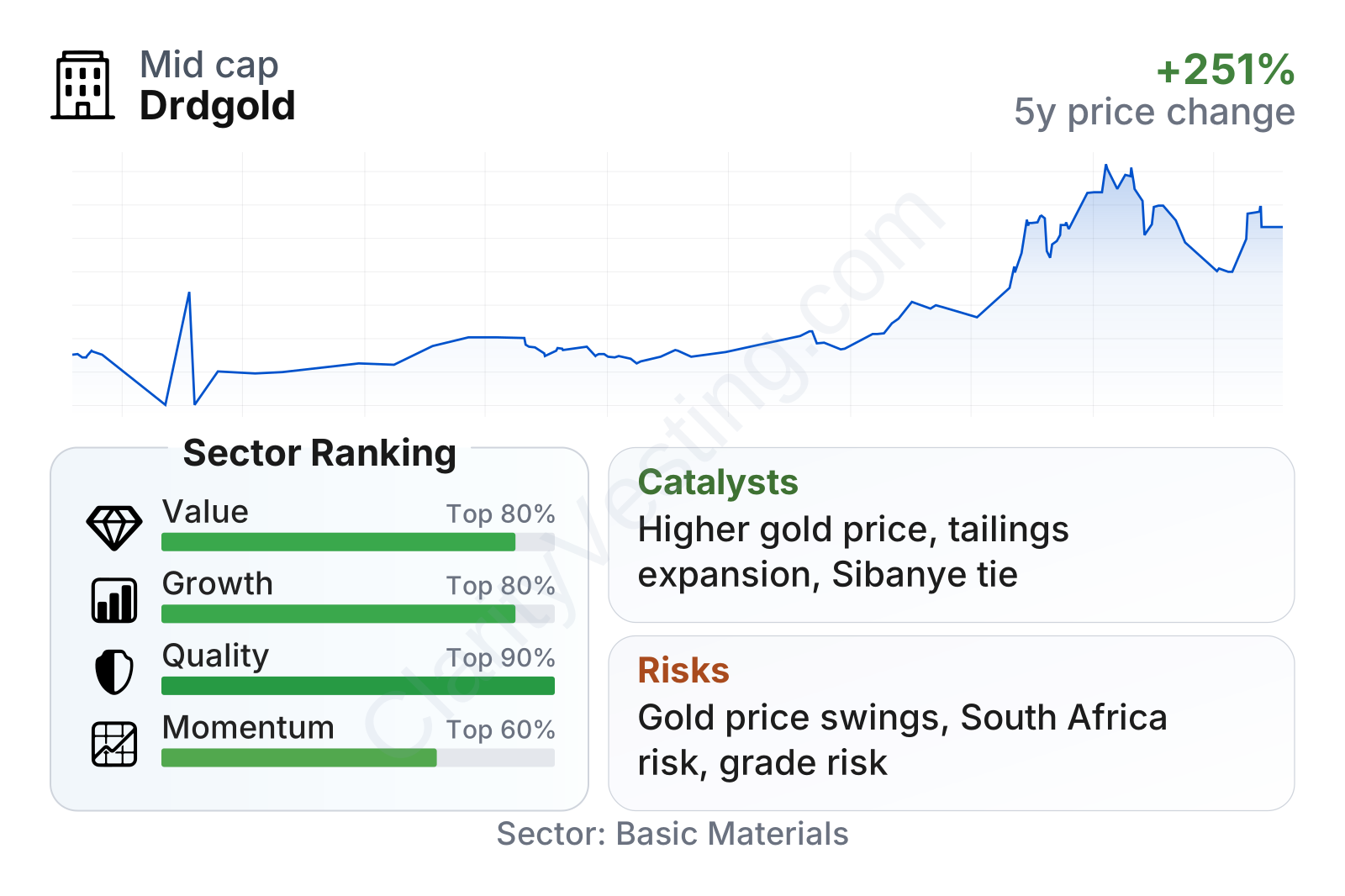
DRDGOLD stands out as a mid-sized gold company with unusually strong profitability and balance sheet metrics for its sector. Valuation multiples are well below the sector median on earnings and book value, while dividend yield is above the sector norm. Growth is mixed depending on the time frame: recent year-over-year expansion has been very strong, but some five-year per-share measures remain uneven. Quality is where the company looks strongest, with high returns on assets, very low leverage, and cash generation that appears well above many peers. Share price performance has also been strong over the last three years, although the shorter-term trend has been less consistent.
Growth
DRDGOLD operates in a part of the gold industry that has a credible long-term role. Tailings retreatment is tied not only to gold production but also to environmental rehabilitation, land recovery, and improved water management around old mining districts. That gives the business a practical reason to exist even when the wider mining sector faces pressure to improve its environmental footprint. In that sense, the company is exposed to gold demand while also benefiting from a cleaner and often more predictable operating model than deep underground mining.
Its strategy also makes industrial sense. Large historical tailings resources can support long project lives if grades remain economic and processing infrastructure is managed well. Because the material is already mined and sits on surface, expansion can be less dependent on major new discoveries than at a conventional miner. The main growth levers become plant throughput, recovery rates, access to additional tailings storage resources, and disciplined capital allocation.
One of the clearest positives is the company’s recent financial momentum. Revenue growth in the latest period was far above the sector median, and free cash flow has also moved up strongly. That matters because cash generation gives management more flexibility to fund expansion, support dividends, and preserve resilience during weaker periods for gold or operations.
The recent rise in free cash flow suggests that stronger earnings are not only accounting-driven. The company has been turning more of its operating performance into cash, which is especially relevant for a mining business where capital intensity can often absorb much of the benefit from higher commodity prices.
A major catalyst is the gold price itself. DRDGOLD’s earnings can respond strongly when gold prices rise, especially because the company already has operating infrastructure in place. Another catalyst is any progress in extending processing capacity or securing additional tailings resources around Johannesburg. Its relationship with Sibanye-Stillwater is also important, because Sibanye holds a significant stake and can influence future strategic options, resource access, and project development pathways.
Recent annual reporting and company announcements point to continued operational progress, stronger profitability, and a favorable pricing environment rather than a turnaround case. For long-term analysis, the key question is less about whether the model works and more about how durable current margins remain if gold prices normalize or operating costs rise.
Risks
This article is for informational purposes only and does not constitute financial advice. Some content is AI-generated. See Disclaimer


