Stock Analysis · Dow Inc (DOW)
Overview
Dow Inc is a large commodity chemicals producer. It makes basic materials that are used by other manufacturers rather than selling most of its products directly to consumers. Its products go into packaging, infrastructure, transportation, consumer goods, electronics, and industrial applications. The company operates globally and is especially important in plastics, silicones, polyurethanes, coatings materials, and performance intermediates.
Dow reports its business through three main operating segments. Based on the latest annual reporting structure, revenue is spread across these activities in roughly the following order:
- Packaging & Specialty Plastics: about 45% of revenue. This includes polyethylene, elastomers, and other materials used in food and industrial packaging, hygiene products, and consumer applications.
- Industrial Intermediates & Infrastructure: about 35% of revenue. This segment includes polyurethanes, propylene oxide, construction chemicals, industrial solutions, and materials used in energy, mobility, and infrastructure markets.
- Performance Materials & Coatings: about 20% of revenue. This includes silicones, coatings materials, and products used in personal care, home care, electronics, and transportation.
Geographically, Dow is broadly diversified, with meaningful exposure to North America, Europe, Asia Pacific, and Latin America. That gives it scale, but it also means results are heavily influenced by global industrial demand, energy costs, and chemical pricing cycles.
The long-term business model is straightforward: Dow turns hydrocarbon-based and other feedstocks into large-volume chemical products, then sells them into many end markets. The advantage of this model is broad industrial relevance. The downside is that earnings can swing sharply when volumes, selling prices, or input costs move against the company.
The multiyear earnings flow shows a clear compression since the 2021-2022 peak. Revenue has declined, gross profit has narrowed even faster, and interest expense has become a heavier burden as profits weakened. That pattern highlights how sensitive Dow is to the chemical cycle: modest changes in pricing and plant utilization can have a large impact on net income.
Key Figures
| Metric | Value | Sector ⓘ |
|---|---|---|
| Date | Oct 24, 2026 | |
| Context | ||
| Sector | Basic Materials | |
| Industry | Chemicals | |
| Market Cap ⓘ | $22.17B | |
| Beta ⓘ | 0.41 | |
Value (Cheapness) | ||
| P/E Ratio ⓘ | N/A | 16.92 |
| P/B Ratio ⓘ | 0.94 | 1.66 |
| FCF Yield ⓘ | 1.97% | 5.83% |
| Dividend Yield ⓘ | 4.65% | 2.07% |
| EBIT / EV ⓘ | 0.53% | 6.38% |
| PEG ⓘ | 38.89 | |
Growth (Business expansion) | ||
| Revenue Growth ⓘ | 19.70% | 11.25% |
| RPS Growth (5Y CAGR) ⓘ | -6.47% | 4.49% |
| EPS Growth (5Y CAGR) ⓘ | -34.14% | -15.24% |
| BVPS Growth (5Y CAGR) ⓘ | -4.27% | 5.49% |
| Margin Growth (5Y Trend) ⓘ | -20.19% | -1.54% |
| FCF Growth (5Y CAGR) ⓘ | N/A | 0.37% |
| DPS Growth (5Y CAGR) ⓘ | -6.74% | 5.91% |
Quality (Business durability) | ||
| ROIC (Latest) ⓘ | 1.76% | 9.59% |
| ROA (Latest) ⓘ | -1.97% | 4.92% |
| ROIC (5Y Median) ⓘ | 5.40% | 7.91% |
| ROA (5Y Median) ⓘ | 1.94% | 3.92% |
| Net Debt / EBIT (Latest) ⓘ | 87.96 | 1.36 |
| Net Debt / EBIT (5Y Median) ⓘ | 4.23 | 1.69 |
| Net Debt / EBITDA (Latest) ⓘ | 5.68 | 0.93 |
| Net Debt / Assets ⓘ | 27.42% | 13.69% |
| EBITDA / Interest ⓘ | 3.42 | 12.38 |
| Operating Margin (Latest) ⓘ | 0.46% | 13.24% |
| Operating Margin (5Y Median) ⓘ | 5.49% | 11.82% |
| Debt to Equity (Latest) ⓘ | 85.41% | 40.30% |
| Profit Margin (Latest) ⓘ | -3.13% | 6.38% |
| Free Cash Flow (Latest) ⓘ | $436.00M | |
Momentum (Price trend) | ||
| 3Y Return ⓘ | -26.29% | +73.47% |
| 12M Return (excl. last month) ⓘ | +26.29% | +27.59% |
| 6M Return ⓘ | -18.96% | -4.02% |
| Price vs. 200-Day MA ⓘ | -4.56% | -0.65% |
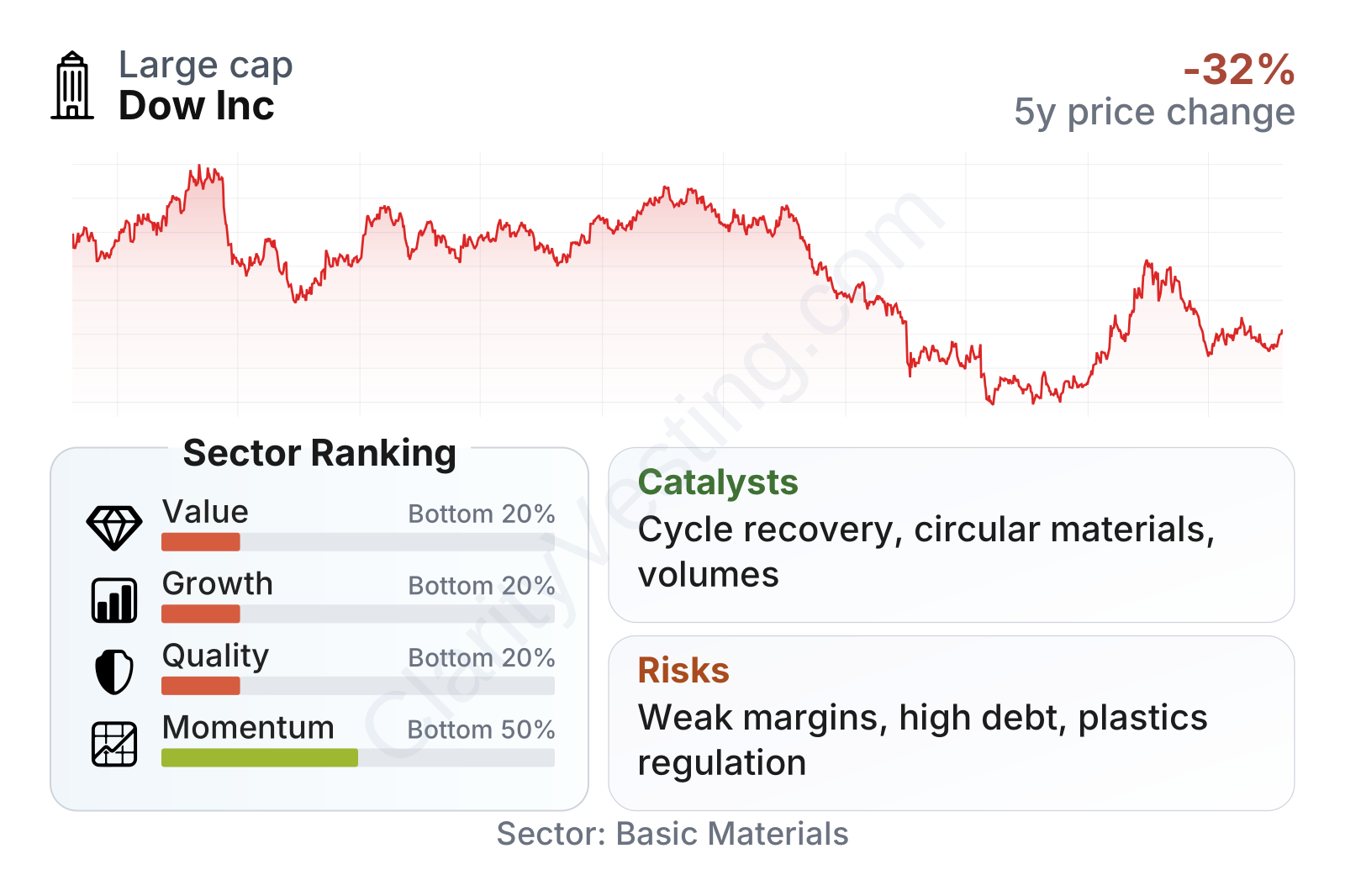
Dow remains a large chemicals company, but the current profile is weak relative to much of its sector. Value metrics look optically cheap on book value and the dividend yield is elevated, yet profitability, balance-sheet strength, and growth quality rank toward the lower end of the materials universe. Recent revenue growth has improved, but longer-term trends in earnings, margins, and per-share value remain unfavorable. The stock has also been volatile over the last few years, with a sharp decline from 2024 into 2025 followed by an uneven rebound in 2026.
Growth
Dow operates in markets that should remain relevant for decades. Packaging demand tends to rise with population, food distribution, e-commerce, and consumer goods consumption. Infrastructure and industrial materials also benefit from construction, grid investment, water systems, automotive lightweighting, and electronics demand. In that sense, the company is tied to durable end markets, even if near-term results are cyclical.
The main question is not whether Dow serves important sectors, but whether it can convert that exposure into stronger growth and returns. The company’s strategy has been centered on cost discipline, high-return downstream and specialty-leaning expansions, and selective capacity projects where it believes it has feedstock or technology advantages. That logic makes sense for a chemicals producer: in a cyclical industry, low-cost assets and disciplined capital allocation matter more than aggressive expansion.
One of the most important catalysts is the gradual recovery of the chemical cycle after a weak period for prices and demand. Recent year-over-year revenue has turned positive again after a long stretch of contraction, suggesting that volumes and pricing may be stabilizing. If industrial production improves further and customers rebuild inventories, Dow’s operating leverage could become visible quickly.
The recent rebound in year-over-year sales is encouraging because it breaks a long sequence of declines. Even so, the broader pattern still shows how uneven the recovery has been. For Dow, a few stronger quarters are helpful, but they do not yet erase several years of weak top-line momentum.
Another area to watch is cash generation. Free cash flow has weakened sharply from the highs reached earlier in the cycle, partly because profitability fell while capital spending remained meaningful. For a capital-intensive manufacturer, restoring stronger free cash flow is important because it supports debt reduction, dividends, and future investment capacity.
The free-cash-flow trend points to a business that has been under pressure rather than one currently compounding smoothly. A future improvement is possible if spreads recover and new projects contribute, but the recent pattern shows that Dow’s growth case still depends heavily on a cyclical earnings rebound rather than on steady secular expansion alone.
Recent company updates have also emphasized higher-value applications, circular materials, and decarbonization-linked opportunities. Recycled and lower-emissions plastics are not likely to transform results overnight, but they could help Dow defend customer relationships and maintain relevance as regulation and customer preferences evolve.
Risks
This article is for informational purposes only and does not constitute financial advice. Some content is AI-generated. See Disclaimer


