Stock Analysis · Dole PLC (DOLE)
Overview
Dole plc is one of the world’s largest fresh produce companies. Its business centers on sourcing, growing, packing, shipping, marketing, and distributing fruits and vegetables, with especially strong positions in bananas, pineapples, packaged salads, and other fresh foods. The company operates across farms, procurement networks, shipping, logistics, ripening, and distribution, which gives it a broad role in the food supply chain rather than a narrow focus on one product.
The business is organized into four main segments. Based on the company’s latest annual reporting, revenue is spread across these areas in a fairly diversified way:
- Dole Diversified Americas: approximately 35% of revenue. This segment includes fresh fruit, fresh vegetables, berries, avocados, and distribution activities across North America and Latin America.
- Dole Europe, Middle East and Africa: approximately 31% of revenue. This business covers fresh produce distribution and marketing across Europe and nearby regions.
- Dole Fresh Fruit: approximately 20% of revenue. This is the core tropical fruit operation, mainly bananas and pineapples, supported by growing, sourcing, shipping, and ripening assets.
- Dole Fresh Vegetables: approximately 14% of revenue. This segment includes packaged salads and other fresh vegetable products, primarily in the United States.
That revenue mix matters because Dole is not just a banana company. It has exposure to staple fresh foods that people continue to buy in most economic environments, but it also operates in categories where margins can be thin and execution is critical. Over the last several years, total sales have trended upward, rising from just under $6 billion in 2021 to more than $9 billion in 2025, while profitability has been much more uneven because produce pricing, freight, weather, and operating costs can shift quickly.
The business model is therefore built on scale and logistics. Dole’s ability to move perishable products efficiently, maintain retailer relationships, and manage sourcing across multiple geographies is a core part of its value proposition.
The financial flow also shows a key feature of the business: very high revenue comes with a large cost base. Gross profit improved meaningfully from 2021 through 2024, but net income remained relatively modest relative to sales, and 2025 showed weaker bottom-line conversion despite higher revenue. That is typical of a large produce distributor, but it also explains why small cost swings can have an outsized impact on earnings.
Key Figures
| Metric | Value | Sector ⓘ |
|---|---|---|
| Date | Oct 17, 2026 | |
| Context | ||
| Sector | Consumer Defensive | |
| Industry | Farm Products | |
| Market Cap ⓘ | $1.26B | |
| Beta ⓘ | 0.68 | |
Value (Cheapness) | ||
| P/E Ratio ⓘ | 17.99 | 17.88 |
| P/B Ratio ⓘ | 1.08 | 1.29 |
| FCF Yield ⓘ | 6.30% | 12.39% |
| Dividend Yield ⓘ | 2.59% | 2.85% |
| EBIT / EV ⓘ | 9.82% | 6.43% |
| PEG ⓘ | N/A | |
Growth (Business expansion) | ||
| Revenue Growth ⓘ | 2.90% | 4.10% |
| RPS Growth (5Y CAGR) ⓘ | 3.82% | 6.18% |
| EPS Growth (5Y CAGR) ⓘ | -5.33% | -13.59% |
| BVPS Growth (5Y CAGR) ⓘ | -3.86% | 3.20% |
| Margin Growth (5Y Trend) ⓘ | 2.50% | -0.15% |
| FCF Growth (5Y CAGR) ⓘ | -14.51% | 4.10% |
| DPS Growth (5Y CAGR) ⓘ | 8.59% | 6.79% |
Quality (Business durability) | ||
| ROIC (Latest) ⓘ | 6.26% | 12.34% |
| ROA (Latest) ⓘ | 1.34% | 6.30% |
| ROIC (5Y Median) ⓘ | 7.41% | 10.49% |
| ROA (5Y Median) ⓘ | 1.87% | 5.44% |
| Net Debt / EBIT (Latest) ⓘ | 4.97 | 1.96 |
| Net Debt / EBIT (5Y Median) ⓘ | 4.16 | 2.35 |
| Net Debt / EBITDA (Latest) ⓘ | 3.34 | 1.38 |
| Net Debt / Assets ⓘ | 25.75% | 21.51% |
| EBITDA / Interest ⓘ | 4.72 | 9.46 |
| Operating Margin (Latest) ⓘ | 2.45% | 8.87% |
| Operating Margin (5Y Median) ⓘ | 2.56% | 9.53% |
| Debt to Equity (Latest) ⓘ | 108.98% | 72.35% |
| Profit Margin (Latest) ⓘ | 0.63% | 5.40% |
| Free Cash Flow (Latest) ⓘ | $79.26M | |
Momentum (Price trend) | ||
| 3Y Return ⓘ | +34.76% | +20.92% |
| 12M Return (excl. last month) ⓘ | -0.07% | +2.13% |
| 6M Return ⓘ | -12.14% | +1.26% |
| Price vs. 200-Day MA ⓘ | -5.40% | +1.39% |
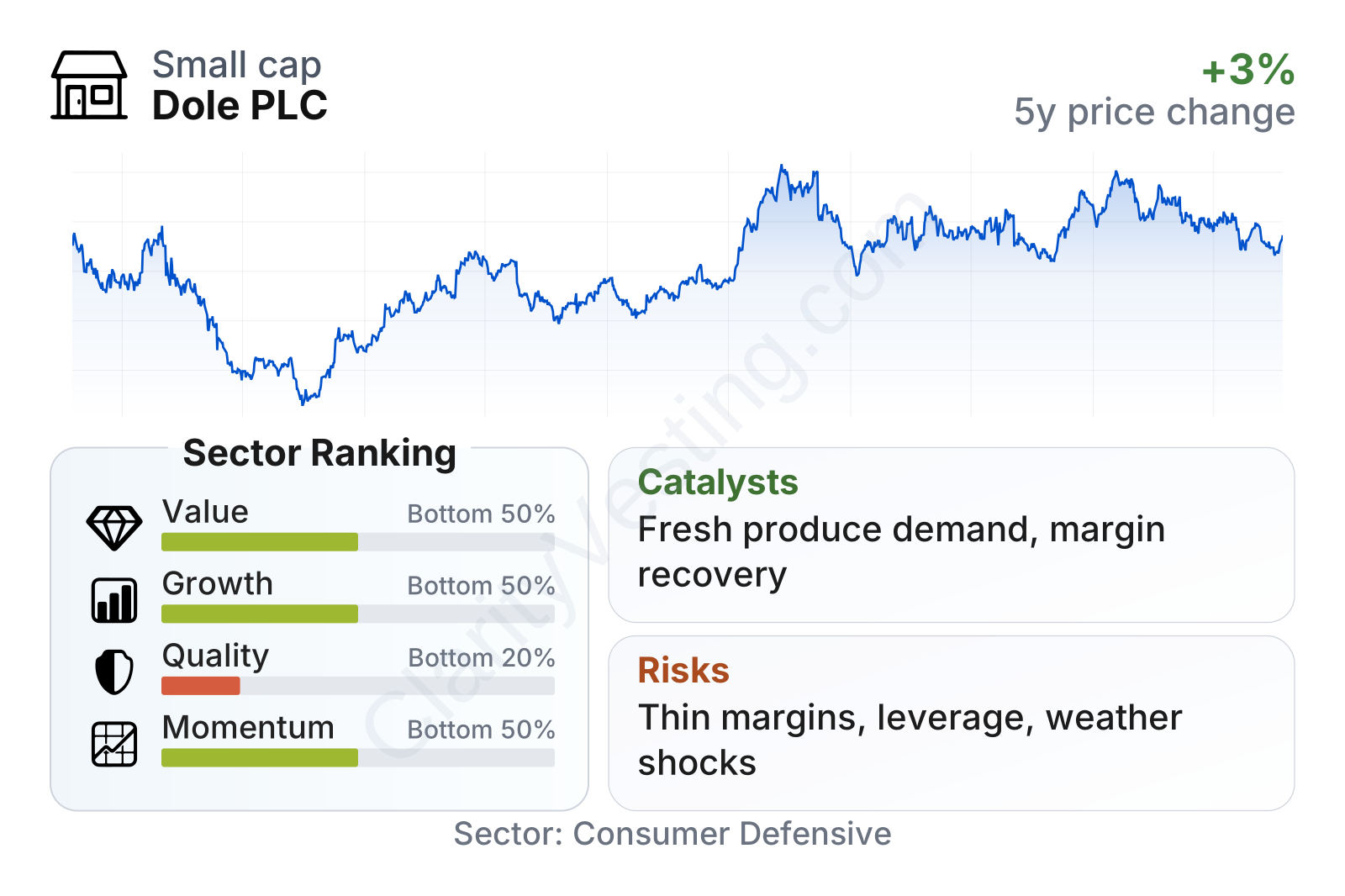
Dole is a small-cap company with a relatively low beta of about 0.63, which suggests the shares have tended to move less sharply than the broader market. On valuation, the stock sits near the sector median on earnings and below the sector median on price-to-book, while its EBIT-to-enterprise-value ratio looks better than many peers. The weaker areas are quality and growth: returns on capital and assets trail sector norms, leverage is elevated, and free cash flow generation has softened from stronger levels seen earlier in the cycle. Momentum has also been somewhat weak recently even though the longer stock performance has been more stable than the short-term trend suggests.
Growth
Dole operates in a sector with durable long-term demand. Fresh fruits and vegetables are basic food categories, and over time the industry benefits from population growth, retailer demand for reliable supply, and consumer interest in healthier eating. That does not make it a high-growth sector in the technology sense, but it is a large and resilient market with recurring demand.
The company’s strategy is logical for that environment. Its mix of owned production, third-party sourcing, shipping capacity, and direct customer relationships gives it tools to serve large grocery and foodservice customers at scale. In produce, size matters because it can improve procurement, route density, shelf availability, and customer service. Dole has also emphasized operational efficiency, portfolio management, and disciplined capital allocation since becoming a public company in its current form.
Recent revenue growth has been positive but not perfectly steady. After very volatile comparisons earlier in the post-merger period, growth settled into a lower range, then reaccelerated in parts of 2025 and remained positive in 2026. The latest year-over-year pace is around 3%, slightly below the sector median, which points to a business that is still expanding but not at a particularly fast rate.
Free cash flow is one of the most important items to watch here. Dole moved from deeply negative free cash flow in 2022 to strong positive generation in 2023, but the level has come down materially since then and is now closer to the low tens of millions of dollars rather than the earlier peak. For a company in a low-margin industry, this matters because cash generation supports debt reduction, dividends, and flexibility during more difficult produce cycles.
A notable catalyst is the company’s exposure to food categories that remain essential regardless of the broader economy. Another is the possibility of margin improvement if shipping, sourcing, and farm productivity continue to be managed well. Dole has also been active in simplifying operations and sharpening execution in recent years, which can create incremental gains even without dramatic industry growth. In a business where margins are thin, modest operational improvements can have a meaningful effect on earnings.
Risks
This article is for informational purposes only and does not constitute financial advice. Some content is AI-generated. See Disclaimer


