Stock Analysis · Doximity Inc (DOCS)
Overview
Doximity is a digital platform built for medical professionals. It is often described as a professional network for U.S. physicians, but its business goes beyond networking. The company provides tools that help doctors communicate with patients, collaborate with colleagues, stay informed through medical news and continuing education, and connect with pharmaceutical companies and health systems. Its user base is heavily concentrated in the United States, and the company has emphasized that a large share of U.S. physicians use its platform.
The business model is largely based on selling digital marketing and workflow tools to organizations that want access to clinicians. In practice, that means drugmakers, hospitals, and other healthcare industry clients pay Doximity to reach doctors or to use tools embedded in the company’s platform.
Based on company disclosures, revenue is primarily generated from subscription services sold to pharmaceutical manufacturers and health systems. Doximity reports revenue in a single overall category, so exact public percentages by product line are limited, but the mix can be understood approximately as follows:
- Pharmaceutical manufacturer solutions: approximately 70% to 80% of revenue. This includes digital marketing, brand messaging, market research, and promotional tools that help life sciences companies engage physicians.
- Health system solutions: approximately 20% to 30% of revenue. This includes hiring and recruiting solutions as well as telehealth and workflow products used by hospitals and healthcare providers.
- Other sources: a small share of revenue. This includes smaller platform-related offerings tied to the broader clinician ecosystem.
Doximity’s economics are notable for very high gross margins because software and digital advertising require limited direct delivery costs once the platform is built. Over the last several years, revenue has expanded steadily, while operating income and cash generation have remained strong even as the company increased spending on research and development.
The business has kept a wide profit spread between revenue and direct costs, which is typical of efficient software-like platforms. A visible trend over time is that research and development spending has risen meaningfully, showing that management is reinvesting to expand products while still preserving strong operating profitability.
Key Figures
| Metric | Value | Sector ⓘ |
|---|---|---|
| Date | Oct 17, 2026 | |
| Context | ||
| Sector | Healthcare | |
| Industry | Health Information Services | |
| Market Cap ⓘ | $5.33B | |
| Beta ⓘ | 1.22 | |
Value (Cheapness) | ||
| P/E Ratio ⓘ | 35.20 | 24.79 |
| P/B Ratio ⓘ | 6.57 | 3.08 |
| FCF Yield ⓘ | 5.61% | 3.15% |
| Dividend Yield ⓘ | N/A | 1.94% |
| EBIT / EV ⓘ | 5.57% | 0.57% |
| PEG ⓘ | 0.59 | |
Growth (Business expansion) | ||
| Revenue Growth ⓘ | 7.30% | 7.45% |
| RPS Growth (5Y CAGR) ⓘ | 15.85% | 8.61% |
| EPS Growth (5Y CAGR) ⓘ | -37.60% | -17.81% |
| BVPS Growth (5Y CAGR) ⓘ | 0.95% | 3.72% |
| Margin Growth (5Y Trend) ⓘ | 5.58% | -0.62% |
| FCF Growth (5Y CAGR) ⓘ | 27.31% | 1.04% |
| DPS Growth (5Y CAGR) ⓘ | N/A | 6.77% |
Quality (Business durability) | ||
| ROIC (Latest) ⓘ | 16.95% | 3.24% |
| ROA (Latest) ⓘ | 14.27% | 3.01% |
| ROIC (5Y Median) ⓘ | 19.28% | 4.60% |
| ROA (5Y Median) ⓘ | 16.42% | 1.89% |
| Net Debt / EBIT (Latest) ⓘ | -1.17 | 1.34 |
| Net Debt / EBIT (5Y Median) ⓘ | -0.86 | 1.84 |
| Net Debt / EBITDA (Latest) ⓘ | -1.09 | 1.00 |
| Net Debt / Assets ⓘ | -24.35% | 5.45% |
| EBITDA / Interest ⓘ | N/A | 9.64 |
| Operating Margin (Latest) ⓘ | 34.51% | 9.27% |
| Operating Margin (5Y Median) ⓘ | 36.14% | 7.38% |
| Debt to Equity (Latest) ⓘ | 1.06% | 28.58% |
| Profit Margin (Latest) ⓘ | 25.48% | 3.59% |
| Free Cash Flow (Latest) ⓘ | $299.29M | |
Momentum (Price trend) | ||
| 3Y Return ⓘ | +41.64% | +42.80% |
| 12M Return (excl. last month) ⓘ | -64.39% | +18.50% |
| 6M Return ⓘ | +31.80% | +7.57% |
| Price vs. 200-Day MA ⓘ | +20.47% | +5.12% |
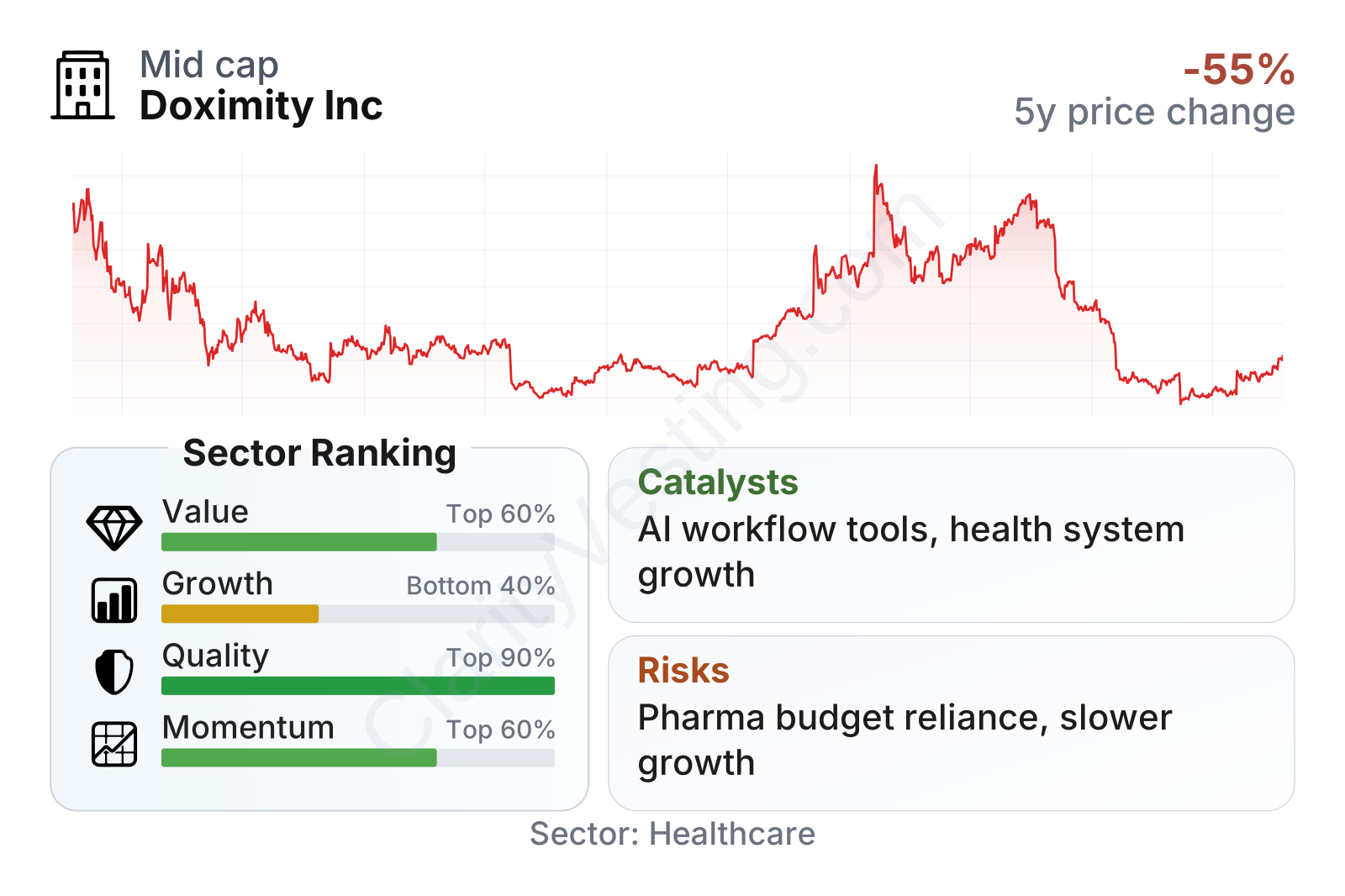
Doximity stands out more for business quality than for traditional deep-value measures. Profitability, returns on capital, and balance sheet strength rank well above much of the healthcare sector. Growth looks more mixed in the latest period, with recent revenue expansion slowing to high-single-digit levels, but longer-term cash flow growth remains strong. Market performance has also been volatile, which helps explain why valuation multiples have compressed from earlier peaks.
The stock’s historical path shows this clearly: after trading at very elevated levels following its public listing, the shares went through a major derating, then rebounded, and later weakened again. That pattern suggests the market has repeatedly adjusted its expectations for future growth rather than questioning the company’s ability to generate profits.
Growth
Doximity operates in a healthcare segment that still has room to digitize. Drugmakers continue shifting promotional spending toward digital channels, hospitals need more efficient recruiting and physician communication tools, and clinicians increasingly expect mobile-first workflow products. Those are supportive industry trends because they align with Doximity’s core strengths: a large professional user network and software tools tied to daily physician activity.
The company’s strategy also makes sense for long-term expansion. Instead of relying on a single feature, it has built a broader platform around clinician identity, communication, news, telehealth, scheduling-related tools, and industry engagement. That creates more ways to monetize the same physician audience. It also gives Doximity a chance to deepen usage rather than simply adding new accounts.
Growth has clearly normalized from the very fast rates seen earlier in the company’s public life. Recent year-over-year revenue increases have slowed from double- and triple-digit levels to the high-single-digit range. That is less exciting on the surface, but it also reflects a business moving from an early surge into a more mature phase. Importantly, revenue has still been advancing, not shrinking.
Cash generation remains one of the strongest parts of the case. Free cash flow has moved sharply higher over the last several years, reaching more than $300 million on a trailing basis. That matters because it shows the company is not funding growth with heavy borrowing or constant external capital. It is producing real cash while continuing to invest in product development.
A meaningful catalyst is the expansion of AI-enabled workflow tools for physicians. In recent company communications, Doximity has highlighted products that help automate administrative tasks such as documentation and communication. If those tools gain wider adoption, they could make the platform more deeply embedded in clinical workflows, which would strengthen retention and create room for additional monetization. Another catalyst is continued growth in health system solutions, which can diversify the business beyond pharmaceutical marketing budgets.
Recent company updates have also pointed to ongoing product launches and broader adoption of clinical productivity tools. That matters because the market has sometimes viewed Doximity mainly as a digital advertising vehicle; successful expansion into workflow and productivity software could support a more durable and diversified growth profile.
Risks
This article is for informational purposes only and does not constitute financial advice. Some content is AI-generated. See Disclaimer


